Diego Rivera died in 1957, a few years after his third wife, Frida Kahlo. These titans of art had a tumultuous relationship, but Rivera, in a final romantic gesture, asked for his ashes to be mixed with Kahlo’s at her Casa Azul home, uniting them forever. Instead he was buried in Mexico City’s prestigious Rotonda de las Personas Ilustres, miles away.
But in Gabriela Lena Frank’s remarkably accomplished first opera, “El Último Sueño de Frida y Diego” (“The Last Dream of Frida and Diego”), with a libretto by Nilo Cruz, the two artists get the reunion and healing reconciliation they never had. And, in a fantastical twist on the Orpheus myth, Frida guides Diego to the underworld on the Day of the Dead.
“Frida y Diego” premiered at San Diego Opera in 2022, and has since been revived up and down the coast of California. Now it has traveled east, in a joyless and confused new production by Deborah Colker that opened at the Metropolitan Opera on Thursday. (It will be broadcast to cinemas on May 30.)
To a degree, this opera seems able to weather different productions, whether Lorena Maza’s absorbingly vivid original staging or Colker’s jumble of solemn drama and dance theater. Frank is a natural storyteller who often infuses her music with playful mythology, such as in her recent “Picaflor,” which won the Pulitzer Prize last week. And she is well matched with Cruz; they operate with a similar sensibility of charm and concision, the score and libretto equally able to convey character, mood and plot in the instant.
As for that plot, there isn’t much: In the first act, Frida wrestles with the possibility of returning to her dying husband, and in the second, she does just that. Orpheus operas are no more complicated, and like many of those, “Frida y Diego” is only about an hour and 45 minutes long. As if to establish herself in a mythic tradition, repeated and transformed throughout history, Frank opens with an orchestral pulse that resembles both a heartbeat and a ritualistic invocation.
The orchestra continues to have more of a foundational, grounding role rather than a symphonic one, which in another opera might have settled into mere underscoring. Here, Frank creates an inescapable dreaminess that rattles with otherworldly timbres and phrases that constantly rise and fall, matching the Day of the Dead’s porous boundaries and traffic between worlds.
You could imagine a lesser composer succumbing to the temptation of folkloric sound, but Mexican music surfaces rarely and abstractly, as in an evocative but brief trumpet call. But the score has Frank’s usual eclecticism, borrowing from different traditions, as well as her own works (like a marimba theme from “Seven Armenian Songs”) and opera classics (like a repeating flourish from “Peter Grimes”).
Frank seems to have had the most fun with two minor roles: Catrina, the regally skeletal keeper of the dead, and Leonardo, a queer-coded actor who serves as a kind of spiritual and artistic guide for Frida. The chorus, present in nearly every scene, is written with a radiance matched by the Met singers all night.
Catrina, sung by the soprano Gabriella Reyes in the finest performance on Thursday, is given musicalized laughter and long, Handelesque lines that often descend in chromatic triplets like a corkscrew. Leonardo, a countertenor role performed by Nils Wanderer in a mightily assured Met debut, is announced with the “Grimes” motif but is otherwise composed with plush, flowing melodies. Wanderer carried himself with the delusional grandeur of Sally Bowles, whom he resembled in Jon Bausor and Wilberth Gonzalez’s costume design: He fluttered long lashes under Marlene Dietrich eyebrows while strutting around in a corset and draping robe.
Frida and Diego, sung by the mezzo-soprano Isabel Leonard and the baritone Carlos Álvarez, are roles that sit low with earthy heft. These are not the easiest voice types to hear, and in the pit Yannick Nézet-Séguin conducted with judicious restraint, reserving outbursts for orchestral passages. Still, Álvarez held the enormous Met stage with his sound, and Leonard, while less rich and dusky than Daniela Mack in earlier productions, nevertheless had a commanding and charismatic presence.
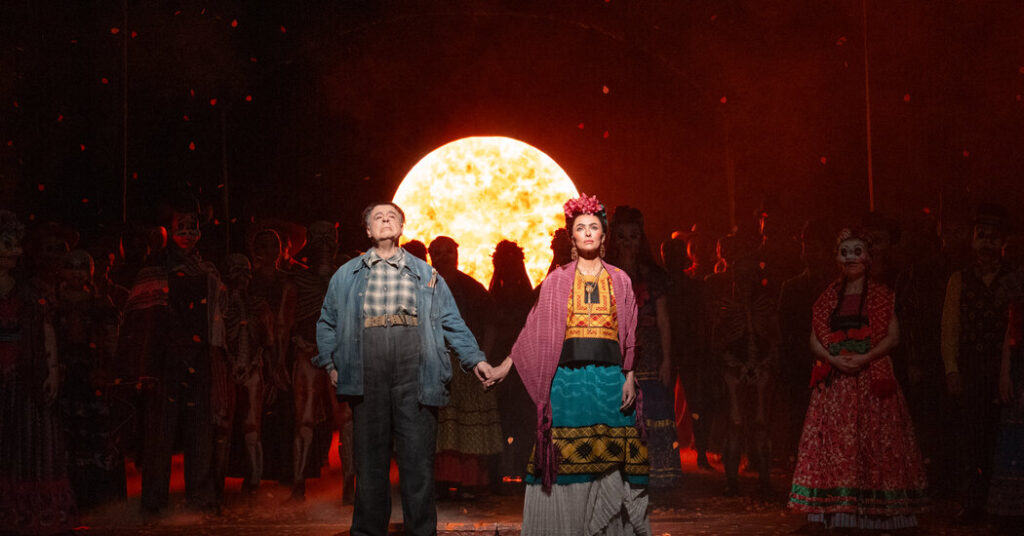
Leonard and Álvarez were an instantly recognizable Kahlo and Rivera, a bright spot of clarity in an otherwise muddled vision for the opera by Colker. “Frida y Diego” is her second production for the Met, and while it is an improvement on her undramatic take on the Lorca-inspired “Ainadamar” in 2024, it rarely seems sure of how to handle the material.
Cruz’s libretto balances reflective healing with levity, while Frank’s score teems with color. Colker’s staging, though, filled with her own choreography and designed by Bausor, is self-serious (down to the muted palette) and aesthetically chaotic. At its most literal, the production clearly depicts the Day of the Dead, with ofrendas and papel picado decorations; references to Kahlo and Rivera’s life and art abound.
And at its best, the show is great to look at, especially in an early coup de théâtre that reveals the Aztec underworld. Still, it doesn’t move well or logically. The chorus often just flanks the set, not always clearly representing the voices of those living or dead; and Diego, when he is very much alive, seems capable of coming and going from the underworld rather than singing from a different plane.
The irony of all this is that Colker’s production almost never stops moving, with an ensemble of dancers dressed like animated escapees from “Bodies: The Exhibition.” Leonard’s Frida is not allowed a moment of contemplation without movement echoing her thoughts and emotions around her. At one point, even the dancers are doubled by doppelgängers in a mural coming to life behind them.
Colker’s “Frida y Diego” is part of a worrisome trend at the Met of cluttering the stage with gratuitous dance. There is no problem with movement in opera; some of the earliest ones included horse ballets, and composers have written entire balls into their scores. But recent productions at the Met have featured dance for reasons that are less dramaturgical than ornamental, in both classics (“Tristan und Isolde”) and contemporary works (“The Hours”).
Opera is an art form rooted in the voice. And directors should trust the audience and the music enough to know that on its own, the voice can accomplish quite a lot.
El Último Sueño de Frida y Diego
Through June 5 at the Metropolitan Opera, Manhattan; metopera.org.
Joshua Barone is an editor for The Times covering classical music and dance. He also writes criticism about classical music and opera.
The post Review: Frida Kahlo and Diego Rivera, Reunited on the Opera Stage appeared first on New York Times.