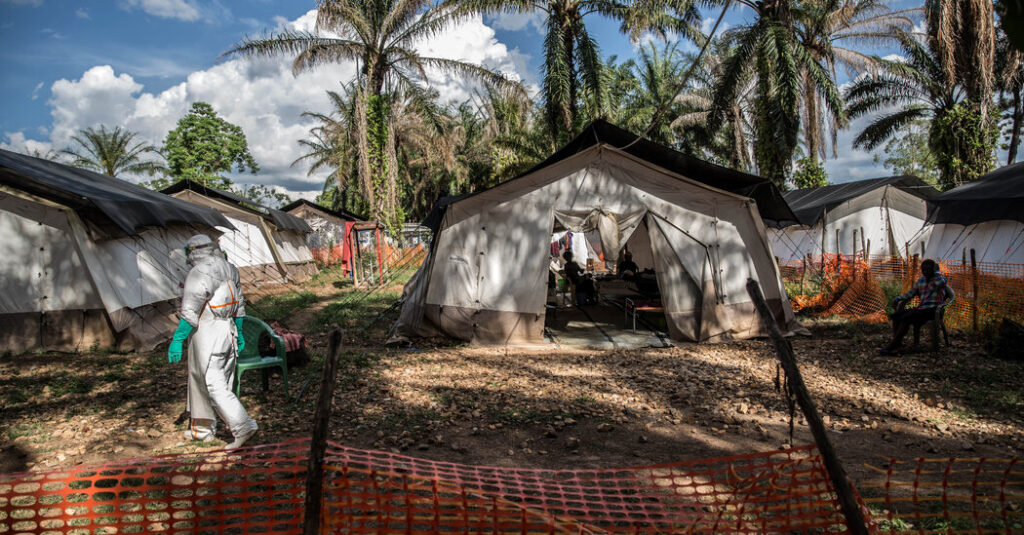
Africa’s leading public health authority said on Friday that there was an outbreak of the Ebola virus in a province of the Democratic Republic of Congo, with dozens of deaths and hundreds of infections suspected.
The Africa Centers for Disease Control and Prevention, the public health agency of the African Union, said 65 deaths from Ebola had been reported in the northeastern province of Ituri, though only four had been definitively linked to the virus through laboratory testing. The agency said that 246 suspected infections had been reported in Ituri and that 13 had been confirmed.
The agency said it was working with Congo’s health ministry on a response to the outbreak. The results of tests to determine the specific species of the virus circulating in Ituri are expected within 24 hours, it said in a statement. It is the 17th recorded Ebola outbreak in Congo since the virus was first identified in 1976.
Some global health experts said they were alarmed that the first reports of the outbreak emerged so late in its development.
“It’s pretty stunning to have first notice of an outbreak in D.R.C., which is very experienced, and have it be so large,” said Jennifer Nuzzo, director of the Pandemic Center at the Brown University School of Public Health.
Outbreaks are typically picked up much earlier by the World Health Organization, by the U.S. Centers for Disease Control and Prevention or by news reports, she said.
Tedros Ghebreyesus, the director general of the W.H.O., said in a briefing on Friday that the organization was first notified about suspected Ebola cases on May 5 and sent a team to Ituri to investigate. The samples they collected initially tested negative for the virus, he said.
Samples were later sent to the National Institute of Biomedical Research in Kinshasa, Congo’s capital, which confirmed on Thursday that some of them had tested positive for Ebola, Dr. Tedros said.
Preliminary analyses by the institute in Kinshasa indicate that the virus does not belong to the Zaire species, the only Ebola type for which a licensed vaccine exists. Two other species of Ebola, Sudan and Bundibugyo, had previously been detected in Congo. Dr. Tedros said in a text message that the Ituri samples initially tested negative because the field testing equipment could only detect the Zaire species.
Early detection, contact tracing, prompt isolation and care and safe burials are all crucial for containing Ebola outbreaks, the African health agency said.
Some of the suspected cases are in Ituri’s main city, Bunia, which could pose a challenge for public health workers, since infectious diseases can spread faster in urban settings. Ebola is transmitted through direct contact with the bodily fluids of an infected person, a fact that often puts people caring for sick family members at risk.
In addition, Ituri Province has seen decades of violence linked to insurgent groups. Partly because of that, people frequently cross the borders into Uganda and South Sudan, and back. That could make it harder to trace potential contacts of infected people, as could the prevalence of unregulated mines in one part of Ituri.
Guinea, Sierra Leone and Liberia were hit by an Ebola epidemic in 2014 and 2015 that eventually killed more than 11,000 people and sickened more than 28,000 across 10 countries, according to estimates released by the World Health Organization. Responders initially failed to recognize the extent of the outbreak and did not take sufficient steps to prevent its spread.
Since then, there has been a string of outbreaks, mainly in Congo and Uganda. But they have been contained, largely because public health officials have reacted quickly, drawing on knowledge and experience gained in past battles with the virus.
The Africa Centers for Disease Control and Prevention said it would convene a meeting about the outbreak on Friday that would include health officials from Uganda and South Sudan as well as from the W.H.O. and the U.S. Centers for Disease Control and Prevention.
American officials have said that aid cuts by the Trump administration hampered the ability of the authorities in Uganda to curtail an Ebola outbreak in that country early last year.
“It’s possible that we’re starting to see the consequences of severe and sudden cuts to global health programs that have eroded surveillance and allowed deadly viruses to spread undetected,” Dr. Nuzzo said.
Matthew Mpoke Bigg is the East Africa bureau chief for The New York Times, based in Nairobi, Kenya.
The post Large Ebola Outbreak Is Declared in Congo appeared first on New York Times.