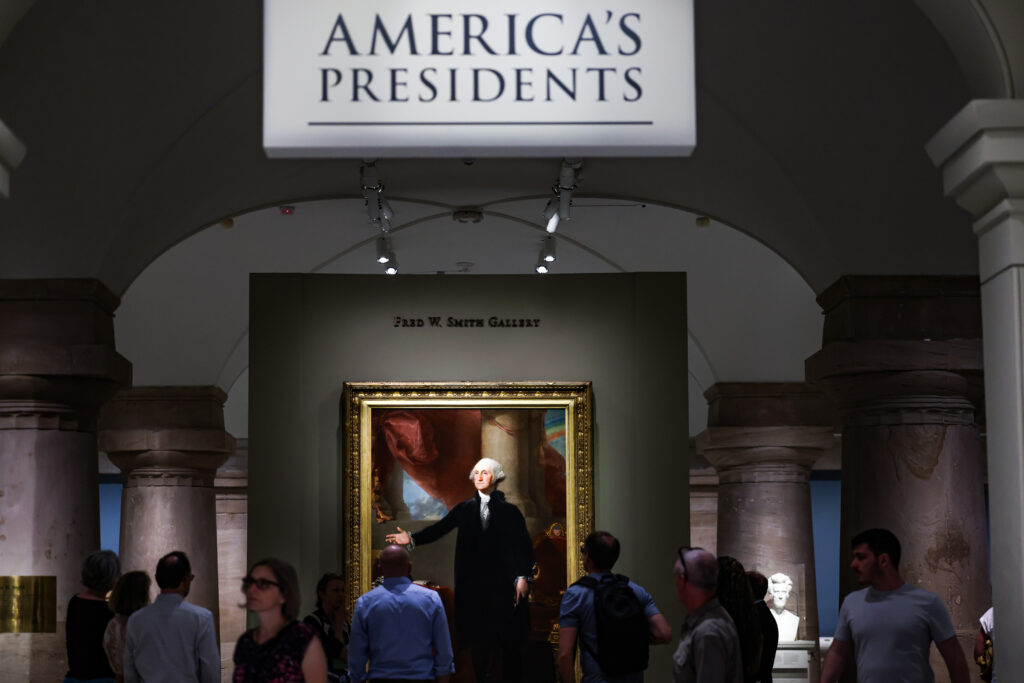
Since Donald Trump returned to office in January 2025, the Smithsonian has been the administration’s favored target for its new museum-focused culture war against diversity and inclusion, and narratives of U.S. history that include the ugly truth of slavery, Native American genocide, and the ongoing struggle for the rights of women, Latinos, Asian Americans, immigrants, LGBT communities and others.
And the Smithsonian, no stranger to political pressure, has managed to push back and mostly hold its ground — with a few key losses.
By June of last year, Trump had forced out the head of the National Portrait Gallery, Kim Sajet, who was a vigorous supporter of inclusion in the national narrative. And earlier this year, the administration celebrated the hanging of new portrait of Trump, which came with another change: The brief wall text summarizing Trump’s first term was removed and along with it mention of his two impeachments and the insurrection he fomented on Jan. 6, 2021. The old label was replaced with a so-called “tombstone” label, which gave only the name and basic facts about the image.
No single exhibition in Washington may be more scrutinized than the Portrait Gallery’s “America’s Presidents,” and among its critics, apparently, was Trump, whose administration took issue with the wall texts that mentioned his impeachments among other low points of his first presidency. The beloved exhibition, which includes the iconic Gilbert Stuart “Lansdowne” Portrait of George Washington, reopens today after a month-long closure to refresh and rethink key elements of the display. The good news: The basic facts about Trump, along with all the other presidents, are still on offer; wall texts haven’t been removed, though some of them have been edited; and the exhibition continues to present an accurate, pithy overview of American history, warts and all.
And curators have found an elegant way to defuse political controversy around the most recent presidents. Trump’s tombstone label is gone, replaced with longer texts, one quoting from his Jan. 19, 2021, farewell address, and another that gives a basic résumé of his life, including his education, prior experience, inauguration dates, major legislative accomplishments and notable events. The same format, including extracts from farewell addresses, is now used for all the presidents since Jimmy Carter.
Among the notable events listed on Trump’s CV are ones that went missing earlier this year. The first and second impeachments, the insurrection, and the George Floyd protests of 2020 are included along with the Abraham Accords and the “Operation Warp Speed” initiative that developed lifesaving covid vaccines.
The facts are back, but there is a substantial change to the tone. For all the presidents up to Carter, the Smithsonian uses an omniscient, authoritative voice, which it abandons for the more recent ones. “The presidency of James K. Polk reflected his belief in Manifest Destiny,” begins one summary; Andrew Jackson “campaigned for president as a self-made man,” reads another.
Museum historian Mindy Farmer, who oversaw the refresh, says the move to just-the-facts bullet points for later presidents is a virtue, given that historians haven’t yet fully processed our most recent executives.
“We want to wait for a scholarly consensus,” she says. Farmer also said that she has had no contact or pressure from the White House.
If this is a game of chess, it’s not quite checkmate for the administration, which is pursuing a comprehensive content review of the Smithsonian and would still like to make the entire museum and research complex comply with its nativist historical agenda, which celebrates American exceptionalism. But the Portrait Gallery has for now checked the king, and the administration will be in the awkward position of disputing basic facts rather than the interpretation of them.
Of course, the choice of which facts to highlight is a form of interpretation, and in other places, the new résumé-style wall labels may anger people from the other side of the political spectrum. The major legislation list for Bill Clinton, for example, includes the 1993 Family and Medical Leave Act and the 1996 Megan’s Law, but not the 1996 Defense of Marriage Act, which ensured that LGBT people would have no hope of legal marriage until the Supreme Court defined same-sex marriage as a fundamental right in 2015.
Close observers of the wall texts may find what might be called the fallacy of nuanced tweaks, a phenomenon that haunts journalism as well. Throughout the display, there are changes to the wording and emphasis of wall texts that suggest curators may have been trying to defuse potential controversies by making small but significant changes. The folly of this, of course, is that critics of the Smithsonian, especially those in Trump’s camp, won’t be appeased by little shifts in emphasis. They want to own history in its entirety.
Previously, the gallery began its description of one of Trump’s favorite predecessors, Andrew Jackson, this way: “Andrew Jackson’s life was colored by struggle, conflict, and aggression.” Now, it drops the omniscient judgment and quotes Jackson giving his own self-analysis: “’I was born for a storm, and a calm does not suit me,’ Andrew Jackson reportedly told a friend.”
Earlier language about Woodrow Wilson made it clear that his progressivism was more than counterbalanced by racism and opposition to women’s equality: “Wilson is most often remembered as a champion of liberal values, but recent scrutiny has drawn attention to his regressive actions with regard to women’s voting rights and segregation in the government, as well as other violations of civil rights.” The new wall text makes his belated and reluctant support of the 19th Amendment, which guaranteed women the right to vote, less ambiguous and equivocal. Racism isn’t mentioned, though segregation is discussed on labels for Presidents Teddy Roosevelt and Warren Harding.
And the new wall text about Rutherford B. Hayes, whose election spelled the end of Reconstruction and the beginning of a newly violent effort to reimpose de facto slavery in the South, notes that with the withdrawal of U.S. troops, Black Southerners suffered “violent attacks from militias.” The original language referred to “white terrorist groups.”
Is this self-censorship, a strategic retreat or merely the happenstance of rewriting a lot of basic material for the umpteenth time? It is small stuff, but not insignificant, and as with so many developments in what will be a long struggle against the administration’s attempt to rewrite American history, they should be noted, contested, catalogued and remembered when the next reinstallation of the gallery takes place. No lies have been told, and the basic narrative is intact. But important details have gone missing.
None of this will temper the administration’s ambition, though it may disappoint some of the Portrait Gallery’s longtime supporters. Smithsonian supporters have been disappointed before, as when the institution canceled a 1995 exhibition about the U.S. plane that dropped the first atomic bomb on Japan and censored a work in the 2010 “Hide/Seek” exhibition, focused on images of LGBT people, at the Portrait Gallery.
But the Portrait Gallery came back from that exhibition, as have other Smithsonian museums from earlier controversies. Trust in the institution has been consistently high, and if it survives the Trump administration, these small changes will eventually be amended, and we will get closer to the real, full, nuanced history of America. For now, the mission is to survive.
The post The Smithsonian’s most contested exhibition is back on view, mostly intact appeared first on Washington Post.