For Chinese Americans, the news this week might have seemed disorienting.
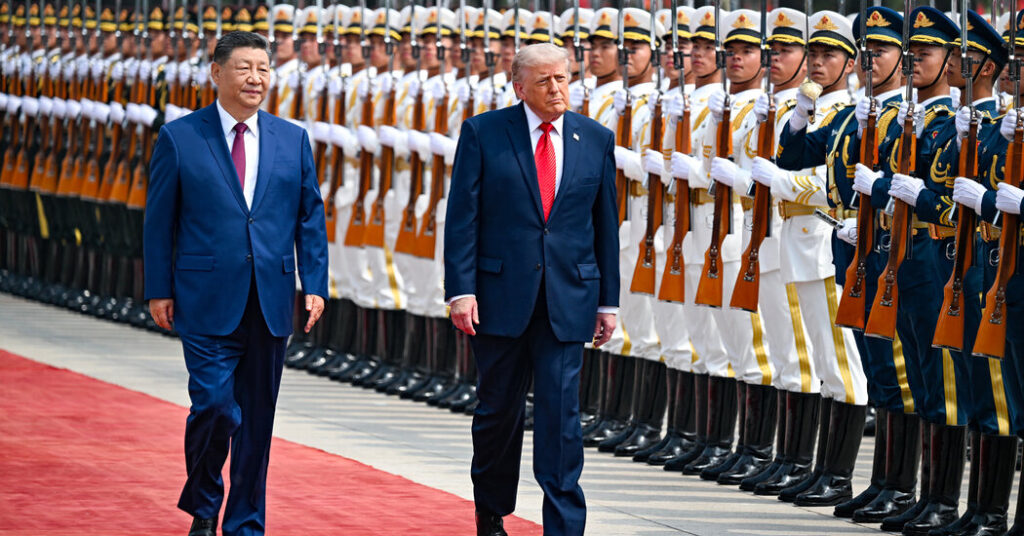
There was the largely make-nice tone of the summit in Beijing between President Trump and the Chinese leader, Xi Jinping, which ended on Friday.
But in the days leading up to the summit, two criminal cases in the United States reflected how the countries’ competitive and often tense geopolitical relationship has made life more difficult for many people of Chinese origin living in the United States.
On Monday, federal prosecutors announced that Eileen Wang, the mayor of Arcadia, a suburb outside Los Angeles, would plead guilty to acting as an illegal agent of the Chinese government. Prosecutors said that Ms. Wang published propaganda on a purported news site under direction from Chinese officials. She has resigned. Ms. Wang’s lawyers emphasized in a statement that the actions took place before Ms. Wang ran for public office.
And on Wednesday, Lu Jianwang, a Chinese American community leader in New York, was convicted of illegally working as a foreign agent. He had been accused of running a secret police station in Manhattan that reported on political dissidents at the direction of the Chinese government.
John Carman, Mr. Lu’s lawyer, had said that his work was limited to helping immigrants renew their Chinese driver’s licenses. The laws, he said, “are written in such a fashion that they capture both those intending to do good deeds and bad.”
Over the years, there have been similar cases of China’s political meddling, and analysts have said there is a pattern in which Beijing recruits Chinese immigrants to infiltrate governments or to silence Chinese dissidents living abroad and other critics of the government.
Intelligence officials have said that as China’s sway in Washington diminishes, the government is increasingly seeking to influence local governments, which are not as savvy at detecting such efforts.
The intermittent drip of such incidents has fueled broader suspicions about Chinese Americans as spies and perpetual foreigners, echoing earlier periods of American history when they were subject to exclusion, racism and discrimination.
In a podcast last month, two Republican state delegates in Maryland accused a Chinese-born Democratic colleague, Chao Wu, of being a spy for China and mocked his accent.
The delegates, Mark Fisher and Brian Chisholm, criticized Dr. Wu for introducing a bill last year that would have required developers of generative artificial intelligence systems to disclose information about the data used to train their models.
Jason Buckel, the leader of the Republican minority in the Maryland House, said in a statement that he had “no reason to believe” that Mr. Wu was “somehow affiliated with the Chinese government as an American citizen and elected official.”
In a text message, Mr. Wu attributed the comments to “McCarthyism, xenophobia, racism.”
During the pandemic, Mr. Trump was also accused of racism and xenophobia when he referred to the coronavirus as the “Chinese virus” and “kung flu.”
There are around 5.5 million people of Chinese descent in the United States. While some can trace their roots in America back five generations, to the earliest transcontinental railroad workers, many more are first- or second-generation immigrants who have familial or professional ties to China.
Views on China vary widely within the diaspora in the United States. A survey published by Pew in 2023 found that less than half of Chinese Americans saw China in a positive light.
But Beijing’s recruitment within the diaspora has left some Chinese Americans feeling increasingly as if there is a target on their backs, as their personal ties to China are twisted and turned against them. Some lawmakers and civil rights advocates say fears of Chinese espionage have resulted in the blocking of some Chinese Americans from government jobs and the racial profiling of ethnically Chinese scientists and researchers at universities.
One in five American adults believe that Chinese Americans pose a threat, according to a recent survey by the Asian American Foundation.
The scrutiny may be most harshly felt in the San Gabriel Valley, which encompasses Arcadia, where Ms. Wang was mayor. The valley has one of the largest populations of ethnically Chinese people in the United States, and some Chinese American elected officials said that since Ms. Wang’s plea agreement was announced, they have sensed more suspicion and wariness.
Thomas Wong, a Chinese American and a City Council member in the nearby town of Monterey Park, said, “Incidents like what happened with Eileen are continuing to provide opportunities for racism, xenophobia and anti-Chinese sentiment to grow.”
Amy Qin is a national correspondent for The Times, writing primarily about Asian American communities.
The post How Two Criminal Cases Reflect America’s Tense Relations With China appeared first on New York Times.