One problem with modern horror is that it rarely has a sense of humor about itself—or if it does, the best it can do is point to its own self-awareness with a wink and a nudge, as if awkwardly apologizing for its own existence. Writer-director Jane Schoenbrun’s Teenage Sex and Death at Camp Miasma, premiering here at the Cannes Film Festival, breaks that cycle without breaking a sweat: it’s funny, charming, even breezy at times. And if there’s any justice in the world of movies—there isn’t always, but we can hope—Gillian Anderson’s performance will get the same kind of attention Demi Moore’s did a few years ago for the exhausting gross-out fest The Substance. What Anderson does here, as a 1990s scream queen turned glamorous, eccentric recluse, is sublime, and her co-star Hannah Einbinder (of Hacks) keeps pace with her every minute. They’re having fun, and so are we: together, they make this movie a pleasure.
Einbinder plays Kris, a smart, ambitious filmmaker who’s been hired to direct a reboot of a popular 1990s slasher franchise in which a crazed serial killer wearing a helmet shaped like a ceiling vent terrorizes teens at a remote summer camp. The killer—played by Jack Haven, who also appeared in Schoenbrun’s I Saw the TV Glow—is known as Little Death, a not-so-subtle nod to the French nickname for that fleetingly blissful postcoital loss of consciousness, and his game is skewering his victims with a big, pointy, phallic lance: they scream performatively as geysers of candy-apple-red translucent blood spurts from their sternums. Little Death has a a crazy backstory, rendered in clumsy, non-ideologically correct 1990s terms: he couldn’t decide if he was a girl or a boy, and a group of bullying male campers drowned him in a lake. In the Camp Miasma mythos, Little Death, wearing not just his customary helmet but also a kind of shimmery rubber onesie, emerges from the murky lake waters at opportune times, generally waiting until his teenage victims are in flagrante before moving in for the kill. The Camp Miasma films—the first one spawned a jillion sequels before the franchise was deemed “problematic” and retired—are all about, as one character puts it here, “flesh and fluids.”
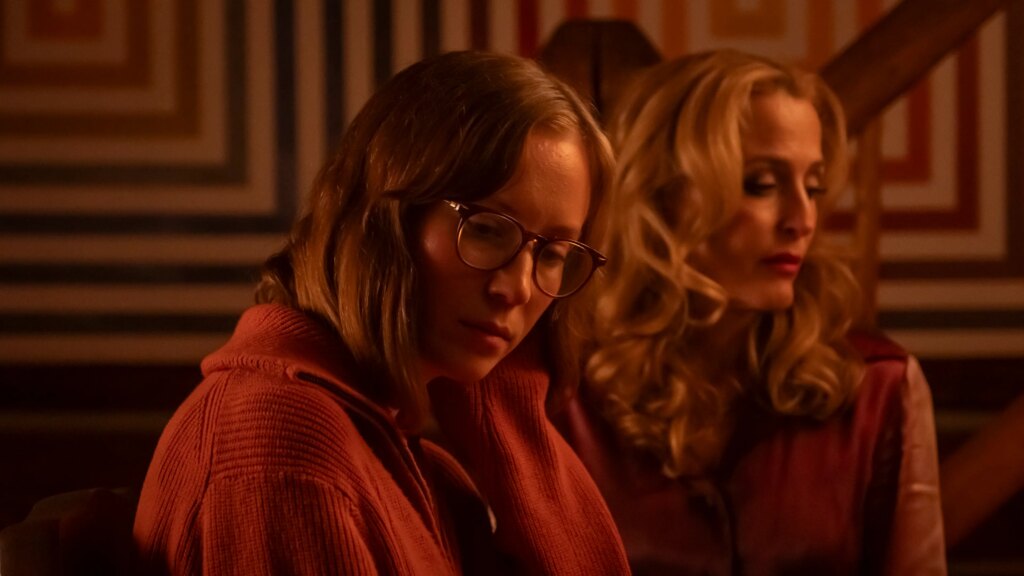
Kris has a chance to resurrect the Camp Miasma mystique for the modern age, and she’s hoping to lure the star of the first film out of retirement, at least for a cameo. That’s how she meets the alluring Billy Presley, played by Anderson, the series’ original “final girl,” who now lives alone in the Pacific Northwest, spending her days making obsessive paintings of one specific geometric subject. She also just happens to have purchased the land, and the cabins, where the original films had been shot, a place where she can relive her past glory every day, running her most famous movie on a rickety old projector—a little like, as she puts it, “what’s her name from Sunset Boulevard.” Kris, the eager, brainy film nerd, of course knows exactly who she’s talking about.

Billy makes her entrance rendered in classically mysterious key lighting. She greets her guest in a soft felt hat the color of overripe grapes, peering seductively from beneath its floppy brim. Her hair is a Veronica Lake-blond cascade, her voice a silky Southern purr. For dinner, she’s procured takeout fried chicken for herself and her guest. Their conversation slithers from the professional to the personal to the ultra-personal: Kris, it turns out, is involved in an unhappy polyamorous relationship and feels out of tune with her own sexuality. By the time Billy asks her, “Speakin’ of desire, do you like dippin’ sauce?” not just Kris but probably everyone in the audience is already a goner.
That’s Anderson’s superpower. In her X-Files days, she was the thinking man and woman’s sex symbol. Her costar David Duchovny was cute, but she was the one who made legions of men and women rethink their sexual orientation. She was even more thrummingly charismatic, if more mournful, as Lily Bart in Terence Davies’ superb 2000 adaptation of Edith Wharton’s House of Mirth. Her sense of humor, even if it’s just glimmering beneath the surface, is part of her charm. Kris, eager to make a good impression on her sultry, captivating host, explains her overarching approach to her work: she’s interested in “the intersection of queerness and intellectual constructions of monstrosity.” Billy, who’s already done her research on Kris, nods knowingly: “You rendered Psycho from the perspective of the shower curtain.” Then, fearing she might have been a bit too aggressive in puncturing her guest’s self-seriousness, she purrs, “We’re just from different generations, that’s all.”
What follows is really more a love story and erotic adventure than a true slasher film. It’s also an occasionally heady examination of how and why horror movies matter to us, even when they don’t fit our term-paper ideas of what’s proper and acceptable in terms of our own sexuality. Schoenbrun’s 2021 psychological horror film We’re All Going to the World’s Fair explored the phenomenon, thrilling but also potentially dangerous, of teenagers figuring out who they are by noodling around online. The filmmaker’s 2024 I Saw the TV Glow, about teenage misfits who bond over their love for a cult TV show of the ’90s, was more elaborate and less effective, a meditation on identity and self-acceptance that too often veered toward self-pity. Similarly, Teenage Sex and Death at Camp Miasma sometimes gets tangled up in the rigging of its ideas, and the film blows off course more than once on its way to the ending. But its joyousness, tethered to its deep affection for movies that plenty of people would just call junk, is its guiding spirit. And then there’s Anderson’s Billy: seductress, mischief-maker, irredeemable flirt. She’s why the final girl lives: to become the woman who shows us how it’s done.
The post Teenage Sex and Death at Camp Miasma Is Funny, Charming, and a Sublime Showcase for Gillian Anderson appeared first on TIME.