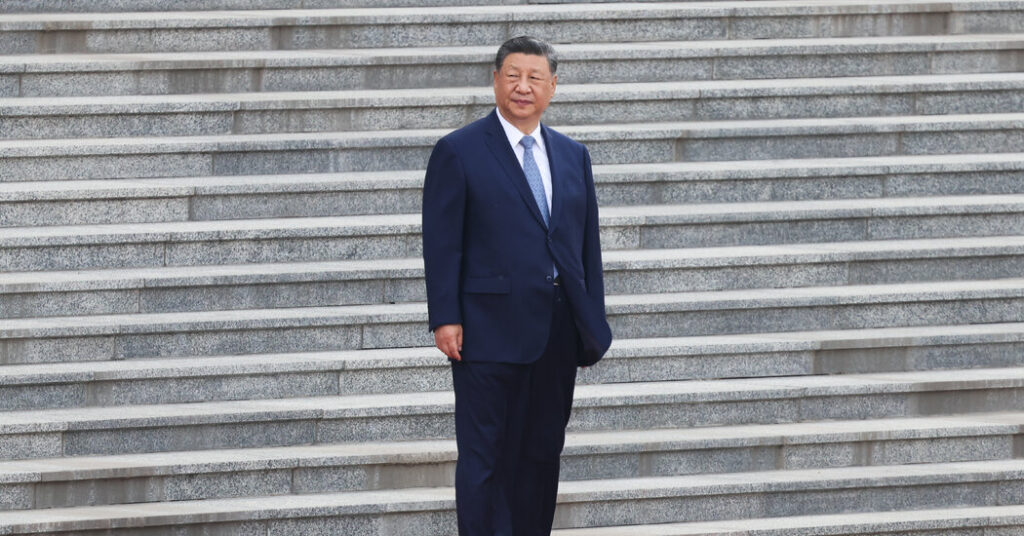
When Xi Jinping met President Trump last year, the Chinese leader wielded his country’s control over critical minerals, a strong posture that helped nudge Mr. Trump to agree to a yearlong trade truce. This week, when Mr. Xi hosts the American president in Beijing, he will have another powerful card to play: the war in Iran.
While the United States has been at war, Mr. Xi has been calling for peace and receiving foreign dignitaries from the Gulf and Europe seeking his help to end the crisis. Just before the U.S. president’s visit, Iran’s foreign minister, Abbas Araghchi, traveled to Beijing in a not-so-subtle reminder of China’s sway over its partner in the Middle East.
“The Iran issue actually helps China,” said Li Daokui, a prominent economist at Tsinghua University in Beijing.
China, he said, has important economic leverage over Tehran that it could be willing to use in pursuit of goals it cares more about — chief among them, prying the United States away from Taiwan, the self-governing island Beijing claims is its own.
That should give Mr. Xi extra confidence going into the summit that starts Thursday, the leaders’ first in-person meeting since October. The White House has been trying to pressure China, a key buyer of sanctioned Iranian oil, to cut back on its support of Tehran.
China’s Useful Influence Over Iran
China has its own reasons to help end the conflict. Its economy is affected by higher energy prices. A global recession would hurt China’s exports, which are a major engine of growth. Its strategic oil reserves, while helpful, are not limitless.
China has prodded Iranian officials to negotiate with the United States, but is wary of becoming entangled in a war it sees as largely Washington’s to resolve. Even if it won’t get involved militarily, though, China may be willing to work with the United States on the reopening of the Strait of Hormuz, a key sea route through which as much as 40 percent of China’s oil imports are shipped.
“The Chinese side may reach some agreement with the U.S. saying, ‘Let’s work together to persuade Iran to keep the strait open,’” Dr. Li said, adding that Beijing would also likely want assurances that the United States would not blockade the waterway.
China could still offer various incentives to Tehran to work with Washington, such as loans, investments and offers to help with postwar reconstruction, analysts say. (Beijing is unlikely to press Tehran to give up its nuclear program, though.)
Discussing Taiwan Arms Sales: No Longer Taboo?
What Mr. Xi wants most from Mr. Trump lies elsewhere — in Taiwan. Mr. Xi is seeking a softening of America’s support for the island, whether through a delay or reduction in arms sales, or a statement that Washington opposes its independence. The Trump administration has already delayed announcing a $13 billion package of arms sales to Taiwan to avoid angering Mr. Xi.
Mr. Trump this week said again that he planned to discuss with China the question of arms sales to Taiwan. If he were to do so, Mr. Trump could be violating a longstanding commitment known as the Six Assurances, a pillar of U.S.-Taiwan and U.S.-China policies. The Reagan-era assurances were sent to Taiwan’s president in 1982, and one is generally understood to say that the U.S. government would not consult with Beijing before an arms sale to Taiwan.
For Mr. Trump to put this on the table could be a departure from decades of American foreign policy, depending on how the topic was broached, and a win for Mr. Xi.
Among more hawkish Chinese scholars, the war in Iran has also exposed U.S. military weakness, giving Beijing yet more confidence to push on the issue of Taiwan. During the conflict, the United States was forced to divert military assets away from Asia and deplete its munitions stockpiles.
“The conflict with Iran indicates that the U.S. simply cannot sustain a major war with China over Taiwan. That’s very clear,” said Wu Xinbo, a leading American studies scholar at Fudan University in Shanghai.
Redefining the Relationship
For Beijing, the summit is perhaps less about extracting any specific concessions and more about redefining the terms of how the two superpowers should engage.
Mr. Xi will be seeking validation that his country, the world’s second-largest economy, is now an equal to the United States. And that he, as its leader, is a peer of Mr. Trump’s. It is something Mr. Xi has sought since he first took office in 2012 and an understanding that Chinese officials and analysts say would herald a more stable relationship of managed, however uneasy, coexistence.
“If the U.S. president is the leader of the free world and Xi Jinping is his peer, then what does that say about Xi Jinping’s — his leadership? That means that he must be a world leader as well,” said Yun Sun, director of the China program at the Stimson Center in Washington.
China has argued, most recently in an editorial by the official Xinhua News Agency on Wednesday headlined “Finding the Right Way for China and the U.S. to Get Along as Major Powers,” that the United States should not expect to have it both ways with China. It criticized Washington for asking Beijing to help on issues it cares about — such as helping to curb the flow of fentanyl to America — while simultaneously hurting Chinese interests, for instance by imposing sanctions on Chinese companies.
But that dynamic has defined the relationship for the past eight years, leading them to spar over everything from the origins of the Covid-19 pandemic to the appearance of a Chinese spy balloon floating over the United States. Today, the two sides remain at odds over China’s support of Iran and Russia, as well as U.S. export controls that cut Chinese companies off from advanced computer chips and other technology.
China Wants to Buy Time to Get Stronger
Ultimately, China wants more stability and a continuation of the trade truce. That means no more tariffs, no export controls, no sanctions imposed on its companies.
“They just want time and space to fortify themselves for future competition,” said Amanda Hsiao, a director in Eurasia Group’s China Practice, who was recently in Beijing meeting scholars and officials.
Beijing has already been doing that, by building up what Mr. Xi calls “national self-reliance” in technology but also trade and science. Since the two leaders last met six months ago, China has sharpened its tools to inflict economic pain on rivals. After years of U.S. export controls, Chinese companies are building their own chips, while firms like DeepSeek are designing A.I. systems that get around the constraints.
Beijing has also demonstrated that it will push back if provoked: When Washington placed sanctions on a Chinese refinery in April for buying Iranian oil, China ordered its companies not to comply.
To help set a positive tone, though, China may commit to purchases of Boeing aircraft, American soybeans and U.S. beef.
“For the Chinese, that’s an OK price to pay for stability,” Ms. Hsiao said.
Pei-Lin Wu contributed reporting.
Lily Kuo is a China correspondent for The Times, based in Taipei.
The post Why Xi Doesn’t Need a Deal With Trump appeared first on New York Times.