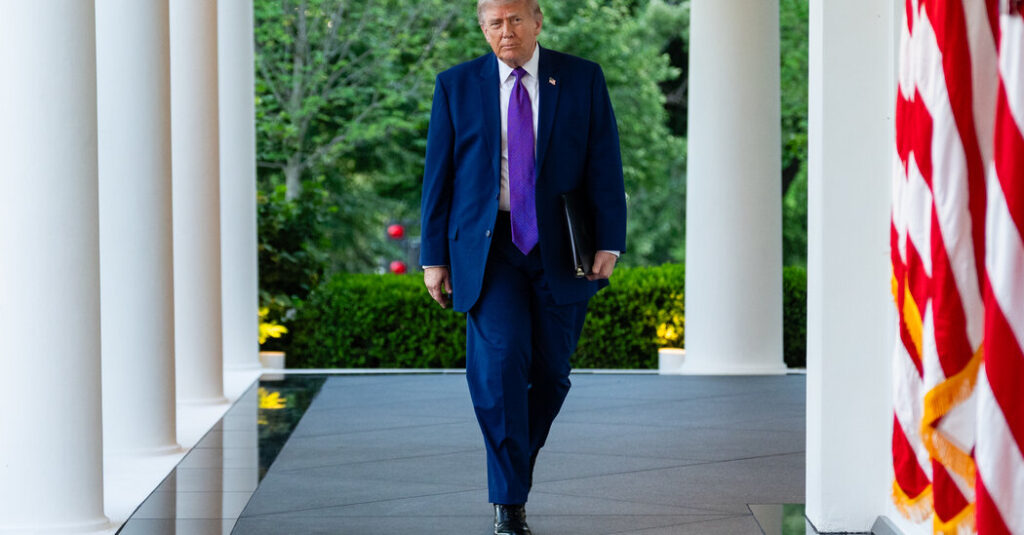
President Trump has never been a fuzzy, feel-your-pain kind of politician.
That came through in an especially striking way yesterday, when he answered a question about whether he was motivated by the financial situation of Americans to make a deal to end the war with Iran.
“Not even a little bit,” he replied, as my colleague Erica Green reported. (You can watch the video here.)
“I don’t think about Americans’ financial situation,” Trump added. “I don’t think about anybody. I think about one thing: We cannot let Iran have a nuclear weapon. That’s all.”
It was a response that flouted fundamental rules of American politics — that voters are motivated above all by economic concerns, that they want to support politicians who “care about people like me” — and it was a risky one, given Trump’s dire political standing:
-
His disapproval rating is consistently hovering around 60 percent or worse
-
A new CNN poll found that 77 percent of Americans — including a majority of Republicans — thought his policies had increased the cost of living in their own community
-
Inflation rose a startling 3.8 percent in April, the fastest rate since May 2023, sending a flashing warning about how the war in the Middle East is raising prices for Americans
-
Republican pushback to the conflict is growing in Congress
And Trump has not exactly given the impression that he is single-mindedly focused on bringing down the cost of living. He spent one recent night unleashing a barrage of Truth Social posts about various grievances and topics, including conspiracy theories about Barack Obama and Hillary Clinton.
“President Trump was re-elected for four reasons,” Whit Ayres, a veteran Republican pollster, told me. “To improve the economy, to bring down inflation, to control illegal immigration and to get away from woke culture. Anything that works against any of those four goals is not helpful.”
Republicans have had some good news, however, on the redistricting front. Two favorable court rulings for them have spurred a rapid escalation of Republican-led redrawing of maps across the South.
Trump, for his part, has arrived in Beijing for a two-day summit with China’s leader, Xi Jinping. Several primaries unfolding this month will test his influence, and the popularity of his policies, in his party. And of course, November is a long time from now.
“The longer-term forces are obviously not promising, with increasing inflation and declining job approval on the part of the president,” Ayres said. “There’s some short-term forces, particularly the mid-decade redistricting, which might work in their favor on the House side. So we’ll see which one dominates.”
But, he noted, “there’s no question that there’s a strong relationship between the president’s job approval and his party’s performance in the House.”
quote of the day
“His name recognition six months ago would be 0 percent or 1 percent”
That’s Charles Bullock III, a political scientist at the University of Georgia, describing the remarkable rise of Rick Jackson, a billionaire health care executive, in the state’s important race for governor.
Jackson’s astronomical spending on ads has forced his Republican primary opponents — including one who earned President Trump’s endorsement months before Jackson entered the race — to supercharge their own spending to remain competitive, my colleagues Rick Rojas, Katie Benner and Michelle Baruchman write.
Ultimately, they write, Jackson’s upstart candidacy has been a striking display of the power that extraordinary wealth can have in rapidly transforming an election.
Number of the Day
$115.5 million
That’s how much the venture capital firm Andreessen Horowitz has thrown into the midterm cycle — making it the biggest known contributor so far, surpassing big individual donors like George Soros or Elon Musk.
My colleague Theodore Schleifer has more on what he writes is “an astonishing effort by an investment shop to bend politics to its will.”
How Polymarket is rattling politics
Suspiciously well-timed bets on Israel attacking Iran. An odd wager on the capture of Venezuela’s leader. Big payouts on the announcement of a Middle East cease-fire.
Dozens of long-shot bets about global affairs on the prediction market Polymarket have defied the odds, my colleagues Stuart Thompson and David Yaffe-Bellany found, fueling concerns about a new kind of insider trading by military leaders and government officials with access to confidential plans.
ONE LAST THING
What is this mysterious super PAC doing?
A new super PAC has spent more than $1 million on at least three Democratic congressional primaries, including one in Texas where it is backing a left-wing sex therapist who has been accused of bigotry and antisemitism.
The twist? The group is tied to Republicans, my colleague Shane Goldmacher writes, and its spending appears meant to elevate Democrats who are seen as weaker candidates.
Such quiet meddling in the opposing party’s primaries, Shane explains, suggests that the race for control of the House has entered an intensive new phase in which both parties are vying for every imaginable edge.
Taylor Robinson contributed reporting.
Read past editions of the newsletter here.
If you’re enjoying what you’re reading, please consider recommending it to others. They can sign up here.
Have feedback? Ideas for coverage? We’d love to hear from you. Email us at [email protected].
Katie Glueck is a Times national political reporter.
The post A Revealing Trump Remark Points to Republicans’ Midterm Challenges appeared first on New York Times.