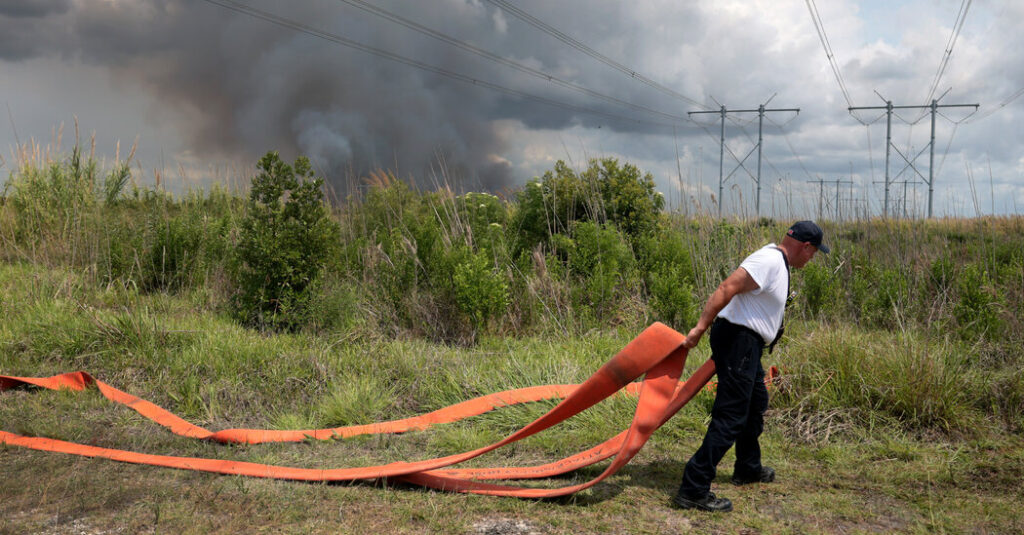
Florida and Georgia are seeing an unusually severe and early start to a wildfire season that is shaping up to be one of the worst in decades.
The fires are driven by a widespread drought gripping the Southeast. Virtually all of Georgia and the 94 percent of Florida is in a state of drought ranked by the U.S. Drought Monitor as “severe” or worse.
Georgia and other Southeast states are home to much of the nation’s wood production, in the form of sprawling timber plantations used for paper and lumber. Worldwide, research has found that timber plantations can be more flammable than native forests, depending upon how they are managed.
That trend hasn’t shown up yet in the American Southeast, but fires in the region are becoming more frequent, research has shown. Scientists suspect that’s a result of climate change.
In Georgia, two large wildfires have scorched more than 50,000 acres combined, destroying at least 120 homes. In Florida, smaller fires have torn through more than 120,000 acres, and one has claimed the life of a firefighter. In recent days, a brush fire in the Everglades has also spread rapidly, threatening nearby neighborhoods and consuming more than 11,000 acres.
The intensity of the drought made this year’s fires extremely dangerous and tricky to contain, said Troy Clymer, chief of forest management at the Georgia Forestry Commission, which oversees the state’s forests and wildfire response. “We were seeing flames dozens of feet high,” Mr. Clymer said. “Working in those conditions, we’ve had to pick and choose our battles.”
Many ecosystems in the Southeast are fire prone and would naturally burn at regular intervals. Some species even depend on it. The region, particularly Florida, is a hot spot for lightning, which is responsible for a small percentage of wildfires. Officials believe the fire currently burning in the Everglades was caused by a lightning strike.
“Most research on wildfires in the U.S. is in Western states, but the dynamics of those systems are extremely different than what they are in the Southeast,” said Victoria Donovan, an assistant professor of forest management at the University of Florida. “We still have to do a lot of research to understand the nuances of wildfire dynamics here.”
Florida and Georgia also lead the nation in the number of controlled burns conducted each year. The practice, also known as prescribed fire, involves intentionally setting small, carefully managed blazes in an effort to burn up excess vegetation that can fuel larger or more dangerous fires.
But controlled burns aren’t used everywhere, and the areas now burning are not typically managed with fire-suppression tactics, said Morgan Varner, an ecologist at Tall Timbers, a nonprofit research and conservation organization in North Florida known for its expertise in fire ecology. The extreme dryness is allowing fires to burn through habitats that would typically stop them, like wetlands, he said.
These emerging and poorly understood wildfire risks are emerging not just in the South, but the entire Eastern United States, said Erica Smithwick, a professor who studies forests and wildfires at Pennsylvania State University. She leads the Eastern Fire Network, a new collaboration between scientists across at least seven institutions to study wildfire risks and fill in the research gaps. “Any place can burn under the right conditions,” she said. “Now that the climate signals might be changing, we want to be able to anticipate those risks.”
One main concern is the rise in drought, particularly rapid drops in humidity and rainfall that can last for just a few weeks, known as flash droughts. Depending on the time of year, these can create conditions that help fires ignite and spread.
Another important consideration is that the Eastern United States is more densely populated than the West, with communities built near or around wooded areas. That means more people could be living in harm’s way. It also increases the risk of a fire starting. Most wildfires are caused by people by, for example, tossing a cigarette. And infrastructure, like power lines damaged by winds or storms, also pose a risk.
Hurricanes, which are becoming more intense as the planet warms, can also indirectly make wildfires more likely and harder to fight. They knock down trees, which can dry out over time and fuel fires while also making it harder for firefighters to pass through.
In the Southeast, much of the forest is made up of planted pine trees. Known as the nation’s “wood basket,” the region is home to a timber plantations and mills that produce most of the country’s pulpwood and roughly half of its softwood lumber, paper, packaging and other forest products.
Owners of timber plantations try to protect their crops and minimize fire risk, Mr. Clymer said. The state of Georgia helps private landowners conduct controlled burns and thin out brush, such as a waxy shrub known as fetterbush that can build up and acts “like gasoline” on wildfires, he said.
But it’s unlikely that most plantations routinely use prescribed burns, said Daniel Johnson, an associate professor of silviculture at the University of Florida. Loblolly pine, the kind most common grown on plantations, doesn’t necessarily hold up well during such planned burns, he said. “Nobody is taking the risk of damaging their trees on purpose,” he said.
Instead, pine plantations try to reduce wildfires by thinning out their forests. This is often done about halfway through a plantation’s typical 20-year life cycle and the early harvest is made into pulp. But demand for pulp is declining as mills close and foreign markets produce it more cheaply, meaning plantation owners may no longer be motivated to go to the trouble, Dr. Johnson said.
Sachi Kitajima Mulkey covers climate and the environment for The Times.
The post Wildfires Strike Florida, Georgia and America’s ‘Wood Basket’ appeared first on New York Times.