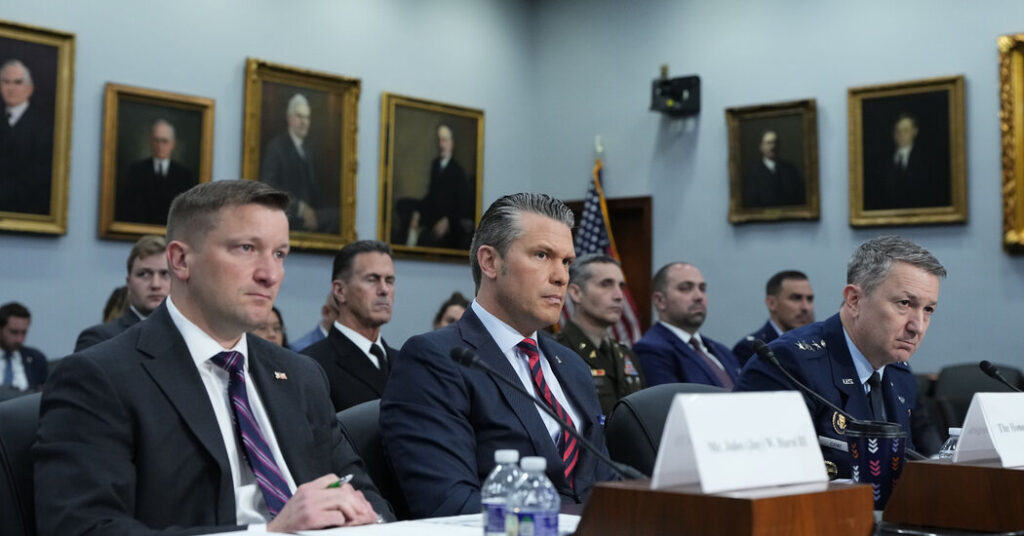
A top Pentagon official testified on Tuesday that the cost of the war with Iran had risen to around $29 billion, as Defense Secretary Pete Hegseth refused repeatedly to tell members of Congress how much he would request on an emergency basis, or when, to fund the 11-week-old conflict.
Jay Hurst, the Pentagon comptroller, said the cost of the war had risen to “closer” to $29 billion since Mr. Hegseth testified on Capitol Hill two weeks ago, when he estimated it had cost $25 billion.
“That’s because of updated repair and replacement of equipment costs and also just general operational costs,” Mr. Hurst said.
But Mr. Hegseth sidestepped questions about how much money outside of the Pentagon’s normal budget would ultimately be needed to finance the war — and when he would request it — even as Republicans and Democrats alike pressed him for details.
“It’ll be helpful to get the supplemental sooner rather than later so we can get to work on it,” Representative Ken Calvert of California, the Republican chairman of the House Appropriations defense subcommittee told the secretary, inquiring about when the request would be submitted.
“First of all, the munitions issue has been foolishly and unhelpfully overstated,” Mr. Hegseth replied. “We know exactly what we have. We have plenty of what we need.”
“Whatever we think we need, we will submit,” he added.
The White House told Congress earlier this month that hostilities with Iran had terminated amid a cease-fire. On Tuesday, however, Republicans and Democrats raised questions about the cost of the continuing military operation in the region and the durability of the cease-fire that the administration was relying on to make that claim.
Mr. Hegseth made no mention of Iran in his opening remarks at the hearing, which was called to review of the Pentagon’s nearly $1.45 trillion budget request for the coming year.
His assertion that munitions had not been depleted by the war was difficult to square with the Defense Department’s historically large request, which includes a large infusion for restocking munitions.
The war has forced the Pentagon to rush bombs, missiles and other hardware to the Middle East from commands in Asia and Europe. The drawdowns have left these regional commands less ready to confront potential adversaries like Russia and China and have forced the United States to find ways to scale up production to address the depletions, officials in the Trump administration and in Congress have said.
But Gen. Dan Caine, the chairman of the Joint Chiefs of Staff, also sought to allay fears that the war had significantly drained much of the U.S. military’s global supply of munitions.
“We have sufficient munitions for what we’re tasked to do right now,” General Caine said, citing what he said top commanders around the world had told him.
The House hearing concluded with the top Republican and Democrat urging Mr. Hegseth to move quickly to submit a request — on top of the Defense Department’s annual budget — for additional money to fund the war.
“Sooner is better,” Mr. Calvert said. “This makes my job easier, and at the end of the day, it makes your job easier, Mr. Secretary, if we can get the information both on the base budget and on the supplement.”
Democrats rejected the Trump administration’s claim that the war had drawn to a close, pointing to the fighting in the Strait of Hormuz, and said the White House had demonstrated a pattern of withholding critical information from Congress about the conflict.
“Military operations have continued,” said Representative Betty McCollum of Minnesota, the senior Democrat on the subcommittee. “We have a naval blockade, and both sides are exchanging fire — they did so over the weekend.”
Mr. Hegseth sought to deflect questions from several Democrats about the durability of the cease-fire.
“As you know, for the most part, a cease-fire means fire is ceasing, and we know that has occurred while negotiations occur,” Mr. Hegseth said.
But he added that the administration could restart the war if negotiations were to collapse.
“We have a plan to escalate, if necessary,” the secretary testified, declining to provide more details. “We have a plan to retrograde if necessary. We have a plan to shift assets.”
Mr. Hegseth has repeatedly said he wants to rely in part on a reconciliation bill, a budget-related measure that is shielded from a filibuster, to fund the Defense Department. That would allow the White House to steer around Democratic opposition and push it through with only Republican votes.
But a senior Republican warned that strategy could backfire, suggesting that some in the G.O.P. might not be willing to go along with the high levels of spending the Pentagon has requested.
“I would remind you that, frankly, the use of reconciliation depends on political support in Congress,” said Representative Tom Cole of Oklahoma, the Republican chairman of the Appropriations Committee.
He added, “It’s a high-risk strategy, as opposed to building things” into the annual appropriations bill, which needs bipartisan backing to pass.
Robert Jimison and Eric Schmitt contributed reporting.
Megan Mineiro is a Times congressional reporter and a member of the 2025-26 Times Fellowship class, a program for early-career journalists.
The post Pentagon Puts War Cost at $29 Billion as Hegseth Deflects on Funding appeared first on New York Times.