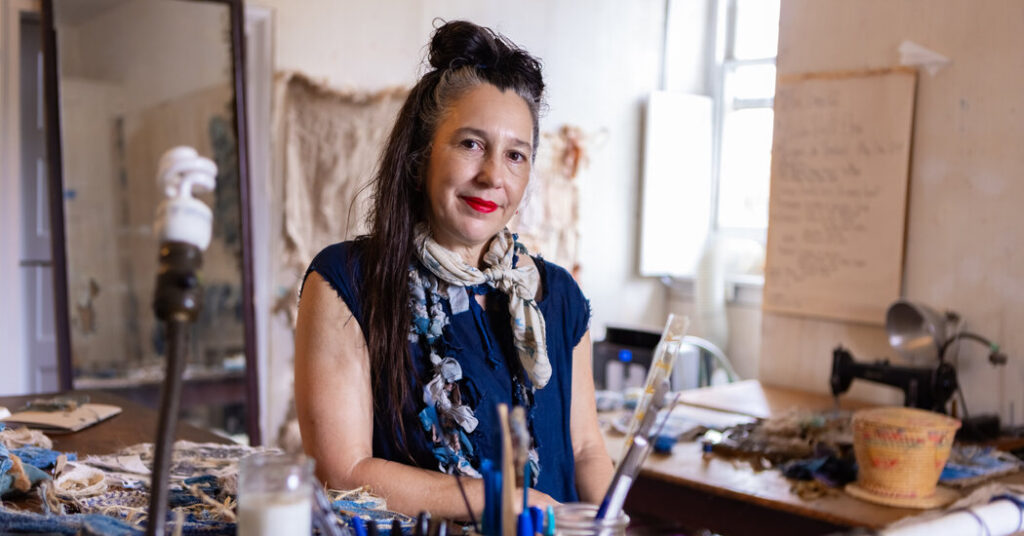
Leigh Magar, a milliner turned textile artist, slow-fashion designer and indigo grower who created handmade garments and artworks, died on April 16 at her home on Kauai, in Hawaii. She was 57.
The cause of death was breast cancer, her husband, Johnny Tucker, said. Last summer, the couple moved to Kauai from Johns Island, S.C., to give Ms. Magar a tropical respite.
Before she grew her own indigo, fermenting the leaves to create the deep blue dye prized by ancient Mesopotamians and using it to embellish her fabric designs and artwork — a practice known as “seed-to-stitch” that mimics the ethos of the farm-to-table food movement — Ms. Magar was a high-end milliner.
For decades, she made singular hats from her studio in Charleston, S.C., selling them at a storefront boutique, Magar Hatworks, and at Barneys New York and other high-end outlets.
Her creations were fanciful and bold. She made sculptural millinery that defied description: confections of feathers, fabric and felt, as well as more conventional, if elevated, fare — bespoke trilbies, pork pies and Panamas that were sought after by artists and performers, including Eartha Kitt, Nick Cave and Michael Stipe, for whom she made a deconstructed felt fedora.
She and Mr. Tucker, an architect and artist, were an integral part of Charleston’s creative community, said Mark Sloan, a former director and chief curator of the Halsey Institute of Contemporary Art there.
For a time, the couple lived in a vine-covered former candy shop at the back of a property in the historic district. During their tenure, it was all bohemian funk and decay — a Southern gothic artist’s atelier — with plaster flaking off the walls and exposed lath, battered antiques and statuary, vintage appliances and found artwork.
“They had the air of people not of this time,” Mr. Sloan said, recalling an early visit during which Ms. Magar was hard at work steaming her creations on antique hat blocks. “There was a certain drama to their lives.”
Of her hats, he added: “The shapes were outrageous, and so beautiful. Some looked like underwater sea creatures, or single-celled organisms.”
Mr. Sloan included a few in his 2005 group exhibition “Alive Inside: The Lure and Lore of the Sideshow,” which spread out over four locations in Charleston, including Ms. Magar’s King Street storefront. For the show, she designed hats for imaginary sideshow performers — including a tiara for a human pincushion, a spiky crown made from knitting needles.
By 2013, however, Ms. Magar had closed her store and started working with textiles, hand-dyeing fabric with various botanicals and other materials and selling them under the name Madame Magar. During one artist’s residency in a former mill town, she began experimenting with dyes made from rusty railroad ties.
Also in 2013, she and Mr. Tucker moved to Johns Island, where they rented a modernist house on nearly 400 acres. Ms. Magar began to research the site of their new home, where a cotton and indigo plantation had once stood. She learned that in the 18th century, plantations on the island began growing indigo with the labor of enslaved Africans, many of whom brought with them from their home countries methods for cultivating the plants and extracting the dye.
Indigo was a boom crop throughout the Lowcountry. Eliza Lucas Pinckney, the daughter of a Charleston-area plantation owner, is often credited (though perhaps not quite accurately) with starting the boom in 1738, the year she turned 16 and took over the management of her first plantation.
When Ms. Magar decided to grow indigo herself, and to use it in her work, she had to reckon with the plant’s tainted history. “I had to go through the light and dark of it,” she told The New York Times in 2024. “It was ‘open your eyes, white girl.’”
Seeds were not easy to come by. Through South Carolina’s indigo community, a zesty cohort of makers and growers, she met Father John, an Eastern Orthodox monk who had been growing indigo for decades and using it in his artwork. (Why indigo? “As a monk, one often develops a heightened focus,” he said in an interview, “and learns how to sublimate.”)
He shared seeds and tips with her, as did Arianne King Comer, a Charleston-based indigo artist and grower. Thus armed, Ms. Magar planted her own patch and began to experiment with techniques for extracting the dye from the plant and for dyeing fabric.
“She really ran with it,” said Father John, whose order traditionally forgoes surnames. “She tried it all.”
One day while bushwhacking at home, she followed a blue dragonfly through the brush and discovered a patch of wild indigo, likely descended from a crop that had been grown on Johns Island three centuries earlier. She felt it was a sign, and began to tend that patch, too.
At that point, she was well and truly hooked, captivated by all things indigo — not an unusual trajectory for artists who come in contact with the stuff.
“We’re like cigarette smokers,” Ms. King Comer said. “We can’t help ourselves.”
Ms. Magar made shift dresses dipped in indigo, and baskets and rag dolls woven from fabric scraps. She followed the Japanese practice of shibori, which involves folding fabric before placing it in the dye — essentially, an extremely precise version of tie-dye. She made collages from indigo squares; housewares like napkins and coasters; and epic quilts and portraits that she called scrap silhouettes. Among her subjects were Nina Simone and Eliza Lucas Pinckney.
“Indigo is the never-ending story of the Lowcountry,” Virginia Theerman, the curator of historic textiles at the Charleston Museum, said in an interview. “Today, there’s a community of artisans and farmers involved in a growing cottage industry.”
Ms. Magar “was coming at it from an artist’s perspective,” she added. “It was personal, yet tied into the history of indigo here, and to women’s history. Hers was a single-minded vision, and she was both passionate and exacting about her work.”
Jennifer Leigh Magar was born on June 30, 1968, in Spartanburg, S.C., and raised by her mother, Jennifer (Edwards) Fly, and her stepfather, John Fly, a textile executive.
Spartanburg is a former mill town, and Leigh’s maternal grandmother and great-aunt worked in the mills. She remembered them coming home flecked with lint from their labors.
Still, textiles were not her first love. She briefly studied culinary arts at Johnson & Wales University in Charleston, and worked for a time as a chef there, when she met Mr. Tucker, an architecture student at Clemson University.
They moved to New York City together in the early 1990s, and Ms. Magar studied millinery techniques at the Fashion Institute of Technology, graduating in 1995. Soon after, she and Mr. Tucker returned to Charleston; they married in 1997.
In addition to Mr. Tucker, she is survived by her mother and stepfather; a brother, Brian Magar; two stepsisters, Caroline and Katherine Fly; and a stepbrother, Ashley Fly.
Ms. Magar’s cancer was diagnosed in 2023. A year later, she began to work on a piece for “Reimagined Fashion: Creations of the Future Past,” an exhibition that opened at the Charleston Museum in 2025.
One of 18 local designers invited to make something inspired by the museum’s collections, she was drawn to the 19th-century quilt squares and to a collection of late 19th-century hair wreaths. (The wreaths are Victorian memento mori, made from twisting and braiding a loved one’s hair into flowers and leaves; they are beautiful and deeply weird.)
For the exhibit, she made what she called a Healing Gown. It had a Victorian feeling, with a nipped waist and trailing skirt. The bodice she fashioned from scraps of indigo-dyed fabric, a ruffle of feathers and her own waist-length hair, which she had cut off before starting chemotherapy; the skirt was made from hospital sheets.
At her death, Ms. Magar had moved on from indigo. She was working with Kauai’s iron-rich volcanic soil, practicing a technique called dirt dyeing. She was excited about orange.
Penelope Green is a Times reporter on the Obituaries desk.
The post Leigh Magar, High-End Milliner Turned Indigo Artist, Dies at 57 appeared first on New York Times.