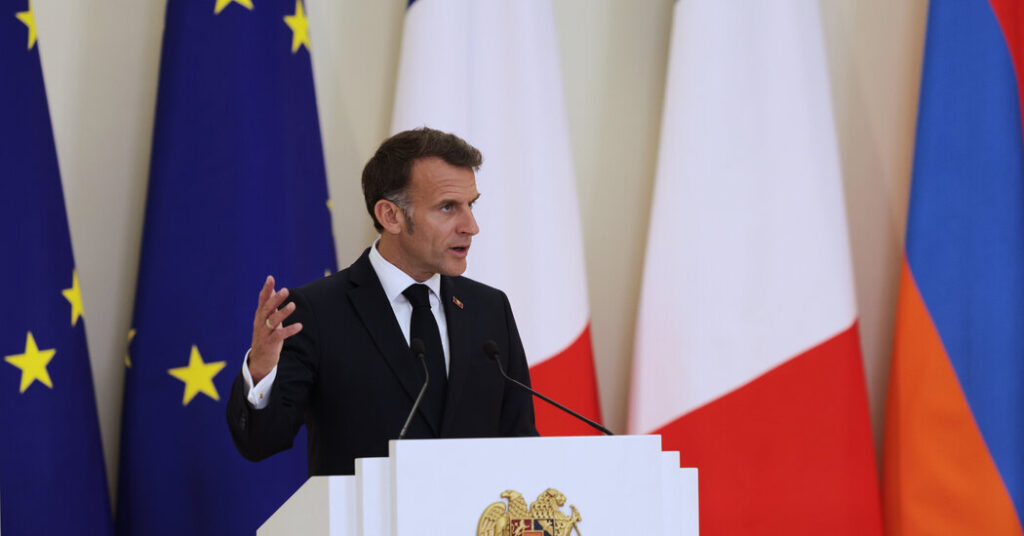
Barred from re-election and increasingly a lame duck, President Emmanuel Macron has few obvious levers to prevent a far-right, would-be successor from reshaping France after presidential elections next year. But he does have one, which he is using to striking effect: patronage.
In recent months, Mr. Macron has moved to appoint close allies to head several of France’s most powerful state institutions, including the central bank, the national auditing authority and the Constitutional Council, the closest French equivalent to the Supreme Court.
Taken together, political analysts say, Mr. Macron’s personnel moves could help weatherproof France against the effects of a far-right presidency, should either of the two likeliest far-right candidates, Marine Le Pen or Jordan Bardella, win. Both are comfortably ahead of all rivals in opinion polls.
“We’re talking about the country’s most important independent institutions,” said Benjamin Morel, a constitutional scholar at Panthéon-Assas University in Paris. “They are the ones that can largely limit the scope of certain political decisions.”
“There are clearly limits and boundaries being set here,” Mr. Morel said. “These appointments are far, far from neutral.”
The president, Mr. Morel was quick to say, was not overstepping his authority. It is hardly unknown for French presidents to appoint politically friendly people to influential positions, even if the practice is less prevalent than in the United States.
To some extent, Mr. Macron is simply the beneficiary of a string of convenient vacancies, most recently at the central bank, the Banque de France, where last week he proposed his chief of staff, Emmanuel Moulin, as the new president. That nomination will need to be confirmed by France’s Parliament, as was the head of the Constitutional Council, though not the president of the auditing authority.
Asked for comment, a presidential spokesman said Mr. Macron appointed competent and committed people. The spokesman, who spoke on the condition of anonymity in keeping with French political practice, said Mr. Macron would not have chosen differently, regardless of the possible rise of the far right in 2027.
Yet the appointments to posts with multiyear terms, coming as France approaches a potentially transformative election, have drawn criticism, not least from the leaders of the largest far-right party, the National Rally.
In a video last February, Mr. Bardella, the party’s president, accused Mr. Macron of “seeking to lock down our institutions in the hope of maintaining control and extending his influence.”
Ms. Le Pen, the party’s parliamentary leader, whose future is clouded by an embezzlement conviction that she is appealing, said Mr. Macron’s “regime” was “ready to commit all manner of ethical transgressions to place its loyalists and disrupt the future political alternation.”
People who know Mr. Macron suggest that putting allies in influential posts could pave the way for his own comeback six years from now. Although under French law, Mr. Macron cannot run for a third consecutive term in 2027, nothing would prevent him from running again in 2032, when he would be 54.
Some analysts play down the importance of the appointments, attributing them less to a calculated political strategy than to a time-honored practice by leaders of rewarding allies with plum jobs.
“Frankly, I do not think those appointments are going to be politically decisive,” said Philippe Marlière, a professor of French and European politics at University College London. “They were close collaborators of Macron and none of them is known by the public at large. They are not politically material in the strict sense of the term.”
On one level, Mr. Macron’s choice of Mr. Moulin for the central bank was conventional. A former Treasury director, he has the right pedigree to run the institution. But Mr. Moulin, 57, is best known for ties with Mr. Macron, advising senior ministers in his government before taking over management of the president’s office last year.
In February, Mr. Macron named Amélie de Montchalin, a former budget minister, as president of the auditing authority, which examines public spending. Critics objected to the appointment of a former government official as head of an agency meant to be an impartial watchdog of good governance.
Among other things, the authority published a damning audit of the Louvre after a brazen daytime jewel heist in October. The audit concluded that the museum’s security systems were outdated and faulted the Louvre’s leaders for ignoring basic upkeep.
Perhaps the most politically divisive appointment came last year when Mr. Macron named Richard Ferrand, one of his early supporters and the first leader of his party, as head of the Constitutional Council. Mr. Ferrand’s closeness to Mr. Macron and lack of legal training provoked a storm of criticism, and his appointment was approved by a one-vote margin in the Parliament.
The court, which judges the constitutionality of laws and supervises elections, also rules on the long-debated question of whether the president has the right to call a referendum to amend the constitution without Parliament’s approval.
The National Rally, Professor Morel said, “would like to take a shot at this issue, despite everything. And so here, you have a Constitutional Council that may find itself on the front lines.”
Ségolène Le Stradic contributed reporting.
Mark Landler is the Paris bureau chief of The Times, covering France, as well as American foreign policy in Europe and the Middle East. He has been a journalist for more than three decades.
The post Is France’s Centrist Leader Trying to Weatherproof It From the Far Right? appeared first on New York Times.