It was quite the gathering.
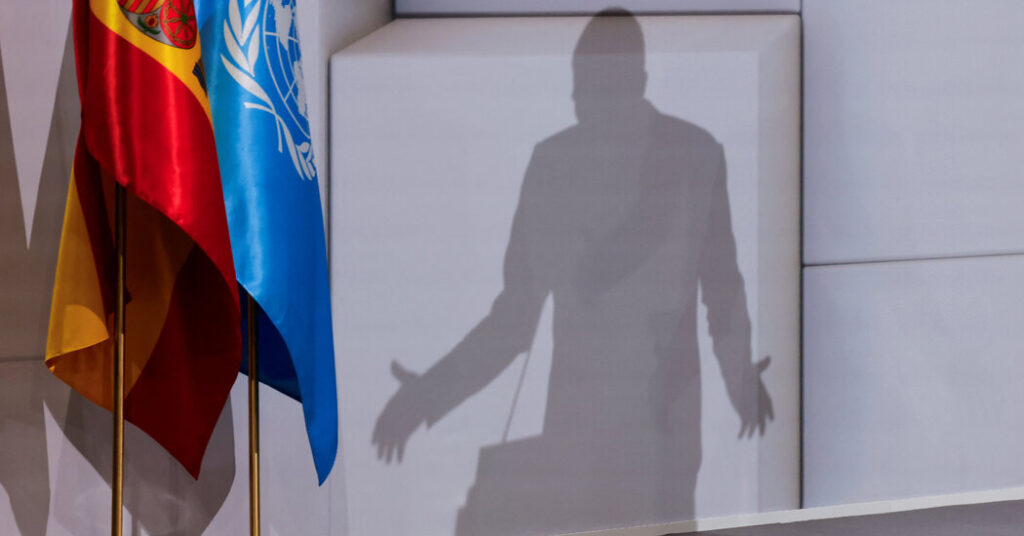
In April, many of the world’s progressive luminaries, including President Luiz Inácio Lula da Silva of Brazil, President Claudia Sheinbaum of Mexico and President Cyril Ramaphosa of South Africa, descended on Barcelona. Ostensibly, they were there to show their support for democracy and multilateralism against the threat posed by the far right. But you’d be forgiven for thinking the real purpose of their visit was to honor Spain’s prime minister, Pedro Sánchez. The West’s longest-serving center-left leader, he has recently become better known for something else: heading the global opposition to President Trump.
In contrast to the “don’t poke the bear” approach of most foreign leaders, Mr. Sánchez has boldly challenged the American president — condemning Mr. Trump’s removal of Nicolás Maduro from power and denying the United States use of military bases in Spain for the war in Iran. These stances were preceded by a string of confrontations with Washington. Last year, Mr. Sánchez was the sole NATO leader to oppose Mr. Trump’s demand for a large increase in military spending, faced down the threat of tariffs and took the lead in recognizing Palestinian statehood and calling the war in Gaza a genocide.
To Mr. Sánchez’s detractors, this turn as Mr. Trump’s nemesis is the latest manifestation of “Sanchismo,” a populist and unprincipled politics designed to retain power at any cost. But this pejorative moniker misses the mark. Across eight years in office, Mr. Sánchez has succeeded in making Spain the last social-democratic stronghold in Europe, surviving — even thriving — in a brutal environment for progressive politicians. He has accomplished this feat by mixing ambition, idealism and pragmatism, along with opposition to Mr. Trump. For left-leaning leaders of almost any stripe, it provides a blueprint to follow.
Not unlike Mr. Trump, Mr. Sánchez rose to power as an impatient disrupter. In 2017, he regained control of the Spanish Socialist Workers’ Party, driving his Peugeot 407 all over Spain to spread his anti-establishment message and connect with the party’s grass roots. The next year, he orchestrated the removal from office of Prime Minister Mariano Rajoy — whose conservative People’s Party was knee-deep in corruption scandals — through a no-confidence vote in the Congress of Deputies. Having successfully brought down a government for the first time in Spain’s post-Franco history, Mr. Sánchez emerged as the country’s leader.
Once in office, Mr. Sánchez displayed remarkable audacity. In 2023, after calling a snap election, he struck a controversial deal with Catalan separatists. In exchange for their support, Mr. Sánchez offered amnesty for anyone linked to the illegal referendum on Catalan independence held in 2017, including those showing no remorse. Many in the judiciary opposed the deal, which caused a meltdown among conservatives and set off huge public protests. But the gamble paid off. Mr. Sánchez stayed in power, and after the amnesty deal was enshrined in law, support for Catalan independence receded significantly.
Such risk-taking has been in the service of an idealistic agenda that Mr. Sánchez calls progressivism that works. Between 2018 and 2025, he increased the minimum wage by 61 percent, as well as introduced labor reforms to reduce unemployment, curb short-term contracts, make it harder to fire workers, and protect women and L.G.B.T. Q. people from workplace discrimination. These policies, combined with higher taxes on the rich and generous support for workers during the pandemic, were the prelude to a triumphant relaunch of the Spanish economy. By 2024, The Economist was heralding Spain as the world’s “best-performing rich economy.”
Mr. Sánchez has also tried to bring accountability for Spain’s dictatorial past. In 2019, he secured the removal of the remains of Gen. Francisco Franco from the Valley of the Fallen, Spain’s grandest public monument and the dictator’s memorial to his victory in the Spanish Civil War. And in 2022, against stiff opposition from conservatives, he enacted the Law of Democratic Memory. Most notably, this landmark law compelled the government to locate, exhume and rebury some 2,000 mass graves containing the remains of as many as 150,000 victims of the Civil War and the Francoist dictatorship.
Yet no one should mistake Mr. Sánchez for an ideologue. His pragmatism is unmistakable, especially when it comes to the economy. The so-called “Iberian Miracle,” anchored in a booming tourist sector, high-value service exports, automobile manufacturing and renewable energy, has been accompanied by Mr. Sánchez’s courting of Chinese investment. Another building block of the miracle is an immigration policy that though generous — a law regularizing the status of 500,000 undocumented people went into effect this year — gives priority to Latin Americans who can assimilate into Spain and those willing to fill jobs that are unwanted by Spaniards.
To be sure, replicating Mr. Sánchez’s success elsewhere won’t be easy. For one thing, Spain’s aversion to the far right — rooted in its relatively recent experience with dictatorship — has put limits on the radical right’s appeal, unlike elsewhere in Europe. What’s more, the presence of sizable forces to Mr. Sánchez’s left has allowed him to borrow their ideas without losing his status as a responsible politician: He can cleave to the left or disavow it, as circumstances dictate. His skill at outmaneuvering right-wing opponents and sidestepping scandals would be even harder to match.
Mr. Sánchez has announced his intention to stand for re-election next year. His opposition to Mr. Trump will surely be front and center. According to recent polls, the Spanish public is the most antiwar in Europe, with 51 percent of Spaniards holding the view that America poses a “threat” to Europe. Mr. Sánchez has already received a large bump in his polling and approval rates for his trenchant approach to Mr. Trump. But no matter the result next year, he has solidified his position as one of the most consequential Spanish leaders in the post-Franco era.
More surprising is Mr. Sánchez’s global significance. Acting on the belief that center-left leaders have for too long governed as paler versions of their right-wing counterparts, he has drawn a clear distinction between them. In the process, Mr. Sánchez has established an alternative governing philosophy to Trumpism — one that works, too. No wonder like-minded leaders, navigating a tumultuous world, came to pay him homage and to see for themselves how they can learn from Spain.
Omar G. Encarnación is a professor of politics at Bard College and the author, most recently, of “Framing Equality: The Politics of Gay Marriage Wars.”
The Times is committed to publishing a diversity of letters to the editor. We’d like to hear what you think about this or any of our articles. Here are some tips. And here’s our email: [email protected].
Follow the New York Times Opinion section on Facebook, Instagram, TikTok, Bluesky, WhatsApp and Threads.
The post Spain’s Leader Is Showing How to Stand Up to Trump, and So Much More appeared first on New York Times.