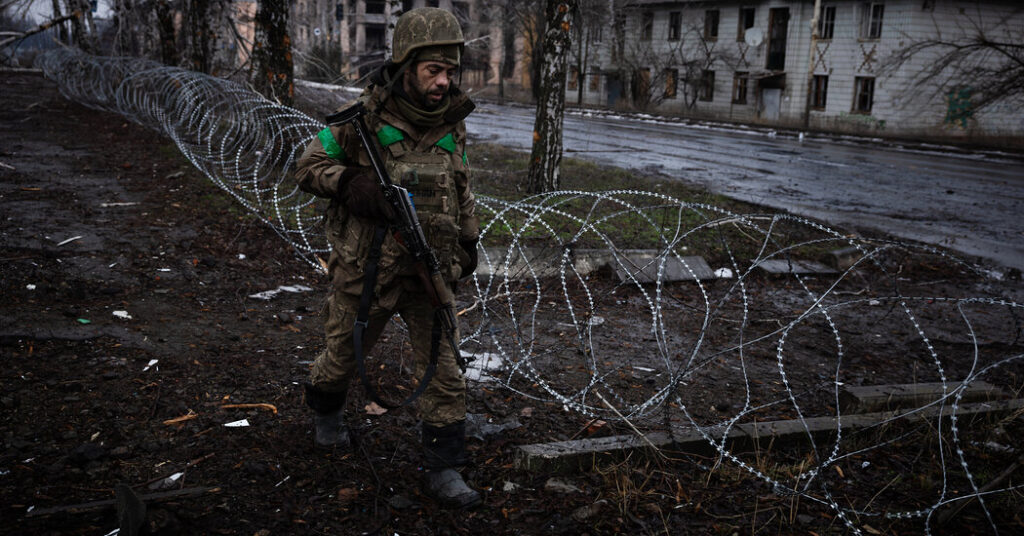
President Vladimir V. Putin of Russia has sought to convince President Trump that his troops are marching toward inevitable victory in Ukraine, arguing that Kyiv should hand over the entire eastern Donbas region to avoid impending defeat.
But the situation on the battlefield tells a different story.
After making gains late last year, the Russian military has slowed to a crawl. In some parts of Ukraine, it has lost territory. At its average monthly rate of advance so far this year, it would take Russia more than three decades to seize full control of the Donbas, which the Kremlin has set as a condition for ending the war.
The slowdown may be temporary, and it is due at least in part to seasonal factors. Russian troops tend to pick up speed over the summer, aided by better weather and foliage that provides more cover from drones. In recent days, Ukrainian officials have warned that Moscow’s troops are gearing up for new offensives and have intensified operations across the front.
Still, Russia enters this push on the back foot. It has faced setbacks this year, including the loss of Starlink satellite internet access that helped guide its drones. The Kremlin’s throttling of the Telegram messaging app, as it tightens control over the Russian internet, has also hampered soldiers’ communications.
More broadly, Russia has yet to solve the fundamental problem of how to make big advances on a battlefield saturated with drones. The days of sending masses of troops charging through front lines in armored vehicles are mostly over.
Instead, the contest between Kyiv and Moscow is largely one of developing better drones, and better defenses against them. On certain parts of the front, Ukraine has gained the upper hand in recent months with rapid advancements in technology, production and tactics. But Russia is working furiously to catch up, building out a bigger drone force after rolling out a successful elite drone unit known as Rubicon.
Drones have forced Russian troops to change their strategy. Now they try to infiltrate territory gradually with small teams of soldiers, often on foot. This has resulted in an ever-growing swath of territory known as the “gray zone,” where troops from both sides are present and control is not clear-cut.
“The best they can do is these infiltration tactics and the targeting of the support networks pretty far behind the line — targeting Ukrainian drone teams and logistics support,” said Dara Massicot, a senior fellow at the Carnegie Endowment for International Peace. “But it doesn’t lead to rapid gains. They are kind of stuck.”
As the war effort stalls, it is putting the Russian government under increasing economic and political strain.
Mr. Putin’s approval ratings have fallen to their lowest levels since the start of the war, as the economy buckles under vast military spending and as mobile internet blackouts, imposed in part to prevent Ukrainian drone attacks, anger ordinary Russians.
For now, the Kremlin is fighting on. But its challenges on the battlefield complicate the narrative of imminent victory Mr. Putin has been selling to the Trump administration as it has brokered peace talks with Ukraine. Russia is looking to put pressure on Kyiv to cede the parts of the Donbas that its military has failed to capture.
Even as Russia struggled on the battlefield this March, Mr. Trump, in an interview with Politico, expanded on his earlier statement that President Volodymyr Zelensky of Ukraine had “no cards” by saying he now had “even less cards.”
On Thursday, the Kremlin’s chief foreign policy adviser, Yuri Ushakov, said that until Ukraine withdrew from the region, Russia saw no point in further peace talks. Ukraine has refused to hand over that territory, though negotiations have continued over turning it into some sort of international demilitarized zone.
While Russia has not figured out how to take and hold large swaths of land through infiltration, it may believe that a gradual push is a better approach anyway, Ms. Massicot said. That avoids the risk of big operations that could go wrong and raise questions about the prospects for victory, she added.
“I think it’s a combination of not having an operational solution and the Kremlin being satisfied with this level of political risk, and hoping that peace talks will negotiate away the difficult part, which is fighting for the rest of the Donbas,” she said.
Whatever Russia’s strategy, it is clear that the pace of Russia’s advance has slowed this year, according to the three main organizations tracking the battlefield, the Institute for the Study of War, Black Bird Group and DeepState.
Two of the groups say there have been months in which Russia suffered net territorial losses, though the ever-widening gray zone on the front has led to differing interpretations of what constitutes captured territory.
Russia’s meager gains in the past three months, according to Black Bird’s statistics, amounted to its worst battlefield performance within Ukraine since 2023.
What limited gains Russia has made have come with heavy casualties. An estimated 352,000 Russian soldiers had died in the war by the end of last year, according to figures released this weekend by the Russian outlets Mediazona and Meduza. That is more than six times the number of U.S. troops killed during the Vietnam War.
As Russia’s losses mounted, it also missed recruiting targets in the first few months of the year, according to U.S. and European officials. That has raised questions about how long the Kremlin can sustain its war effort without resorting to another unpopular draft.
Russian soldiers have described the peril of being ordered to infiltrate territory where every move is tracked by Ukrainian drones.
One 24-year-old soldier, who fought in the Donbas before deserting the force last year, told The New York Times that his unit spent the better part of a month trying to establish a foothold in a single town outside the city of Pokrovsk, as assault troops tried to move in but were wiped out by Ukrainian drones.
Their commander then ordered the troops to start infiltrating the town in two-man teams, which slipped in day after day until they built up enough of a presence to secure the territory. The pairs kept their distance from one another to avoid bunching up in a single location and becoming a target, the soldier said, speaking anonymously for security reasons.
The reality of the gray zone means that injured Russian troops are often left stranded in contested territory, their units unable to retrieve them. The Russian soldier recounted trying to send water and candy bars by drone to a stranded comrade dying of dehydration.
For much of last year, Russia’s small-team infiltration tactics worked, albeit slowly. According to Black Bird, the Russian military gained 1,768 square miles of territory in Ukraine over the course of 2025, an area a bit larger than Rhode Island.
Russia has spent years fighting for Pokrovsk, as well as the town of Chasiv Yar to the northeast. But the front line still essentially runs through them, underscoring the extent to which the battlefield remains broadly stalemated.
Ukraine’s military has its own problems, including a longstanding personnel shortage and high rates of desertion. Drones have enabled it to blunt the larger Russian Army’s advances, but when Russia loses territory, it tends to shift into the gray zone, not back to Kyiv’s outright control.
“Many of the things that are hindering the Russian advance are also making it difficult for Ukraine,” said Emil Kastehelmi, a military analyst with Black Bird, which is based in Finland.
Ukraine is seeking to raise the war’s costs for the Kremlin by striking oil installations and other targets deep inside Russia, and by trying to inflict more casualties.
Defense Minister Mykhailo Fedorov has said that Ukraine’s aim is to kill or seriously wound 50,000 soldiers a month, up from what it says is about 35,000 now. That, Mr. Fedorov said, would impose “costs on Russia that it cannot bear” and “force peace through strength.”
Ukrainian soldiers told The Times that Russia’s activity in the Donbas had recently heated up, raising the possibility that its advance could pick up speed.
Senior Lt. Maksym Bakulin, a Ukrainian officer in the Donetsk region, which makes up most of the Donbas, said Russia’s infiltration operations had begun to improve. For about three weeks, he said, spring foliage had allowed its troops to move covertly, and the drier weather meant they could advance on motorcycles again, rather than on foot.
There has not yet been a “massive push,” Lieutenant Bakulin said by telephone, but “everyone is talking about it, it could happen. We must always be ready.”
Oleksandr Chubko contributed reporting from Kyiv, and Adam Entous from Washington.
Paul Sonne is an international correspondent, focusing on Russia and the varied impacts of President Vladimir V. Putin’s domestic and foreign policies, with a focus on the war against Ukraine.
The post Putin’s Forces Are Barely Inching Along on the Battlefield appeared first on New York Times.