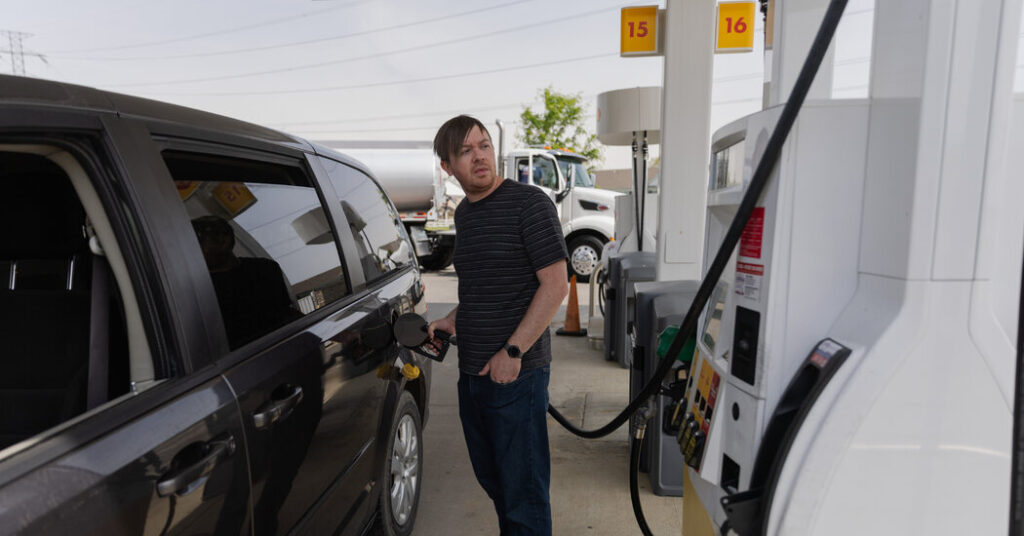
On paper, Alex Watts’s household looks financially stable. He and his wife together earn a bit more than $140,000 a year; own their home near Columbus, Ohio; have great credit scores; and stay on top of their bills. When an unexpected expense hits, like a car repair or a hospital trip, they always finds a way to cover it.
But amid the ever-growing costs of groceries, gasoline and electricity, their monthly expenses are running into the red and their monthly credit card balances have gotten larger. To pay them down, they drive less to save money on gas and have stopped putting away money for savings.
“I’m working between eight and 12 hours of overtime every week,” said Mr. Watts, 36, a hospital nurse raising three young children. “We’re cutting even, at best, but sometimes we’re spending more than we’re getting.”
The Wattses are among an increasing number of households leaning on credit to make ends meet as the costs of essentials — including housing, health care, utilities and food — keep rising. Credit card balances reached a record $1.3 trillion at the end of last year, according to the Federal Reserve Bank of New York’s latest quarterly study of household debt, and more and more people are applying for new credit cards. Applications for credit rose in February to their highest level since late 2022.
The strain from this increasing debt load is starting to show, with the percentage of after-tax income that households spend paying down debt ticking up since early 2025, according to Federal Reserve data.
Banks say they are not seeing signs of serious distress. Jamie Dimon, chief executive of JPMorgan, said late last month that consumer borrowing habits looked “fundamentally healthy.”
But across all consumer debts, the share that is delinquent rose to 4.8 percent, the highest tally since 2017. For the first time in more than a decade, the national average credit score dipped last year, according to data from Experian, one of the three major U.S. credit bureaus.
The data may also understate some of the strain, as more borrowers take on debts that rarely show up on their credit reports, like “buy now, pay later” loans. Unlike most loans, these pay-later products usually do not involve a “hard inquiry” on the borrower’s credit report — the kind that can lower credit scores — and lenders often don’t report short-term loans to credit bureaus.
The Trump administration has noted the spike in consumer borrowing.
“Credit card spending is through the roof,” Kevin Hassett, a top White House economic adviser, said on Fox News last Wednesday. “They’re spending more on gasoline, but they’re spending more on everything else, too.”
Mr. Hassett attributed the spending surge to people having “so much more money in their pockets.”
But many consumers are not expressing optimism. The University of Michigan’s latest U.S. consumer sentiment index reading, released Friday, dropped to a record low in May, even below the levels recorded during recessions.
For the Watts family, higher gasoline costs are one factor pushing up their spending. The cost of a gallon of gas near their home rose 70 cents overnight one day late last month. Their home energy bills have also soared: Mr. Watts’s gas bill, which is normally under $100, was almost $400 in February.
That’s compounding the stress that inflation has inflicted on his family’s budget. His grocery bill is more than $1,000 a month higher than it was a few years ago, and the strawberries and other fruits his children love have jumped in price in recent weeks.
“The secret sauce to keeping everything spinning is financial engineering,” said Mike Pierce, the executive director of Protect Borrowers, an advocacy group. “What happens when the music stops?”
With credit increasingly serving as the glue holding daily life together, the consequences can be dire if that safety net disappears.
Davette Ceasar, 27, had relied on a Fidelity-branded card as her go-to card. Issued by Elan Financial Services, a division of U.S. Bank, the card carried a hefty credit line and a promotional zero-percent interest rate.
But last month, Ms. Ceasar discovered that her credit score had plunged almost 50 points because Elan slashed her credit limit by nearly $10,000, to just a tad more than her existing balance on the card. That spiked her credit-utilization rate, a major factor in credit scoring.
Ms. Ceasar called Elan and Fidelity seeking answers about the reduction. She was told that she had a late payment, which she thinks was a mistake — she is certain she made the payment online before her due date. Fidelity agreed to waive the late fee, but Ms. Ceasar has been unable, after weeks of calls to customer service, to get her former credit limit restored.
Ms. Ceasar, who lives in Maryland, had been looking for a new apartment to rent. Now, she worries her lower score will be an obstacle.
Medical debt pushed Opal Mattila, 42, a high school math teacher in rural Minnesota, over the financial edge. Ms. Mattila, who earns around $70,000 a year, pays $1,200 a month for a health insurance plan for herself and her 7-year-old son that carries a $3,500-per-person annual deductible. A cascade of health ills in recent years — essential dental work for herself and her son, followed by the costs of treating him for a broken arm — left her buried in bills for out-of-pocket costs she could not afford to pay down.
She filed for bankruptcy last year. In the bankruptcy process, the balances she had on her credit cards were discharged — and those accounts were closed.
“If something horrible were to happen, I don’t know how I’d pay for it,” she said.
The tangle of affordability challenges created by health care and inflationary pressures is already having crossover effects.
Vicki Morris, 53, is a middle school speech therapist in a Chicago suburb. For more than 20 years, she has run a small business on the side, operating a clinic that offers a range of therapeutic services for children. It has usually been profitable, giving her a bit of extra income to supplement her public-school salary.
But her clients are facing the same financial pressures that Ms. Morris now feels in her own household. As health insurance costs rise and the Trump administration slashes Affordable Care Act subsidies, millions of people have lost their coverage, and even those with insurance are cutting back on medical appointments they can no longer afford.
Increasing numbers of patients have stopped coming for treatment and left her with unpaid balances, totaling thousands of dollars. Keeping her business running and her staff paid is now stretching her own finances to the edge. She’s turning to debt to hold it together.
“Car repairs definitely are going on credit cards. Household repairs are going credit cards,” she said. “It’s the hamster wheel of the debt cycle. Every time you feel like you’ve met a milestone, you get hit with something else.”
Stacy Cowley is a Times business reporter who writes about a broad array of topics related to consumer finance, including student debt, the banking industry and small business.
The post Consumers Lean on a ‘Hamster Wheel’ of Credit to Manage Rising Costs appeared first on New York Times.