The closing minutes of “No Limit,” a French Netflix drama released in 2022, depict an apparent murder by sabotage. The film’s protagonists, Roxana Aubrey and Pascal Gautier, a couple, are stars in the niche sport of no-limits freediving, in which competitors descend hundreds of feet into the ocean without an external oxygen supply, requiring them to hold their breath for minutes at a time. The no-limits diver travels on a weighted sled attached to a cable. Upon reaching a predetermined depth, the sled drops its weight and the diver uses a tank of compressed air to inflate a balloon that rockets them to the surface.
Pascal is a no-limits legend. Though still a young man — he looks to be in his early 30s — he is a lion in winter. He suffers blackouts brought on by years of deep-sea diving. After he is told he can no longer compete, he comes to see the younger Roxana as an extension of himself. When another woman breaks his record, he presses her to claim the title. She agrees. But their relationship is turbulent, troubled by infidelity and professional jealousy. Roxana drowns during her record attempt when her balloon fails to inflate, and the film suggests Pascal is to blame: It was he, it seems, who emptied her air tank.
“No Limit” was a modest streaming success, but it soon became a problem for Netflix. Before the action in the film begins, viewers are told that what they’re about to see was “inspired by real events.” To many viewers, it had only one plausible true-life basis: the complicated marriage of the elite freedivers Audrey Mestre and Francisco Ferreras — and Mestre’s death in circumstances almost identical to those portrayed in “No Limit.” There is even a tribute at the end of the film: “In memory of Audrey Mestre, 1974-2002.” (Immediately after, another title card states that any resemblance to reality is purely coincidental.)
In Ferreras’s view, the overall effect was to falsely imply that he had murdered his wife. In 2023, he sued Netflix for defamation. “We’ve entered an age in which docudrama is incredibly popular,” Alexander Rufus-Isaacs, Ferreras’s lawyer, said. “That’s fine. Screenwriters are not making documentaries. They are entitled to take real characters and make them look like complete jerks — so long as they don’t identify them.” Rufus-Isaacs was certain that for anyone familiar with his client, Ferreras would be instantly recognizable in the character of Pascal.
Freediving isn’t a natural draw for audiences, no-limits least of all. The events take place in open water, often far from shore. They last less than five minutes and proceed entirely out of view. Unlike traditional freediving, in which participants swim down and back, no-limits requires that divers mostly stay put. Styles vary, but in the approach that Ferreras prefers, the diver descends kneeling, legs bent around the crossbar of his T-shaped sled, with one hand above his head, holding on, and the other pinching his nose. The most important task on the way down is to equalize the pressure in the ears. Bass fishing arguably makes for a more thrilling spectator sport.
Ferreras understood early that translating his esoteric skills into worldly success meant styling himself as a compelling character. By his own (generous) count, during the peak of his career, Ferreras set more than 20 freediving world records, and he treated virtually every dive as an occasion to burnish his legend, chatting up journalists and appearing on camera whenever possible. His stories could stretch credulity. In the first of his three published memoirs, for example, Ferreras claims that he once found himself swimming beside a Soviet submarine on patrol; the crew abducted him, he writes, and subjected him to medical tests, revealing superhuman biology that astonished their military doctor. (He now says that someone else added this detail to his memoir before publication.) In his hands, no-limits, which many traditional freedivers viewed as strange, almost a circus act, became something else: a bold voyage to the edge of human potential. “He was a sort of superhero, a mythical figure,” Rudi Castineyra, a freediving trainer who has known Ferreras for decades, told me. “The undisputed master of the seas.”
That such a figure would one day see himself depicted in a Netflix movie is not terribly surprising. David M. Rosenthal, the director and screenwriter of “No Limit,” is not even the first to mine Ferreras’s life for onscreen drama. Indeed, the most striking feature of the “No Limit” saga — the thing that makes it a weirdly mesmerizing expression of the slipperiness inherent in blending reality and fiction — is the fact that Ferreras’s story has been recounted so many times before. For decades it has been told and retold by a discordant chorus across virtually every medium imaginable — often by Ferreras himself. In addition to being a serial memoirist, Ferreras is the producer and subject of several documentaries. A passionate chronicler of his own life, he has experienced “No Limit” not only as a grave affront but also something akin to burglary.
Libel-in-fiction lawsuits are hard to win, especially for public figures like Ferreras, who must meet a high burden of proof. But his case against Netflix appeared strong. Ferreras has never been charged with a crime in connection with Mestre’s death, and if the filmmakers had essentially accused him of murder, his chances of victory should have been good. “We may end up with the new leading libel case in fiction,” Rufus-Isaacs told me.
Yet Ferreras had his own storytelling problems to contend with. Trailed for more than 20 years by questions about what exactly he did or didn’t do during Mestre’s last dive, Ferreras had provided answers, to journalists and in his writing, that could seem evasive and self-serving. He had remained, as ever, the insistent master of his own story. In the end, his lawsuit would hinge less on its legal merit than on his willingness to acknowledge certain painful gaps between his preferred narrative of his life and its observable facts. And like many of us, Ferreras often found this impossible.
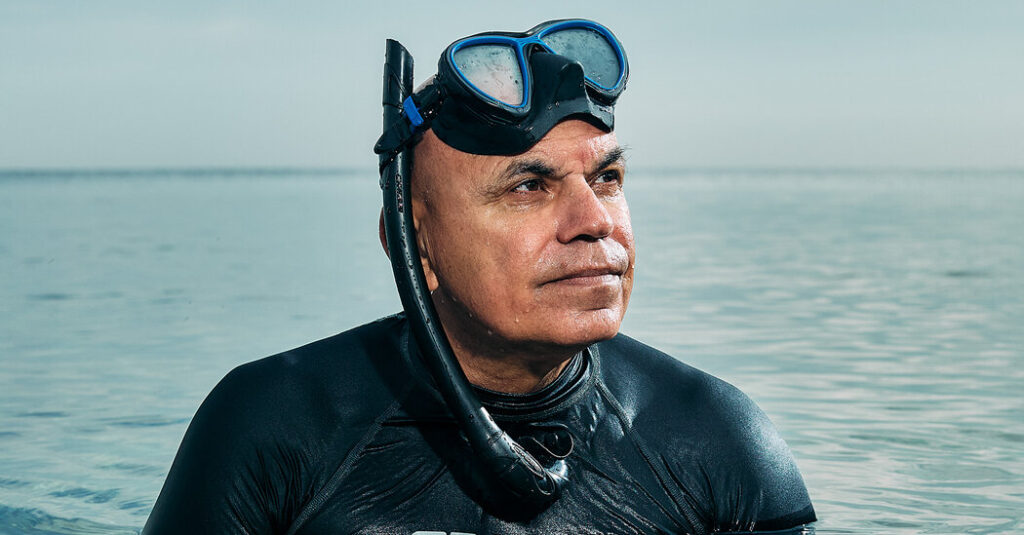
At 64, Ferreras is less physically imposing than he was during his heyday, in the 1990s and early 2000s. Reporters of the era described him as “hulking,” weighing 220 pounds with “a vault for a chest.” His jaw is softer today than it appears in highlight reels. He is no longer 6-foot-3, but he remains robust — bronzed and iconically baldheaded, with thick black eyebrows, broad shoulders and powerful calves.
He lives in a two-story white stucco house in a quiet oceanside neighborhood of Havana, which also contains the offices of his film company, Camm Productions, where he recently finished editing a 10-hour autobiographical documentary titled “Back to the Abyss.” Its story begins in the city of Matanzas, 65 miles east of Havana, where Ferreras was born in 1962. In his own telling, he was a sickly child, afflicted with asthma, poor vision and flat feet. At 3 years old, he has written, he could neither walk nor talk, but in the ocean he felt preternaturally comfortable, able to stay afloat and even hold his breath underwater. By his teenage years, he was diving from the Malecón, Havana’s famed sea wall, to hunt grouper and snapper with a rudimentary harpoon.
In 1987, as part of the opening for a state-owned resort, Ferreras persuaded the authorities to let him stage a freediving exhibition. According to one of his memoirs, he dove to 67 meters, a world record. The dive made international news — good publicity for the Castro regime — and Ferreras soon got permission to travel to Sicily, where in his first official no-limits dive he descended to 112 meters, another world record.
Ferreras has written that he carried press clippings in his pockets in Cuba, showing off his foreign headlines to friends and strangers. As his stature grew, he nurtured a rivalry with Umberto Pelizzari, a diver from outside Milan, that became catnip for sports reporters. “Pelizzari and I understood this only too well,” Ferreras wrote. “We wanted to milk it, too. After all, without the media, we were nothing.”
He signed sponsorship deals with the diving equipment giant Mares and with Sector watches. He dove deeper, breaking his own records. He became known, like Madonna, by a single nickname: Pipín (pip-EEN). Ferreras says he was earning tens of thousands of dollars a year — a fortune by Cuban standards. He bought himself a large house in an upscale neighborhood of Havana and a second one for his mother. He was legitimately famous in his home country. But his brash, flashy style soon created friction with government officials. In November 1993, during a trip to the Bahamas, he got on a flight to Miami and defected to the United States.
As he made more dives — in the United States, the Cayman Islands, Mexico and elsewhere — Ferreras secured enviable media coverage from outlets like Outside, National Geographic and ABC. A persona was coming into view. He liked to talk about his Santeria practice and outlined a theory of oceanic mysticism, proposing that humans had vestigial adaptations that might allow them to dive nearly as well as cetaceans. “My philosophy is that inside every single human being lives an aquatic entity,” Ferreras told me. “If you know how to connect with him, you can become a true freediver.” This bears a striking resemblance to the writing of Jacques Mayol, a French no-limits pioneer who explored similar ideas in his book “Homo Delphinus: The Dolphin Within Man,” published in the 1980s.
Ferreras was frequently photographed in meditative poses, and he claimed to do yoga for two hours a day. “You would see him standing on his head, ‘preparing for the dive,’” Pierce Hoover, an editor who collaborated with Ferreras on a Discovery Channel web series, said. “After he’d film the yoga and whatnot, he’d go to the bar.” But the image was effective, according to Nick Buckley, a dive photographer who spent years working with Ferreras. “Everywhere we went, everybody wanted to talk to him — everybody wanted to know his story,” Buckley said. “He knew how to entice reporters. When you listen to him, it just sucks you right in.”
No-limits dives are complex. Each one involves multiple boats, vast quantities of equipment and a team of a dozen or more people, all of whom must be housed and fed for the roughly two weeks required to set up a big dive. In the 1990s, costs could run north of $100,000. Ferreras learned to work every angle, lining up free or discounted accommodations and negotiating for photo fees. But according to people present at many of his dives, he was often loath to pay for safety divers and crew. The composition of his team tended to change from one dive to the next. “There would be some guy on the beach who was suddenly a support diver,” Kim McCoy, an oceanographer who often verified depth records for Ferreras and other top freedivers, told me. “People would show up and then disappear.”
Ferreras could be charming and generous, going out of his way to help those close to him, but many of his old friends also described him as given to sudden, operatic bouts of screaming and profanity. His volatility contributed to the turnover. Impatient with standards for safety and record certification enforced by freediving’s main governing body, AIDA, the International Association for the Development of Apnea (as in, holding your breath), Ferreras founded a competing group: the International Association of Freedivers (I.A.F.D.). He hired a friend, Carlos Serra, as president. But the I.A.F.D. had little independence; according to McCoy, its procedures amounted to whatever Ferreras said they were. “He’s not only supreme, he is as close to God as you can come,” Bill Stromberg, a Swedish freediver and former AIDA president who dove with Ferreras, explained. Members of his crew knew to tread cautiously. “He was the alpha male, always,” McCoy said. “He was pretty much a chaotic despot.”
Soon after arriving in the United States, Ferreras found an invaluable fan in Emilio Azcárraga Milmo, the scion of the media dynasty behind the Mexican TV giant Televisa. According to Ferreras, Azcárraga was fascinated with his story and gave him a contract for his first memoir, “90 Miles: A Magical Journey to Freedom.” Azcárraga promised to have it adapted as a Hollywood film and flew Ferreras to Los Angeles to meet with Alfonso Arau, the director of “Like Water for Chocolate.” After hearing some promising yarns from Ferreras, Arau expressed interest in directing the movie, and Ferreras further persuaded Azcárraga to underwrite a 13-part documentary series, with himself as co-producer. But first the mogul would arrange a no-limits world record attempt for him in Cabo San Lucas, Mexico, to take place in March 1996.
It’s at this juncture that Ferreras’s biography begins to intersect in important ways with the narrative unspooled in “No Limit.” At the time of Ferreras’s first meeting with Azcárraga, Audrey Mestre, like Roxana in the Netflix film, was a college student. Like Roxana, she was slim and athletic, with long brown hair and prominent cheekbones. Less generically, Mestre, like Roxana, was studying marine biology, with a focus on the effects of deep dives on the human lungs. According to reporting during his career, Ferreras was a true scientific marvel, with a lung capacity of 8.2 liters, more than 30 percent greater than average. His heart rate could slow, for brief intervals, to eight beats per minute. During descents as deep as a skyscraper is tall, he endured pressure that shrunk his lungs to the size of softballs. Mestre had selected Ferreras as the subject of her undergraduate thesis.
Like Roxana before she meets Pascal — the freediving legend with whom she will embark on a doomed affair — Mestre was a seasoned diver but didn’t yet have any no-limits experience. Growing up in a suburb of Paris, she spent summers with her grandfather in the South of France. At 14, after moving with her parents to Mexico City, Mestre contracted typhoid fever. Her recovery left her confined to a plastic brace and plunged her into a period of depression. The sea became a salvation, the only place Mestre felt free. “I need it, it gives me strength and courage,” she wrote in a journal entry, which was later published in a friend’s memoir. “It relaxes me and soothes my rage.”
Ferreras soon occupied an outsize place in Mestre’s mind. “Pipín became my second passion, my newest obsession, and obviously after a few months I bored everyone with my only talking subject: Pipín!” she wrote. A friend gave her a Ferreras poster, which she hung on her wall at school in Mexico. “There was not a night that I would not say good night to it before going to bed … with the hope that one day we would meet each other.”
When Mestre learned of Ferreras’s record attempt in Cabo San Lucas, she boarded a bus to make the 150-mile journey. Upon arriving, Mestre learned that Ferreras was teaching a class on site. She signed up and was invited to dinner with the dive team by a member of his entourage. At the restaurant, she and Ferreras, who was there with another woman, were instantly drawn together. They spent the night in her hotel, and Ferreras’s female companion departed, incensed.
Much of this — the dinner invitation, the irresistible attraction, the angry lover — happens in more or less the same way in “No Limit.” And as with Roxana and Pascal, Mestre and Ferreras became inseparable. Mestre joined his team as a safety diver. Like Roxana in the film, she dropped out of college to be with her new partner, flying back to Miami with Ferreras after his Cabo dive. In 1997, with a no-limits plunge to 80 meters, Mestre, too, became a competitive freediver. She went on to set several world records, and she and Ferreras bought a house on Treasure Island, Fla., between Miami Beach and the mainland, in Biscayne Bay. They married in 1999.
Ferreras and Mestre spent years traveling the world. They made a winning study in contrasts: French and Cuban, lithe and bulky, serene and hot-tempered. In the water, each had distinct, otherworldly qualities. Mestre, gentle and introspective, possessed a graceful, flowing style. She reminded her friends of a mermaid. Mestre loved animals; sea creatures, particularly dolphins, appeared drawn to her. “They seemed to be more calm when they were around her,” Buckley, the photographer, said. “Behind the lens, I always got the most out of the animals with her.”
Ferreras was more bullish — musclebound and severe. But his daring and raw ability were astonishing. It was nothing for him to hitch a ride with a whale shark or a manta ray. Sometimes the cameramen would lose him. Then, suddenly, he would appear, freediving in 80 or 90 feet of water, parting a school of hammerheads. Buckley felt especially awed as Ferreras took his last deep breaths before submerging for a no-limits dive. “I’d be in front of him filming and I almost had to hold my own breath,” Buckley said. “It was as if there would be no air left. Like he was sucking in the whole world.”
Mestre’s final dive took place in the Dominican Republic, rather than in France where Roxana meets her end. But according to Ferreras’s most recent memoir, it was set in motion in almost precisely the same way. In August 2002, Tanya Streeter, a Cayman-born diver in her 20s, set a new overall no-limits world record with a 160-meter dive near Turks and Caicos. Like the woman who breaks Pascal’s record in the Netflix film, Streeter was blond and beautiful — an instant star. And like Pascal, Ferreras was at a low point, experiencing frequent blackouts. Hearing of Streeter’s record, he was vexed, determined to somehow reclaim the title. But he had recently had a CT scan that showed brain damage from oxygen deprivation and rapid pressure changes, and he consented to take a break. “I decided to funnel my energies into Audrey’s career,” he wrote. “I began to live, and dive, through my amazing wife.”
Mestre had little interest in records. Freediving, for her, was a means of intimacy with the sea, and with her husband. “I thought if I could enter his underwater world I could be closer to him,” she once wrote. Ferreras has acknowledged pushing her to dethrone Streeter, writing, “It was blind ambition on my part, and blind devotion on hers.” On Oct. 12, 2002, Mestre descended to a depth of 171 meters. Like Roxana, she found that the air tank meant to fuel her ascent was almost empty. Mestre passed out as she struggled to reach the surface and never regained consciousness.
Ferreras’s attorney, Rufus-Isaacs, has a busy media law practice in Beverly Hills, where he has developed something of a specialty in libel-in-fiction cases. Ferreras’s was his third defamation suit against Netflix in the last few years. In his first, Rufus-Isaacs won a settlement for the chess grandmaster Nona Gaprindashvili over her depiction in “The Queen’s Gambit.” He also represented a former friend of the fraudster known as Anna Delvey in a suit over her portrayal in “Inventing Anna.” The company has faced similar litigation related to “Baby Reindeer” and “When They See Us,” the series about the Central Park Five. The Ferreras case, Rufus-Isaacs told me, was easily the most egregious instance of libel in fiction in recent memory. “Can there be any defamation more foul than an imputation of murder?” he wrote in a filing. “Surely few. Can there be murder more foul, strange and unnatural than the murder of one’s own spouse? Surely few.”
Netflix has argued that “No Limit” is both purely fictional — dreamed up by its screenwriter and director, Rosenthal, a co-defendant in the case — and broadly generic, composed of stock characters and plot points. Their position is somewhat awkward. In filings, Netflix is at pains to highlight the film’s artistry while quietly emphasizing its status as a paint-by-numbers tale of toxic romance. It’s also hard to square with the “inspired by real events” title card and dedication to Mestre. Indeed, the most intimate details of the “No Limit” protagonists’ biographies appear to have been lifted from life. Like Ferreras, Pascal was born to parents who didn’t get along and both were raised by relatives. Like Mestre, Roxana attempted suicide as an adolescent, slashing her wrists. Roxana inherited her love of the ocean from her grandfather. Mestre did, too.
In November 2023, Netflix and Rosenthal filed a motion to strike Ferreras’s complaint under California’s Anti-SLAPP law, which provides for early dismissal of meritless lawsuits that threaten protected speech. Because Ferreras is a public figure, in addition to weighing whether the film contained a false, defamatory statement about him, the court would have to decide if he could show that the defendants published with knowledge of the film’s falsity or with reckless disregard for the truth — the “actual malice” standard established in the 1964 Supreme Court case The New York Times Co. v. Sullivan.
The judge, Bruce Iwasaki, initially appeared inclined to side with Ferreras. “While the film does not identify plaintiff by name, the major elements in the film parallel major elements in plaintiff’s life and his relationship with Audrey Mestre,” Iwasaki wrote in a preliminary ruling. “Further, the film ends with the memoriam to Mestre, indirectly tying the film to plaintiff’s life.” He went on to suggest that the lawsuit didn’t appear meritless at all and indicated that Ferreras raised issues suitable for hearing by a jury.
But Iwasaki hadn’t yet seen “No Limit.” After watching it, the judge signaled his intention to perform an about-face. What brought him up short was the conflict between Ferreras’s narrative of his relationship with Mestre, as presented in court filings, and the one depicted in the movie. The film shows Roxana and Pascal “in a tempestuous relationship,” Iwasaki wrote, “while, according to the complaint, Ferreras and Audrey Mestre were a happy married couple ‘very much in love.’ And the potential motive for murder in the film — Gautier’s narcissistic and controlling personality inflamed by professional and romantic jealousy — are nothing like how plaintiff characterizes his marriage.”
In April 2024, Iwasaki threw out the suit. Pascal and Ferreras were too dissimilar for a reasonable viewer to confuse the two. And if the film didn’t identify Ferreras, then a defamation claim was meaningless. Rufus-Isaacs was flabbergasted by the decision and quickly filed an appeal. How could a few cosmetic changes, he later asked, erase the deeper similarities between the two stories? It wasn’t hard to see his point. Many reasonable viewers had understood that Pascal was Ferreras. No one I spoke with who knew Ferreras and Mestre and was familiar with “No Limit” had any doubt that it portrayed their relationship. “They’re saying they made it up?” McCoy scoffed. “The probability is close to zero.” (In a statement, Netflix stressed that “No Limit” had been licensed, not produced, by the company, and that the film is “a fictional drama made up of fictional characters, back stories and events.”)
As I reviewed the filings in Ferreras’s lawsuit, I began to think he’d made a mistake. The version of his story he chose to tell in court was highly favorable, recognizable from his many media appearances. But that didn’t make it wholly true. At some point, the lines between myth and reality blurred, and Iwasaki had apparently been unable to ignore the divergence between the way Ferreras and his life with Mestre were described in his legal briefs and the relationship depicted onscreen. If, as Rufus-Isaacs insisted, “No Limit” was a docudrama masquerading as pure fiction, then Ferreras may have been guilty of a similar sleight of hand: presenting a fictionalized past as the truth.
There has never been a thorough, independent investigation into Mestre’s death. The first public accounting was an autopsy released by the Dominican Republic’s public health department, which labeled it an accidental drowning. The police conducted only a brief inquiry, and after posting a short statement to the I.A.F.D. website, Ferreras appeared content to leave it at that. Ferreras, the consummate narrator, grew quiet. His silence was made stranger by what little he had said. Ferreras wrote in part: “Audrey’s parents and I have decided not to disclose any information whatsoever about Audrey’s accident and its causes.” (Mestre’s parents say they never suspected Ferreras of wrongdoing, and they remain close with him.)
But as a reporter from The Miami Herald wrote at the time, the autopsy “satisfies no one” in the freediving world. Message boards were awash in dark speculation. Finally, in February 2003, the I.A.F.D. released a report detailing the conclusions of its own investigation. To no one’s surprise, it too indicated Mestre’s death was an accident, something no one could have foreseen.
The I.A.F.D. report was substantially based on yet another set of findings, prepared by McCoy, who was present at the dive. McCoy’s analysis was highly technical, citing an array of mechanical and environmental factors: current and drift, velocity and cable tension. No element in his report received more weight than any other, and he too avoided assigning blame. Most significant, he gave no special emphasis to the fact that Mestre’s air tank appeared to have been nearly empty.
“I did that intentionally,” McCoy told me. Given that Ferreras was in charge of virtually every aspect of the dive, including the air tank, McCoy worried that Ferreras could be made legally liable for Mestre’s death. “I didn’t want Pipín to end up in jail,” he said. McCoy stopped short of exonerating Ferreras; but the I.A.F.D. report seized on McCoy’s caution to essentially absolve everyone involved. “There was no single cause for the tragedy that befell Audrey Mestre,” it read. “It is possible that the compressed-air bottle used for lift-bag inflation was not fully filled, but this factor alone would not have been responsible for all the difficulties encountered.”
McCoy’s report was stuffed with information, but it offered little clarity about what many observers considered the most important question at hand. “His analysis of the data was all very impressive,” Paul Kotik, a dive journalist who was also present in the Dominican Republic, said in an interview years later. “But even then it made one just want to grab one’s head and say, ‘Yes, of course, but did he kill her?’” Stromberg, the former AIDA president, who was at the dive as a spectator, told me: “The bottle was empty.” He speculated that if the dive had happened in the United States, Ferreras could have faced criminal charges.
For the first time, Ferreras found his narrative slipping from his control. But a Sports Illustrated cover story, published that June, provided a catalyst for dramatic reversal. The article, “The Rapture of the Deep,” was written by Gary Smith. Widely considered one of the best sportswriters of all time, Smith had recently won his third National Magazine Award. A patient, tender interviewer, he spent time in Miami with Ferreras, eliciting the kind of intimate detail for which his work is known.
Taken with certain fairy-tale aspects of their story, Smith cast Ferreras and Mestre in a magical realist epic: the Cuban boy who swam before he walked who fell for the French girl who overcame illness by swimming with her spearfishing grandfather; how their love blossomed in the deep, and how the ocean called her home.
Smith dispensed with safety-related criticisms of Ferreras in one passage near the conclusion of the profile, like a disclaimer at the end of a pharmaceutical ad. At almost every turn, his subject got the benefit of the doubt: “Why, Pipín kept wondering, couldn’t they all just say what Audrey’s mother, Anne-Marie, did: that no one was to blame, that the sea wanted her forever?” (Smith declined to be interviewed for this article, citing concerns about becoming entangled in the Netflix lawsuit.)
The S.I. article crossed the desk of James Cameron, who was soon sitting in a South Beach cafe with Ferreras, discussing his interest in adapting his story into a film. Ferreras remembers that Cameron told him he wanted to make something resembling “Titanic,” set in the world of extreme freediving. The two men entered into an agreement that eventually involved an expansive I.P. package, including the rights to Ferreras’s third memoir, which he had yet to write, and for which he got a deal at an imprint of HarperCollins.
To assist him, the publisher hired a ghostwriter, Linda Robertson, an experienced Miami Herald sports reporter. Robertson liked Ferreras right off. In his obvious grief, she found him sympathetic. As she learned more about him, she came to think of him as a quintessential Miami type: the charismatic hustler who makes himself up from scratch. “This was the perfect place for Pipín,” Robertson said. “He could talk out of both sides of his mouth and achieve a level of notoriety. Business is conducted differently here. He found a level of acceptance and freedom — and people who didn’t question him too closely.”
Some of what Ferreras told Robertson about his early life seemed fantastical. But Ferreras’s penchant for embroidery bothered Robertson less than his evasiveness about the day of Mestre’s death and the idealized portrait of their marriage he insisted on. “It had become somewhat scripted to make this fairy tale,” Robertson said. “And you get used to telling the fairy tale — that just becomes how you speak.” The book was her first ghostwriting project, and she approached it like a journalistic assignment, interviewing dozens of sources. People who knew the couple told Robertson that their relationship was complicated, even troubled.
I found much the same in my own reporting. Castineyra, the freediving trainer, recalled witnessing loud arguments at the house on Treasure Island. “It didn’t go both ways,” he said. “It was only him doing the screaming.” In a self-published memoir of his relationship with Ferreras and Mestre, Serra, who eventually fell out with Ferreras, describes him as serially unfaithful and controlling, monitoring Mestre’s meals and sometimes forbidding her from leaving her hotel room. Stromberg stayed in a room adjacent to Ferreras and Mestre on the eve of her final dive. “There was a big fight,” he said. “There was very much bad language and heart-crushing words from Pipín. You could see in the face of Audrey in the morning before the dive that she was already very unhappy.” (Ferreras denies that he and Mestre fought the night before the dive, and rejects these characterizations of his marriage.)
Robertson understood that such episodes would most likely have no place in Ferreras’s book. She hoped, however, to arrive at something more grounded than his tale of star-crossed lovers. “Nobody’s life is like that,” Robertson said. “I kept saying: ‘You want this book to be real, don’t you?’” She found herself at odds with Ferreras’s publisher, Judith Regan. According to Robertson, Regan intended to be a producer on the Cameron movie and wanted a manuscript that could be easily converted into a screenplay of a certain kind. (Regan did not respond to interview requests.) Robertson left her name on the memoir, but the work was substantially altered by another ghostwriter, Pablo Fenjves, who would later work with Regan on the O.J. Simpson book “If I Did It.”
Smith’s Sports Illustrated story had an unpredictable life of its own. In addition to “The Dive” and the Cameron project, it led to another film, an entry in ESPN’s “Nine for IX” documentary series celebrating women in sports. Ferreras refused to participate. The film, which aired in 2013, was directed by Alison Ellwood, who zeroed in on a major failing — really, a series of failings — that went unidentified in the I.A.F.D. report.
During her record dive off Turks and Caicos, Tanya Streeter was supported by 16 divers operating at different depths. Each was in sight of at least one of the others and equipped with a backup air tank and lift bag, which could be attached to Streeter and inflated in the event of an emergency. In the Dominican Republic, Mestre had just three scuba divers, plus a few freedivers at the surface who could provide support in shallower water. None of Mestre’s safety divers carried a backup balloon.
These and other issues — a primitive dive boat, the absence of a physician, Ferreras’s decision to proceed despite bad weather — McCoy told me, largely came down to money, and to Ferreras’s fear of losing the spotlight. The dive was planned hastily, without a major backer. Atypically, McCoy said, “Pipín was funding it himself.” (Ferreras denies that the dive was self-funded.) Ferreras has written that he felt conflicted about the fact that Mestre was poised to surpass him. But he had little to fall back on. “Your world is falling apart because you haven’t done a world record for a while,” McCoy explained. “So you call the press: It’s showtime.”
McCoy was one of about a dozen sources featured in Ellwood’s film. The result is a sober piece of journalism, skeptical rather than damning. But it contains unflattering suggestions, noting, for instance, the fact that Mestre had a bruise beneath her eye on the morning of her dive, and airing a rumor that she intended to divorce Ferreras. (Two experienced divers in Ferreras’s orbit said that the film’s mention of Mestre’s bruise was misleading; such marks are common on divers, often the result of tightfitting goggles or burst blood vessels caused by rapid pressure changes.) Perhaps most damaging, the documentary gives weight to a theory advanced in Serra’s book — “The Last Attempt” (2006) — that Ferreras deliberately left Mestre’s tank unfilled so that he could augment his mythology by coming heroically to her rescue.
Serra lays out his thesis in his book’s closing chapter. At its heart is a failed effort by Ferreras to save Mestre using scuba gear — a dangerous “bounce dive” he made to 90 meters and back with no decompression time. According to Serra, Ferreras executed similar dives in the days leading up to the event for no apparent reason. (Ferreras says this was not uncommon.) In retrospect, Serra says, they looked like practice. As further evidence, he cites Ferreras’s allegedly hostile treatment of anyone who came near Mestre’s air tank during dive prep. “There were people going to test the bottle, but they were denied,” Stromberg, who arrived at the same theory as Serra independently, told me. “It was not only, ‘No.’ It was almost like, If you make a move, I’ll kill you.” (Ferreras denies this; he says he believed someone else had filled Mestre’s bottle that day.)
The Serra narrative has obvious appeal, a puzzle-box quality reminiscent of whodunit mysteries. In the face of a baffling tragedy, it provides a coherent, meaning-making assembly of otherwise ambiguous and troubling facts. For its author, it may offer a palliative against guilt. In the last sentence of his book, Serra, who says he was consumed for years by the riddle of Mestre’s death, describes his sense of relief at having arrived at a solution. “I’ve made a promise,” he writes, “to find out what happened to Audrey no matter what, and now it’s fulfilled.” (Serra did not respond to multiple requests for comment.)
Serra’s theory, while hard to disprove, may be too psychologically and mechanically complex to be plausible. A simpler, more persuasive explanation is that, by Ferreras’s standards, the chaos of Mestre’s dive wasn’t unusual. Since Mestre met Ferreras, two of his safety divers had drowned during no-limits events, and Ferreras preferred to use as few of them as possible. The checklists and job assignments that were de rigueur on AIDA dives had no place on his boat. “There were no procedures that were in place,” McCoy said.
Even Mestre’s nearly empty bottle wasn’t unique. Wendell Ko, a spearfisherman who dove with Ferreras, had a similar experience at a shallower depth. “When I got down there, like Audrey, I turned on the valve to the air tank and I heard a shhhh,” Ko said. “Just a little bit of air came out.” Mandy-Rae Krack, a decorated freediver and friend of Mestre’s who trained with Ferreras, said: “You always knew somebody was going to get hurt, but nobody wanted to think it was going to be her. There were no backups. It was just a matter of time — you’re playing Russian roulette.” (As of 2015, because of the extreme danger of the sport, AIDA no longer sanctions no-limits dives.)
Ferreras told me that he wanted to sue ESPN but was dissuaded by an executive from Cameron’s company, Lightstorm Entertainment. According to Ferreras, a major studio had paid $1 million for the rights to “The Dive,” plus $100,000 a year to maintain them, and he was eager to see Cameron’s hagiographic vision of his story realized. But Cameron became absorbed in “Avatar,” and his Ferreras adaptation never came to fruition. Ellwood’s documentary took on an air of authority. “We didn’t [go] after ESPN, and I think that was the reason why Netflix was encouraged to do this movie now,” Ferreras said.
In a filing in the Netflix case, Rosenthal, the screenwriter and director of “No Limit,” acknowledges watching the ESPN film and “reading other articles and books” about Ferreras and Mestre. But he also provides a long list of other inspirations, including a number of other professional athlete couples: Andre Agassi and Steffi Graf, Kristi Yamaguchi and Bret Hedican, Mirka Vavrinec and Roger Federer. Given their apparent irrelevance to the film, their inclusion has the effect of protesting too much. Rufus-Isaacs argues in a filing that even Sofiane Zermani, the actor who portrays Pascal, “thought that he was playing Ferreras,” pointing to the fact that Zermani reached out to Ferreras on social media and asked to go diving with him.
The Gary Smith article plays a significant role in Ferreras’s case. Rufus-Isaacs offered it as an “authoritative account of the relationship between Ferreras and Audrey and of her death.” This makes a degree of strategic sense. The story is deeply sympathetic to Ferreras, presenting him as a man destroyed by fate. But it’s also very strange. Smith cites few sources other than Ferreras. The result reads like fiction, not only in the complimentary sense but also because it’s missing so much vital information. In court, the article created a bizarre case of competing narratives, setting Smith’s ostensibly factual but highly fanciful account against a purportedly fictional film that is largely true to life.
This paradox would doom Ferreras’s appeal. In late August 2025, just a week after oral arguments in the case, a three-judge panel affirmed Judge Iwasaki’s decision. As presented in his lawsuit, “Ferreras’s relationship with Mestre did not resemble the relationship between the characters of Pascal and Roxana in the film,” the opinion read. Their differences, “combined with generic similarities shared by other freedivers and athletes, indicate no reasonable person would conclude Pascal was actually Ferreras, acting as described.” In December, following a petition for review, the California Supreme Court declined to hear the case.
Rufus-Isaacs did not want to discuss why he and Ferreras chose Smith’s article as their “authoritative” narrative, or whether there might have been a better choice — perhaps one illustrating how the infidelity, egotism and jealousy ascribed to Pascal in “No Limit” may have sprung not from Rosenthal’s imagination but from life. Of course, to acknowledge that Ferreras shared any of these qualities could have sharpened questions about his handling of Mestre’s final dive. Even if he possessed the psychological and emotional wherewithal, by the time of his first appeal, Ferreras may have been otherwise constrained from a more honest accounting. Legally speaking, he was locked into a story. The version of his biography he’d been repeating for decades, and which had been so profitable, was the one Ferreras had to tell.
In the courtroom, it gave Netflix the upper hand. But it’s also what Ferreras appears to understand as reality. In “The Dive,” he insists, against claims made by others there on that day, that “responsibility for filling the tank didn’t fall on the shoulders of any single member of the team.” He admits fault for Mestre’s death only insofar as he introduced her to no-limits freediving, he pushed her to compete and that, technically, he oversaw the dive. Fenjves, the ghostwriter, said, “What’s in the book is the best I could get out of him.”
A condensed, feature-length version of Ferreras’s documentary series “Back to the Abyss” is available online. The story it tells is even less conciliatory than the one offered in “The Dive,” heaping blame for Mestre’s drowning on other members of Ferreras’s crew. Despite the outcome of his lawsuit, Ferreras told me, he is sure his truth will out. “Sooner or later, people will know my story, our love story and how dedicated we were,” he said. “Sooner or later, everything will come out — the real story.”
During one of our interviews, Ferreras and I watched footage from Mestre’s last dive. Ferreras had been swimming earlier in the day and would return to the ocean that afternoon. He was preparing for what was to be his final no-limits attempt, planned for some time in 2026 in Cabo San Lucas, where his story with Mestre began. “I did what I intended to do many years ago,” he said later. “It was a dream. After this, I have nothing left to prove.”
Of course, that wasn’t quite true. But the proof, or insight, Ferreras needed most seemed destined to elude him. Like a kind of cursed, monomaniacal Scheherazade, he would tell and tell again the same story forever. If only he could get the details exactly right, surely everyone would see that he had done nothing wrong, that he was blameless. Ferreras paused the video about two minutes into the dive, just after Mestre makes her terrible discovery. He pointed to the screen. Two helpless people in wet suits. A moment of panic. Bubbles rising through dark water. He wanted me to understand that his wife’s deepest safety diver had been slightly out of position.
Chris Pomorski is a writer in Asheville, N.C. He last wrote for the magazine about a baby-formula crime ring.
The post He Thinks Netflix Accused Him of Murder. The Courts Disagree. appeared first on New York Times.