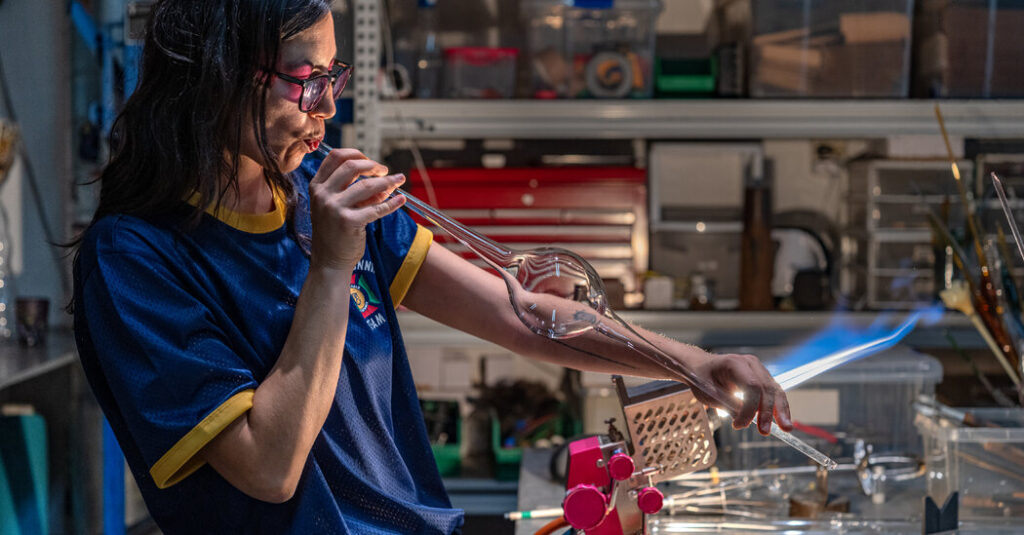
At Barcelona Glass Studio one afternoon last month, Agustina Ros twirled the midsection of a clear glass tube in a flame until it turned a kind of neon salmon color and began to sag.
As she pulled the tube’s ends in opposite directions, the molten part stretched and stretched. When the flame cut it in two, Ms. Ros set one end down on the table and began to bend the other with large tweezers. “Look, I could make this into a ring,” she said.
It is that kind of sensibility that has changed the jewelry scene in Barcelona. Ms. Ros’s work has turned her into the “glass queen” and “mentora,” said Tirsa Vázquez de Parga, the owner and buyer of Muy Frágile, a local boutique that sells several brands of glass jewelry.
Now “girls making glass jewelry is a thing in Barcelona. It’s like a fever — suddenly we are Murano,” she said, referring to the famous glassmakers’ island in the Venice lagoon.
Ms. Ros said she thought it was 2013 when she arrived in Barcelona from Posadas, Argentina, an artist who had become bored with clay and paint and was searching for what she described as “my own material.” So she approached Ferrán Collado, a fourth-generation Spanish glassblower, to teach her that craft.
He told her that establishing a hot shop — the industry term for glassmaking sites equipped with furnaces — was expensive, but then described another option: using a small torch attached to a workbench to melt borosilicate glass. The practice is called lampworking (because oil lamps were used as the heat source in the past), flameworking or torchworking.
“I just loved it,” she said. The glass is “something you can keep investigating.”
Friedrich Otto Schott, a German chemist, invented borosilicate glass in 1887 as a clearer, tougher alternative to the soda-lime glass commonly used for windows and bottles and the lead glass used for crystal stemware and decorative panels. Boro, as glassworkers call it, is best known as the kind of material used for laboratory beakers or bongs in head shops, Ms. Ros said. “But it’s an amazing glass,” she added. “It asks for experimentation.”
In 2016 Ms. Ros and Mr. Collado opened Barcelona Glass Studio in a building that now houses her studio, workrooms used for classes and some co-working space. (Mr. Collado left the business in 2021.)
Boro is sold in the shape of rods and tubes, ready to be worked with a propane- and oxygen-fueled torch often firing at about 1,500 degrees Celsius (2,730 Fahrenheit). The heated tubes can be blown, and Ms. Ros — who was interested in art jewelry and its unusual materials — began blowing tubes into bulbous glass rings and then coating their interiors with silver nitrate to achieve a mirror effect.
In 2018, she received a scholarship to study with the master flameworkers Suellen Fowler and Simone Crestani and the glass artist Pavlina Cambalova at the Studio, the renown glassmaking and education center at the Corning Glass Museum, in Corning, N.Y. “I didn’t sleep,” she recalled. “I wanted to use every minute.”
Much of Ms. Ros’ glass jewelry — unisex rings as well as necklaces and earrings — is clear, silvery (from nitrate coatings) or ruby red (the color of the boro she purchases). Her recent designs, sold by such shops as APOC, an art and fashion boutique in London, and the boutique at UrbanGlass, a nonprofit studio in Brooklyn, features protrusions that she likened to “thorns.”
Her wine-colored Ando ring, for example, is shaped like a sea urchin (about $280), and her Bloody stud earrings resemble spikes made of strawberry jelly (about $110).
Such wearable glass creations are now seen all over Barcelona, as Ms. Ros’s students have established their own brands. “These last five years, when you walk around the city center, it’s everywhere,” said Pia Gordo, 33.
In 2022, Ms. Gordo moved from Buenos Aires to Barcelona, where she learned to work with boro at the studio. That same year she founded Pia Glassworks, her brand of glass jewelry, tableware and decorative objects.
Ms. Gordo said her designs draw on forests and waterfalls such as the ones within Iguaçú National Park in Argentina. Her Ka’aguy necklaces, for example — named after the word for forest used by the Indigenous Guaraní peoples of South America — feature large pendant flowers in mirrored and multicolor boro on chunky silver-plated chains (about $310).
“I’m romantic. I work a lot with weddings,” she said, adding that brides often commission barrettes and glass flowers for their bouquets or pieces for members of the wedding party. Last year, Ms. Gordo said, she produced custom glass brooches for Cinq, a bridal brand based in Los Angeles.
Magdalena Hart, a British-Uruguayan artist with a background in interactive installation design, said it is not hard to be obsessed with something that “looks like water, comes from fire.” She founded her own brand, Rain and Rivers, after taking classes at the studio. (She had her astrological chart done beforehand: “There was no fire, so when I told my therapist about it, she suggested that I ‘ask for fire,’” Ms. Hart recalled.)
Her characteristically experimental pieces include a boro ring that can carry (and comes with) a small birthday cake-size candle (about $115); a ring that, depending on its size, can be worn as either a ring or as a talon-like nail extension (about $135); and a clear, pink or gray ring formed around a stainless steel barbell (about $100).
At her Barcelona studio, Ms. Hart, 31, picked up a transparent ring with some deep brown coloring. “You can fume glass with metals to color it,” she explained. “Gold goes more pinkish, silver goes more yellowish — depending on the distance from the flame — and this brown, well, it’s my hair.”
Boro may be shaped with tweezers, but the “real tool,” Ms. Hart went on — demonstrating how molten glass moves — is gravity. Borosilicate glass can be reheated even after it has cooled, and it can be repaired when it breaks, “but you’re always very aware of where she is at and don’t want to stress her. I think glass generally teaches you about care. You have a different gesture around something that is fragile,” she said, referring to the glass as a female element.
The final thermal step in creating most kinds of boro pieces is placing it in a kiln for annealing, a controlled cooling process that relieves internal stress and prevents against cracking from thermal shock.
The kiln acts “like a cocoon,” said Justine Ménard, 32. The Parisian stylist turned glass artist learned to work with boro at the studio and, in 2023, introduced her namesake brand, which ranges from jewelry to tableware and recently added large decorative pieces such as sconces.
Ms. Ménard crafts chunky earrings, brooches, barrettes, necklaces, rings and some cuffs from clear and milky borosilicate, which she describes as “basically Pyrex” and — as in the case of her watery Les Néréides earrings ($205) — “pretty lightweight.”
At her own studio in Barcelona, Ms. Ménard keeps rods of boro in Champagne buckets on her bench. She pointed to a test that she said she thought resembled “shining snow.” She had added bicarbonate to molten borosilicate: “It’s not supposed to work because glass doesn’t like anything else. It doesn’t want to mix. But I want to push to find its real limits,” she said.
“Through ceramics, through glass, we know so much about humanity. Glass really is a forever material,” said Mara del Hoyo, repeating a lesson she said she learned from her mother, a retired archaeologist.
Ms. del Hoyo, 40, a former actress who was born in Barcelona, initially founded a ceramic jewelry brand there called Levens in 2017. But after one private class in 2020 with Ms. Ros, who she had heard about through friends, “I was like, ‘OK, now I do glass!’” she said. “Glass is fun.”
Her pieces — including earrings, rings, necklaces, hair ties, bracelets and belt buckles — are mostly wrought in candylike colors of borosilicate glass and in such shapes as flowers, bows, hearts, suns, teddy bears, baby pacifiers and gemstones. The XL Heart earrings, for example, feature butter-color hearts dangling from butterscotch- and amber-color sunflowers (about $200). She also designed earrings and necklaces inspired by flamenco dancers as well as characters in early Pedro Almodóvar movies for Carolina Herrera’s spring 2026 runway show.
After one of Ms. del Hoyo’s best friends asked for a set of glass wedding rings, she said she began to think: “Maybe all the wedding rings in the world should be made of glass?”
“Love is like glass. You cannot treat it badly, harshly. You can break it. But you can sometimes put it together again.”
The post Barcelona’s Love Affair With Borosilicate Glass Jewelry appeared first on New York Times.