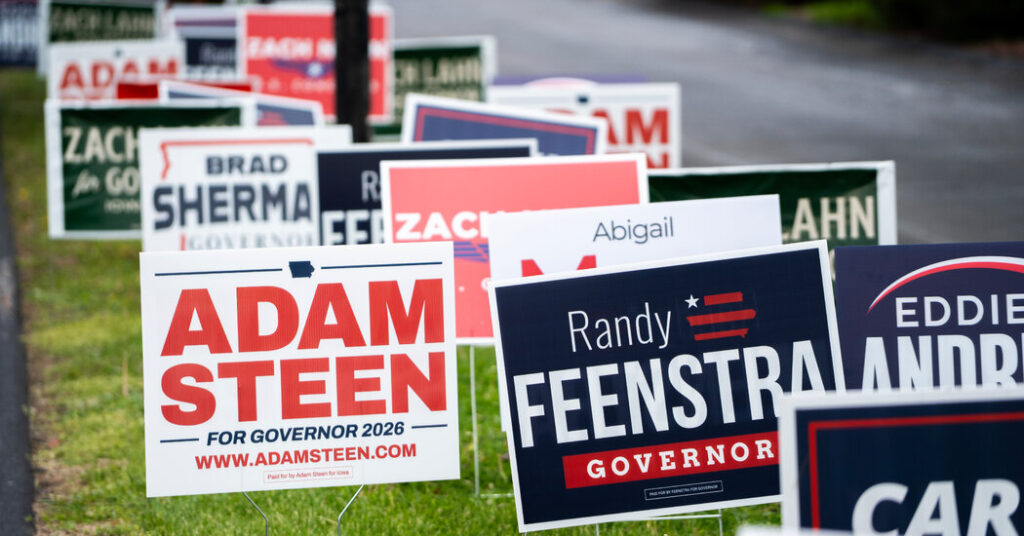
The five Republican candidates vying for their party’s nomination to be Iowa’s next governor mirror one another on policy issues: Abortions must be outlawed, as most are in Iowa; school choice, already state law, should be expanded; and religious freedoms must be protected, as they already are.
But as they sprint toward the June 2 primary under such familiar Republican themes, the three top candidates — Representative Randy Feenstra; Zach Lahn, a farmer and businessman; and Adam Steen, a former aide to the governor he hopes to succeed, Kim Reynolds — can seem oddly removed from the political environment around them.
Instead, with early voting set to start Wednesday, they are focused on one another, in a bare-knuckle, personality-focused primary fight that appears removed from the underlying issues that have made 2026 such a tough year for Republicans. And Democrats, outnumbered in voter registration and out of power for years, are the ones showing confidence in their presumptive nominee for governor, the state auditor Rob Sand.
“The Democrats see the environment; I think they see Republicans are divided,” said Bob Vander Plaats, an influential Christian conservative in Iowa whose endorsement has been long sought-after by G.O.P. candidates. They see there is a fracture in the party,” he continued, “and they believe that Rob Sand, who comes off a churchgoing, gun-toting taxpayer watchdog, they believe he’s the kind of candidate that can win back the governorship.”
The signs of headwinds are all around Republicans. Ms. Reynolds, Iowa’s socially conservative governor, is preparing to leave office after nine years with the lowest approval rating of any governor in the country.
Iowa, a state that three times voted for Donald J. Trump after twice voting for Barack Obama, is groaning amid rising fuel and fertilizer prices, steel and aluminum tariffs that have hurt manufacturers, and countertariffs from trading partners that have walloped agriculture exports.
And policies that might have been popular in theory, such as taxpayer-funded vouchers for private schools, are proving to be less palatable now that they are the law. Public schools have been drained of resources to finance vouchers, especially in rural areas where private schools might not exist.
“Kim Reynolds really attacked public education,” said Mark Nelson, a farmer and Republican county supervisor in Woodbury County. “You can’t attack and undermine one of your biggest areas of the work force and not have it be detrimental to that next election.”
As of May 1, Republicans had nearly 200,000 more registered voters in Iowa compared with Democrats. Yet political prognosticators are calling the Iowa governor’s race a tossup — and some polls give the Democratic candidate a slight edge.
Mr. Sand has presented himself as a moderate, highlighting his Christian faith, his work to target corruption as a prosecutor and his efforts to root out fraud in state government.
Beyond Mr. Sand, part of the problem may rest with the bitterness around the Republican primary. The perceived front-runner, Mr. Feenstra, has deep pockets from his time in Washington and stronger name recognition than his Republican competitors. Going into this year, he had $3.2 million on hand, campaign finance reports show, more than his Republican competitors but far less than the $13.2 million in Mr. Sand’s coffers.
His back story is a source of friction. In 2019, Steve King, a longtime congressman from Western Iowa, whipped up a firestorm after he asked in an interview with The New York Times, “White nationalist, white supremacist, Western civilization — how did that language become offensive?” Mr. Feenstra, a state senator, took advantage of the controversy to challenge, then beat Mr. King in a Republican primary the next year.
Now Mr. King, still influential, is backing Mr. Lahn, who has been attacking Mr. Feenstra as the Republican establishment candidate.
“What’s happening here,” Mr. Lahn said in a video he posted on social media, “is the establishment candidate with the most money is thinking they can bulldoze their way through the primary.”
Meantime, Mr. Vander Plaats is backing Mr. Steen and telling anybody and everybody Mr. Feenstra can’t win the general election because he cannot motivate the Republican base. Another influential Christian conservative, the radio personality Steve Deace, has also been attacking Mr. Feenstra and promoting whichever candidate can keep him beneath 35 percent of the vote.
That is because, if no candidate meets that threshold, a convention of delegates will pick the Republican nominee.
“This is rather unique for us to have an intense primary,” said Jeff Kaufmann, chairman of the Iowa Republican Party. “Sometimes fights in the family are just as intense as the more predictable fights between the Republicans and Democrats.”
Mr. Feenstra’s challenge might be changing the minds of Republican primary voters who say he has hardly been present in his district since being elected to Congress in 2020.
Sherri Webb, 76, a Republican farmer who lives in northwest Iowa, said if the congressman won the nomination, she would vote for Mr. Sand.
“Most of us are sick and tired of him not showing up and not giving us answers,” she said.
Mr. Feenstra’s campaign did not answer a list of questions, including about why he did not participate in a debate aired on PBS last month.
But Mr. Steen, who worked in the Reynolds administration for about five years, faces his own hurdle, on what until recently seemed to be his best selling point: his association with the governor.
Ms. Reynolds, who was first elected in 2018, disappointed voters last year when she vetoed a bill that would have blocked a carbon pipeline from taking over private property through eminent domain, a surprisingly contentious topic in Iowa. Both landowners and conservationists worry the pipeline could disrupt farming practices and harm the environment. Mr. Steen has said publicly that he would support property rights.
Ms. Reynolds was also criticized after she rejected millions of dollars in federal food assistance for children of low-income families. In a statement at the time, Ms. Reynolds said the program, which gave participating states money to purchase food for children during the summer months, did not “have a strong nutrition focus” and would not address childhood obesity.
Perhaps her most debated move was the introduction of education savings accounts that provide about $8,000 in public funds for private school tuition per student. Since the program began in 2023, Iowa’s public schools have lost more than 13,000 students, about 3 percent, and several have closed.
All the Republican candidates have said that they would expand the program.
Ms. Reynolds, the first woman to lead Iowa, also alienated a lot of Republican voters when she supported Gov. Ron DeSantis of Florida, not President Trump, in the 2024 presidential election. Mr. Trump, who won Iowa by 13 percentage points, called her decision “the end of her political career.”
Sheelagh McNeill contributed research.
Pooja Salhotra covers breaking news across the United States.
The post G.O.P. Fatigue in Iowa Strains the Republican Primary for Governor appeared first on New York Times.