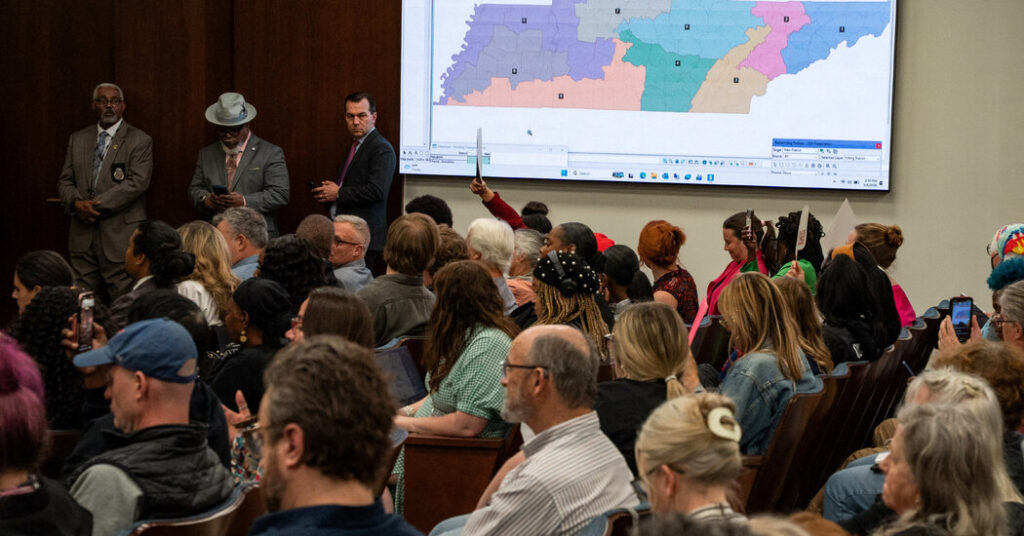
Representative James E. Clyburn of South Carolina, formerly the No. 3 Democrat in the House, is certain he would never have been elected to Congress without changes in the Voting Rights Act that the Supreme Court determined last week amounted to unconstitutional racial gerrymandering.
“And about half of the members of the Congressional Black Caucus wouldn’t be there,” said Mr. Clyburn, the first African American sent to Congress from his state since Reconstruction. He was part of the historic 1992 class of Black and Hispanic lawmakers elected after new maps were drawn to comply with 1982 changes meant to strengthen the Voting Rights Act.
The predominantly Democratic minority groups that set to work back then to increase their representation were boosted by some unlikely allies: Republican strategists who saw an opportunity to break the Democratic hold on the South and force an extraordinary realignment.
Now, Republicans see the chance to cement their grip on the region — and to try to maintain their thin House majority — by eliminating the minority districts that initially worked to their advantage and to take those seats for their own.
It is the latest chapter in an ongoing political saga that has had profound implications for the House of Representatives over the past three decades. Redistricting in minority communities could again be a major factor in deciding the November elections as Republicans try to lessen the traditional midterm advantages for the party out of power — the Democrats in this case — in a year when they face particularly strong headwinds.
Having consolidated their power throughout the South, Republicans are now emboldened to try to eliminate the majority-minority districts, believing they can carry them without risking their strength elsewhere as Democratic-leaning minority voters are dispersed into other districts.
But as Republicans and Democrats have both seen as they have waged a tit-for-tat battle this year to redraw districts around the country to their advantage, such changes do not always work out as planned. The true consequences of the Supreme Court’s recent ruling remain to be seen.
The G.O.P. may find it more difficult to win in more diverse districts of the kind that existed before the reshuffling of maps prompted by the Voting Rights Act.
And Democrats now must decide whether they want to maintain the predominantly minority districts they once demanded as a matter of basic fairness or try to turn the tables on Republicans in blue states and reconfigure them in an effort to threaten G.O.P. lawmakers in those states.
In the late 1980s, Republicans had been deep in the House minority for nearly 40 years. But growing dissatisfaction with the Democratic Party had begun moving white Southern conservatives into the Republican ranks, as illustrated by high-profile party switches in Washington. Then the redistricting initiated under a series of court decisions aimed at fostering more minority representation provided yet another opening that might have seemed counterintuitive at first glance.
Architects of the maps realized that if they could maximize Black and Hispanic representation in the new districts, they would simultaneously dilute Democratic strength in surrounding jurisdictions where coalitions of white and Black voters had elected white Democrats for decades. The shift would ultimately create dozens of openings for Republican candidates in what had formerly been known as Democrats’ “Solid South.”
Groups bankrolled by wealthy conservatives joined with liberal organizations to school minority advocacy groups in state capitals and in Washington about how to shape new districts to meet court tests and best guarantee the election of minority representatives for minority communities — an outcome that many on the left argued was long overdue. Republican groups even provided free access to expensive computer software that could craft the new districts. Democrats eagerly accepted the help.
Some civil rights figures such as Representative John Lewis, the Georgia Democrat, warned at the time that the new maps could empower Republicans by weakening the partnership of progressive white and Black voters in the South. But others said the new districts were the only way to overcome centuries of institutional discrimination against minorities in the region.
“Gerrymandering was done to keep Black folks out,” Mr. Clyburn said. “If you gerrymander to keep them out, you’ve got to gerrymander to bring them in.”
Republicans rejected the complaint that they were acting cynically to increase their own prospects. They said it was the Democratic Party, with its entrenched House majority, that had operated unfairly for decades, relying on minority voters to deliver wins without giving them a seat at the table.
Benjamin L. Ginsberg, then the general counsel of the Republican National Committee, told The Times in 1992 that the redistricting ended “the Democrats’ shameful practice of slicing, dicing and fracturing racial minority communities in order to prop up white incumbents of the Democratic Party.”
The results spoke for themselves. A dozen minority lawmakers were elected from the new districts, including the first Black members since the 1800s from not only South Carolina, but North Carolina, Virginia, Alabama and Florida. Three were elected in Florida alone.
But much of the rest of the South went to the Republicans. Even before the voting, multiple senior Democrats stepped aside rather than run in districts drawn for minorities. Other veteran Democrats were defeated by Republicans in new districts where they were at a sudden political disadvantage.
“The unusual coalition proved incredibly successful,” Allison Mitchell, assistant professor of civil rights studies at the University of Notre Dame, wrote in a historical perspective for Time magazine. “The 1992 election proved that the coalition between Black Democrats and conservative white Republicans delivered for both sides.”
The 1992 cycle touched off a wholesale changeover that two years later led to Republicans grabbing control of the House for the first time in 40 years — with Southern Republicans in command — and cementing their dominance in Southern congressional delegations that continues to this day.
In an interview, Ms. Mitchell acknowledged that the trade-off led to increased minority representation, but at the price of overall Democratic power.
“I would not necessarily say it was a bad deal, but it came at a high cost,” she said.
Its reversal may come at a cost as well.
Mr. Clyburn, who condemned the Supreme Court decision, said the court ruling should spur “a massive turnout at the polls in November to reverse the thinking in the Congress,” so legislation designed to restore the intent of the Voting Rights Act could be passed.
“We can take a look at what they have done and hopefully get a Congress that will pass the John Robert Lewis Voting Rights Advancement Act,” he said.
Carl Hulse is the chief Washington correspondent for The Times, primarily writing about Congress and national political races and issues. He has nearly four decades of experience reporting in the nation’s capital.
The post How Minority Districts Fueled the G.O.P.’s Southern Ascendancy in Congress appeared first on New York Times.