The Scientology “speed running” trend isn’t slowing down.
Since the first incidents in Los Angeles in late March, large groups of people — some in costumes — have tried to race through buildings belonging to the church in New York, San Diego, San Francisco and countries outside the U.S., even as Scientology’s lawyers, law enforcement agencies and social media platforms have sought to halt the viral movement.
At least one person received a legal threat from the church, alleging an online dare prompted a chaotic incident in L.A., according to a legal document reviewed by The Times and confirmed as authentic by a Scientology spokesperson.
Other online content creators on TikTok and Instagram say they’ve had their accounts suspended or threatened with discipline for posting videos about the church and the speed runs.
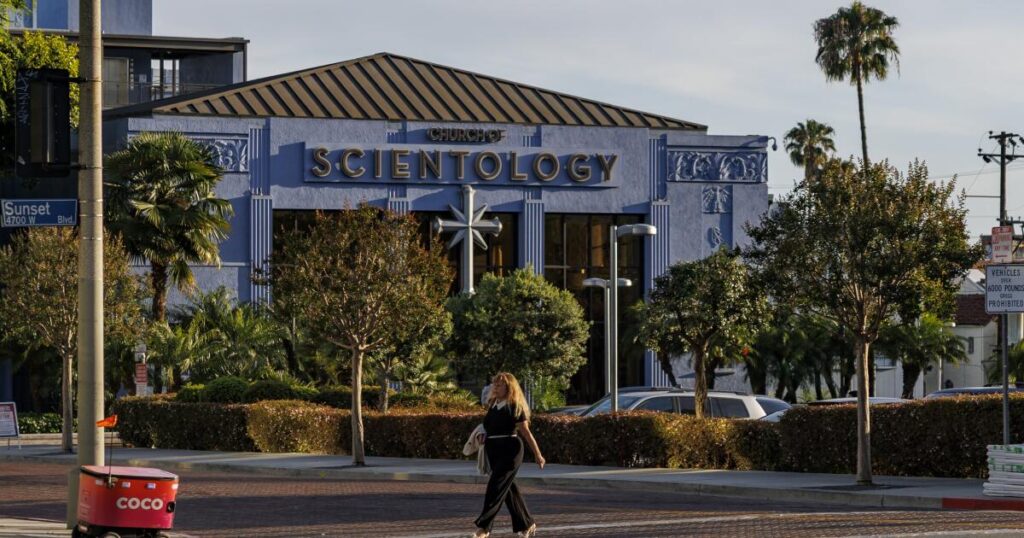
The trend started with groups of teens recording themselves sprinting through properties belonging to the Church of Scientology along the Hollywood Walk of Fame. In each video, runners dart around church staff and race up staircases, seeing how far they can get before someone asks them to leave or threatens to call the police.
“Speed running” is a video game term referring to players who try to complete games as quickly as possible, scurrying around hazards and taking shortcuts to skip through levels. A speed runner who spoke to The Times last month said the events are part-prank, part-protest against an organization that has been accused in lawsuits of sex abuse, violating child labor laws and forcing members to get abortions. The church disputes those allegations and has denied any wrongdoing.
The largest “speed running” incident in Los Angeles happened on April 25, when a crowd led by a man dressed up as Jesus Christ pulled open the doors of the church’s Hollywood Guaranty Building and rushed inside. The building is home to an exhibit about the life of the church’s founder, L. Ron Hubbard, and is also the listed mailing address for Scientology’s public relations department.
Footage shows runners in masks and costumes dashing through the building, tussling with black-shirted security guards and appearing to knock at least one person over.
The church has labeled the incidents “hate crimes” and Scientology spokesman David Bloomberg said at least one member suffered injuries that required medical attention in Los Angeles on April 25. The Los Angeles Police Department’s Major Crimes Division, which investigates hate crimes and attacks on houses of worship, is reviewing the incident, according to a department spokesperson.
No arrests have been made, according to the spokesman, who said there have been five documented trespassing incidents at Scientology properties in Hollywood this year. Only two appeared to be part of the speed running trend, authorities said.
While the incidents have slowed in Los Angeles — in part because the church has removed the handles to external doors at three of its Hollywood properties — “speed runs” have begun taking place in other cities and counties.
The other incidents have resulted in at least three arrests and two minor injuries to Scientology members, authorities said.
San Francisco police said they responded to two separate attempts to break in to or vandalize a Scientology property near the city’s Chinatown neighborhood in recent weeks. Two teens were arrested, though it’s unclear if charges were filed. San Diego Police also documented an incident of “vandalism and trespassing” at the church’s downtown property on May 2.
On May 3, a crowd of approximately 300 people, described by police as “mostly youth,” attempted to enter a Church of Scientology building in downtown Vancouver. Some people tried to kick in a gate and threw items at police, but no one was injured, local authorities said. One teen was arrested.
A similar incident occurred the same day in New York City. Police told NBC that “a group of unidentified individuals forcibly entered” the church’s Midtown Manhattan building around 4 p.m. on May 3 and caused property damage. One man suffered a minor injury, police told the television station. No arrests were made.
A video posted to TikTokalso purported to show an attempted speed run at the L. Ron Hubbard Academy of Personal Independence in Edinburgh, Scotland, last weekend. Police there did not immediately respond to a request for comment.
Bloomberg, the Scientology spokesman, declined to comment on specific incidents outside of Los Angeles.
The church and some social media companies have attempted to contain the spread of speed running content online.
On April 26, a lawyer representing the church sent a letter to the founder of the app Dare Market, accusing the company of “inciting” a Hollywood speed run the day earlier. Dare Market founder Isla Rose-Perfito shared a copy of the letter in a post on X this week.
The Dare Market app allows people to challenge one another to complete dares for prizes or money, but discourages users from breaking any laws, Rose-Perfito said. On April 24 — the day before the large Hollywood “speed run” led by the man dressed as Jesus — Dare Market posted a “Scientology speed run” dare with a $1,000 prize.
“Longest time running inside before getting kicked out wins. You need to repeatedly say ‘Dare Market made me do it’ while running inside the center,” the since-deleted post read.
Someone can be heard saying that exact phrase shortly after the man dressed as Jesus pulled open the front door of the Scientology building in Hollywood on April 25, according to video of the incident.
“Dare Market may be held liable for serious injuries or death resulting from the ‘Scientology challenge,’” read the letter from attorney Rebecca Nell Kaufman. Kaufman wrote that the dare incited “hateful, offensive, and dangerous acts.”
Kaufman also claimed that speed runners hurled racial epithets, including the N-word, at a Black security guard on April 25. An LAPD spokesperson could not confirm if that allegation had been reported to police.
“Church staff have already been battered and assaulted as a result of your business,” Kaufman wrote. “It is only a matter of time before someone is seriously injured or killed.”
Kaufman — who previously threatened The Times with litigation after a reporter sent questions to Scientology officials as part of a 2024 article— did not respond to a request for comment.
In an interview, Rose-Perfito, 29, argued that the speed running trend predated the dare post and rejected the legal threat from Scientology.
“We’re not telling people to break in at all … on their website, they say they welcome people with open doors,” she said.
Rose-Perfito alleged that Scientology officials repeatedly called her mother in the middle of the night after the April 25 speed run. In videos she posted to X and TikTok, Rose-Perfito plays a voicemail from a woman identifying herself as Bari Berger. According to a church website,Berger is the former director of STAND, which is Scientology’s antidiscrimination wing. She now works in the church’s public affairs department, according to her LinkedIn profile.
Bloomberg said calls were placed shortly after the April 25 incident “seeking contact with individuals associated with Dare Market and its CEO concerning matters arising directly from those events.”
Other content creators said their Scientology-related content has drawn extra scrutiny as the speed running trend spreads. Derrek Miranda, the man behind the Whitewallstuntz social media accounts that gained popularity in the last year documenting Los Angeles’ underbelly,said his Instagram account was deactivated after posting a video of the April 25 speed run. A Meta spokeswoman did not respond to a request for comment.
Some TikTok users have also reported that posts they made related to either Scientology “speed running” or the church itself have been flagged or removed in recent weeks.
A TikTok spokesperson said the app’s “Community Guidelines explicitly prohibit the promotion of violent or criminal behavior, and we’re removing this content from our platform.”
Times staff writer Christopher Buchanan contributed to this report.
The post ‘Speed running’ trend spreads despite Scientology and social media sites trying to stop it appeared first on Los Angeles Times.