A friend of mine, generally not finicky, refuses to eat octopus. “I just can’t eat any creature that’s smarter than I am,” he says, and he’s got a point. Octopuses are adept at problem solving and hiding themselves from prey. They can use tools. They can distinguish one human face from another. They even, possibly, have a sense of humor. All of those things might be enough to make you think twice about consuming that grilled, tentacled thing on your plate.
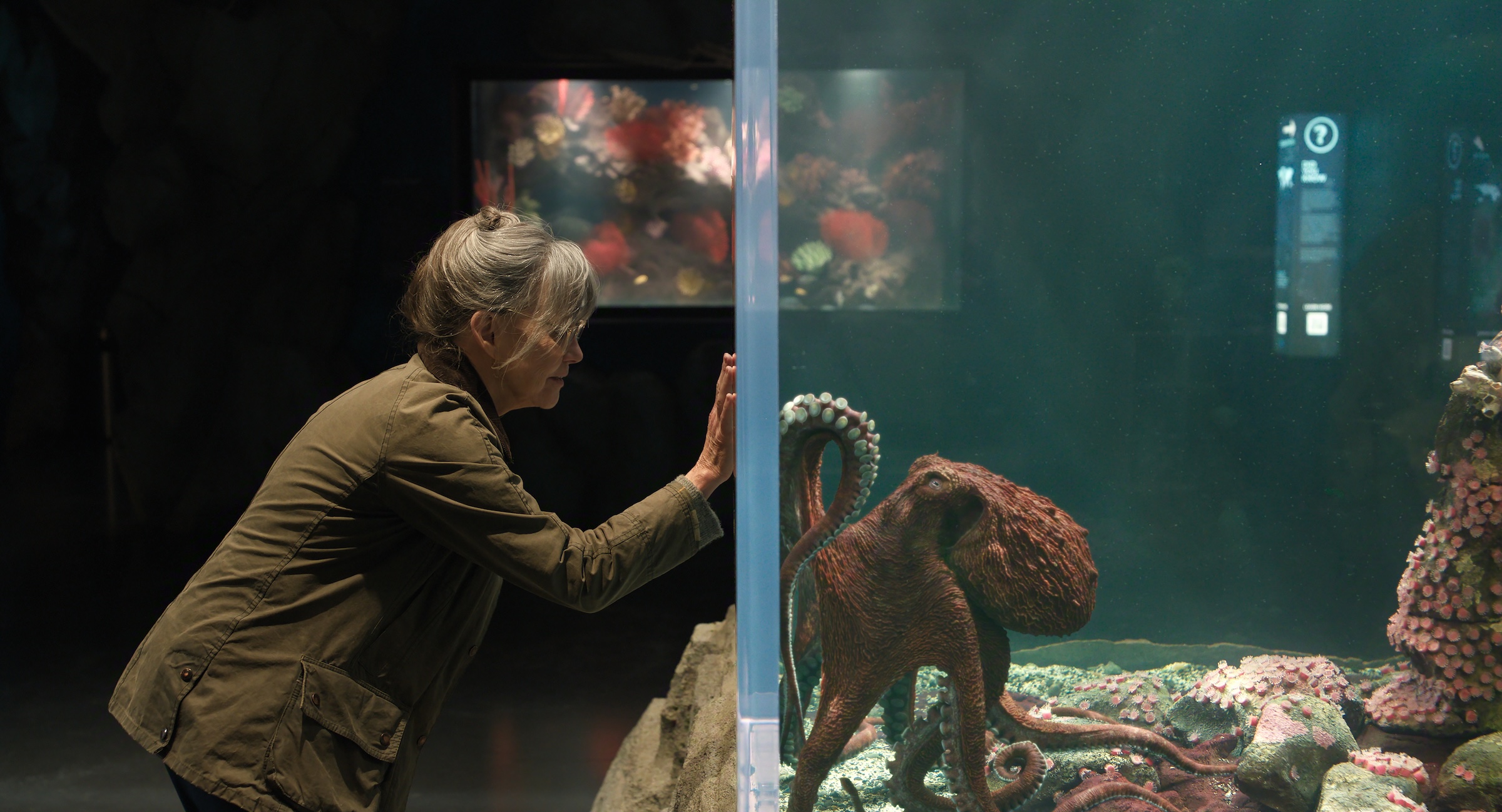
Parts of Netflix’s Remarkably Bright Creatures, directed by Olivia Newman and adapted from Shelby Van Pelt’s 2022 novel, might have the same effect. Sally Field plays Tova Sullivan, an elderly widow who works nights as a cleaning lady at an aquarium on Puget Sound. Even though wiping away each day’s worth of schoolkid grime is hardly anybody’s idea of fun, Tova is OK with her job: nighttime solitude suits her, and she finds herself bonded with one of the aquarium’s star attractions, a wiseacre octopus named Marcellus.
We know Marcellus is a smartie because we can hear his thoughts—they’re voiced by Alfred Molina—and he has lots of feelings about humans. He doesn’t like living in captivity. “There’s no quiet like the bottom of the sea,” he says, gazing at a gaggle of noisy kids with his perceptive, penetrating eyes. Grownups aren’t necessarily better. “I am subservient to a species beneath me in every observable metric,” he laments.
Still, Marcellus is alive to beauty: he notes that the fingerprints schoolchildren leave on the glass of his tank are as “intricate as a moonsnail.” And as much as he’d like to deny it, he’s sensitive to these humans who have made him their prisoner, and he’s deeply aware of Tova’s pain, in particular. He sees that she’s lost something, and he’s right. Her only child died years ago, and she still wonders if she’s somehow responsible for his death. She’s also facing a bewildering choice: before her husband died, he signed the two of them up for a space in a retirement community. For decades, she’s been living in an enviably cozy log cabin built by her father. Faced with the uncertainty of aging, she wonders if it’s time to leave her home behind, though we can see she doesn’t want to.
One day, a stranger chugs into town in a beat-up chartreuse-and-cream minivan. Lewis Pullman’s Cameron is on a mission. He tells the crotchety-amiable proprietor of the town’s general store, Colm Meaney’s Ethan, that he’s looking to collect a debt. But his van has broken down, and he doesn’t have the dough to get it fixed. Tova has just suffered an ankle fracture after slipping on the water-splashed aquarium floor. Maybe Cameron could take her place until she recovers? He grudgingly accepts the job, but because Tova can’t stay away from the aquarium for long, she insists on dropping by to show him the proper way to mop, to polish, to wipe away everyday smears. As Marcellus looks on—and when he’s not escaping his tank for the occasional adventure—Tova and Cameron form a bond. And Marcellus becomes convinced that these two unfortunate humans might have the power to heal one another, but only with his help.
For an invertebrate, Marcellus is quite the busybody. And perhaps unsurprisingly, his hunch is correct: the story resolves itself in a small tidal pool of coincidence that’s highly implausible but also comforting. Remarkably Bright Creatures does sag a little when Marcellus isn’t on-screen: it’s mesmerizing to watch him flit through the water in his tank, his supple skin the striated red of an old weathered barn, his tentacled arms beyond balletic in their grace. And Molina’s voice-over is so convincing you come to believe you really are hearing Marcellus’ thoughts. Compared with that, the presence of mere humans can only be a disappointment.
Still, W.C. Fields advised against acting with children or animals only because he never met Sally Field. The list of characters she’s played over the years—from Gidget to Mary Lincoln—stretches behind her like a bright ribbon. But she knows how to be present in the moment, even when she’s acting with an octopus, and she makes Tova’s suffering—and her preference for solitude—feel distinctive and lived-in. Pullman makes a perceptive, sympathetic match for her: you get the sense he pours more energy into listening than speaking. Remarkably Bright Creatures is a movie, like its cephalopod supporting star, with a gentle soul and an elusive spirit. It might not stick with you long, but it leaves a delicate print behind.
The post Remarkably Bright Creatures Is a Sweet, if Slight, Melodrama with an Eight-Armed Star appeared first on TIME.