ROME — Despite her increasingly tense relationship with President Donald Trump, Italian Prime Minister Giorgia Meloni on Friday gave a rare gift to Secretary of State Marco Rubio: proof of his family’s Italian origins.
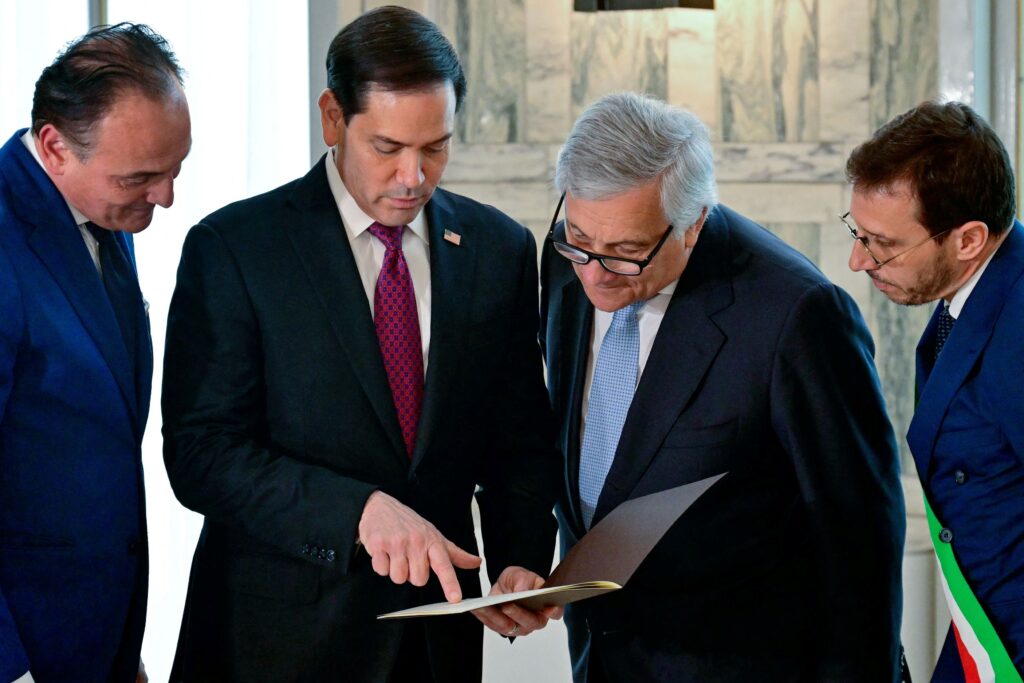
Rubio received the documentation at Italy’s Foreign Ministry on Friday under the supervision of Foreign Minister Antonio Tajani. The honor was given in recognition of Rubio’s family history tied to Piedmont, Italian officials said.
A State Department official, speaking on condition of anonymity to brief the media, said that the document did not confer citizenship either honorary or legal.
In a ceremony, Tajani, Piedmont Region President Alberto Cirio and Mayor of Casal Monferrato Emanuele Capra presented “the family tree of his Italian origins and documents from the research they conducted in the municipal and church archives” that certified Rubio’s Italian family history, the official said. Rubio also received gifts from Piedmont.
In brief remarks, Rubio said it was a “true honor” to receive the documentation and said that visiting Piedmont would be “one more reason to be back” in Italy. Rubio added that he would give a speech in Italian next time he’s in the country.
“I need to learn a third language,” said Rubio. Italian would be “by far the easiest one,” he said, as he already speaks Spanish.
The Italian leader’s move to emphasize Rubio’s Italian heritage comes as Meloni has endured withering criticism from Trump, who told the Italian newspaper Corriere della Sera last week that he had been “wrong” to think that the Italian prime minister had “courage.”
Meloni, a member of Italy’s right wing, had been seen as a rare European leader who could maintain close ties to Trump, but the political and economic fallout from the war against Iran and Trump’s criticism of Pope Leo XIV prompted her to distance herself from the U.S. administration.
Meloni and other Italian officials, including Tajani, had stepped up to support Leo after Trump repeatedly attacked the Chicago-born leader of the world’s 1.4 billion Catholics, claiming this week that the pontiff’s comments were “endangering Catholics and a lot of people.”
Rubio’s brief trip to Rome this week aimed to calm these tensions. The top U.S. diplomat, who is a practicing Catholic, met Leo on Thursday, an encounter that U.S. officials were quick to describe as friendly and constructive. Rubio brought his wife, as well as his close friend Sergio Gor, to join the visit to the Vatican.
Despite attempts to keep the talks cordial, tough topics were clearly at hand. State Department spokesman Tommy Pigott said that the pair discussed issues in the Middle East and the Western Hemisphere, while a Vatican statement pointedly emphasized “the need to work tirelessly for peace.”
Italian officials seemed keenly aware that the disagreements have moved beyond a war of words. Trump has announced plans to withdraw some U.S. troops from Germany in the next year and suggested he could do the same in Italy and Spain. This week he also repeated his threat to raise tariffs on European-made cars, a favorite cudgel.
Tajani sought to stress the importance of the historic alliance between Europe and the United States.
“We strongly believe in transatlantic relations,” Tajani said Thursday, according to the Italian news service ANSA. “If there are points of disagreement, we address them. But this does not mean that disagreeing on certain issues undermines the transatlantic alliance, because Europe needs the United States, but it is equally true that the United States needs Europe.”
There had been discussion of granting honorary citizenship to Rubio earlier this year, after he mentioned his potential familial link to Casale Monferrato in Italy’s northern Piedmont region, sparking a flurry of interest in Italian media. Rubio, who was born in the U.S. to Cuban immigrant parents, holds only U.S. citizenship.
Meloni has made a habit of granting citizenship to friendly international figures, including President Javier Milei of Argentina in 2024 and Maria Bartiromo, the Fox News host and prominent supporter of the Trump administration, the following year.
Granting foreign citizenship to America’s top diplomat, even if purely symbolic, would have been unusual. Dual citizenship is considered a potentially disqualifying factor for security clearances, for example, an issue that was raised when Czech-born Madeleine Albright became secretary of state in 1997. (Though eligible for Czech citizenship, Albright did not take it.)
The post In Rome, Rubio is gifted documents detailing his Italian heritage appeared first on Washington Post.