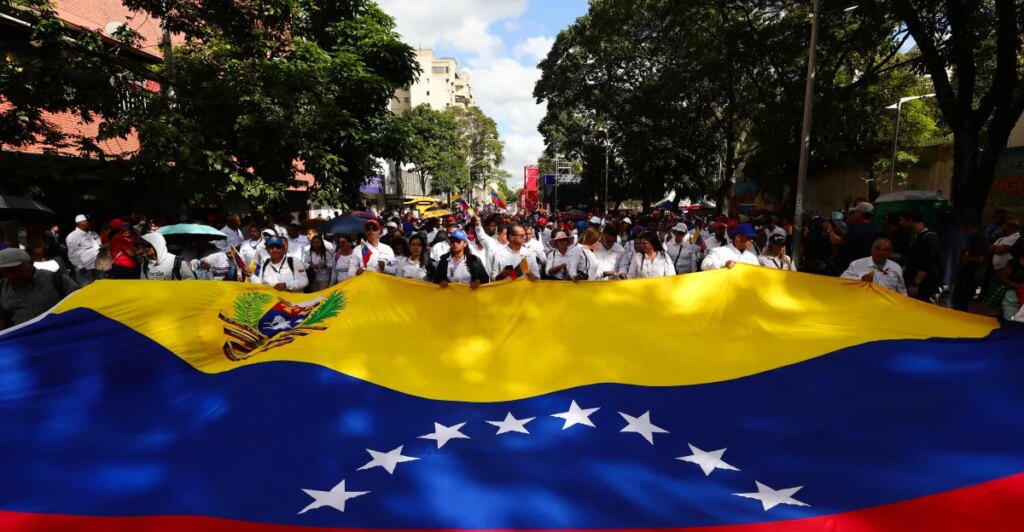
It’s been four months since the US captured Venezuelan President Nicolás Maduro and brought him to the US to stand trial. His vice president, Delcy Rodríguez, is now in charge, but the Trump administration has been largely silent on what comes next for the country.
In the meantime, Missy Ryan, a staff writer at the Atlantic, tells Vox that some polling suggests that a significant number of Venezuelans now feel that their country is better off — or at least no worse — than it was pre-US intervention.
It’s a somewhat surprising finding, given the many less optimistic predictions in the aftermath of Maduro’s removal. To explain what’s going on, Ryan spoke with Today, Explained co-host Sean Rameswaram about the surprising status of the US operation and what some positive outlook from inside the country tells us about what comes next.
Below is an excerpt of the conversation, edited for length and clarity. There’s much more in the full podcast, so listen to Today, Explained wherever you get podcasts, including Apple Podcasts, Pandora, and Spotify.
You published a piece in the Atlantic titled “Venezuela Seems to Be Going … Well?” Why did you call the piece that?
The headline of the piece really captured the surprise that many of my colleagues and many of the Latin America experts that I spoke with for the piece felt three months on from the ouster of Maduro, which was that, contrary to a lot of expectations about the potential destabilization of Venezuela, the potential for an Iraq-style armed insurgency or fracturing of the state, things were pretty quiet in Venezuela.
And in fact, there had been a relatively positive response from the Venezuelan public. In the limited polling that’s been done since January 3, they have expressed cautious optimism or at least a willingness to let some time pass before making a judgment about the overall net analysis of ‘are things better or worse for us in Venezuela?’
And you referenced polling, so this isn’t just people in the media saying things got better in Venezuela. Venezuelans broadly feel that way.
Correct. And I think that that should be the ultimate arbiter. It doesn’t matter as much what analysts in Washington or Miami think. It’s about the Venezuelans in Venezuela and then obviously the exile community throughout the world who are deeply invested in what happens there [and] can potentially return and help grow the economy, rebuild Venezuelan society after a very traumatic period of repression and economic deterioration.
The sense was people were willing to give Delcy Rodríguez, the interim president, some time and the interim authority some time to show if they could deliver on the kind of bread and butter issues that Venezuelans seem most focused on. There are starting to be some improvements there in terms of the economy. It hasn’t really affected prices yet, but certainly investment is starting to slowly materialize, [though] definitely far short of what President Trump had envisioned and promised when we heard from him in early January.
But with oil prices, where they are and the lifting of sanctions, the resource-dependent Venezuelan economy stands to grow if only from a statistical rebound perspective. And hopefully that’ll really begin to trickle down into Venezuelans’ pockets. The question of political freedoms is going to be very important, but it didn’t seem like it was the primary concern of Venezuelans in the polling that has been done so far.
One of the biggest differences is obviously just that there’s someone different in charge. Is Delcy Rodríguez making Venezuela a freer country than Maduro did?
That is a complicated question. There have been a number of metrics that you can talk about.
When the ouster happened in January, the Trump administration talked about it as a simple law enforcement operation that was executed by the military, which is incredibly unorthodox. They were talking about three phases, and this is what Rubio and the people at the State Department were describing as three phases that they saw for Venezuela: stabilization, recovery, and then transition.
As part of that recovery stage, they have leaned on the Rodríguez interim authorities to take certain steps. They focused on the release of political prisoners [and] they backed away from the same level of arbitrary arrests that had occurred under Maduro. There have been some limited, mostly economically focused protests or demonstrations that have happened without the same kind of crackdown that you would’ve expected under Maduro.
These have only been limited steps; there’s so much more that hasn’t actually occurred yet, and that includes the full release of political prisoners.
Remember that although Venezuelan oil exports are really starting to increase and the revenues are really starting to increase, that money goes into a US Treasury-controlled account in the United States, and Delcy Rodríguez has to submit a spending plan to the US government and in order to get that money back to Venezuela to pay salaries, to provide public services. So it is not an autonomous sovereign situation — far from it.
One of the biggest criticisms of this intervention in Venezuela, against President Trump, has been, “You didn’t even change the regime. You just put Maduro’s number two in power.” There’s no commitment to elections, at least in a concrete form. Do we have any idea now that it’s been four months, when we might see elections?
There has been no official statement either from the interim authorities in Venezuela or the US government, but what I’m told privately is that they are planning for elections to occur by the second half of 2027.
However, there is a lot that needs to happen before then, and we haven’t seen any public steps to advance those steps, which would include reform of the National Electoral Commission, an update to the registry of Venezuelans who have all been displaced all throughout Venezuela, and then of course, the question of millions of Venezuelans who are now outside the country who would need to [take] part in any sort of credible election.
The lack of a plan that has been made public raises questions about the level of commitment that the US administration has to the democracy piece of this. Their argument has been, ‘Look, if we jumped right into elections that really would have intensified the potential for civil conflict.’ And so their bet is on slow incremental change.
The fact that elections might be one, two years away only lends more credibility to this argument that this wasn’t about freedom for the Venezuelan people, this was about oil. Now that we’re months out, does it feel like this was just about oil? Is that a fair criticism to lob at the Trump administration?
It definitely was about oil, primarily for President Trump. He mentioned oil 19 times in the press conference that he gave the morning after the Maduro raid. There have been some more modest deals that have occurred, but the kind of big production deals in the oil sector have not yet materialized. And there’s a lot of structural obstacles that need to be overcome.
Primary among them is the overall trajectory of Venezuela and skepticism among oil investors to jump back in when they don’t know who’s going to be ruling the country in a year. Is it going to go back to a socialist model where they’re going to appropriate things?
Again, as Exxon famously said, they had their assets taken not once, but twice, and [Venezuela] was uninvestible. But also, what is this country going to look like in two years, five years, 10 years?
The post Did Trump actually help Venezuela? appeared first on Vox.