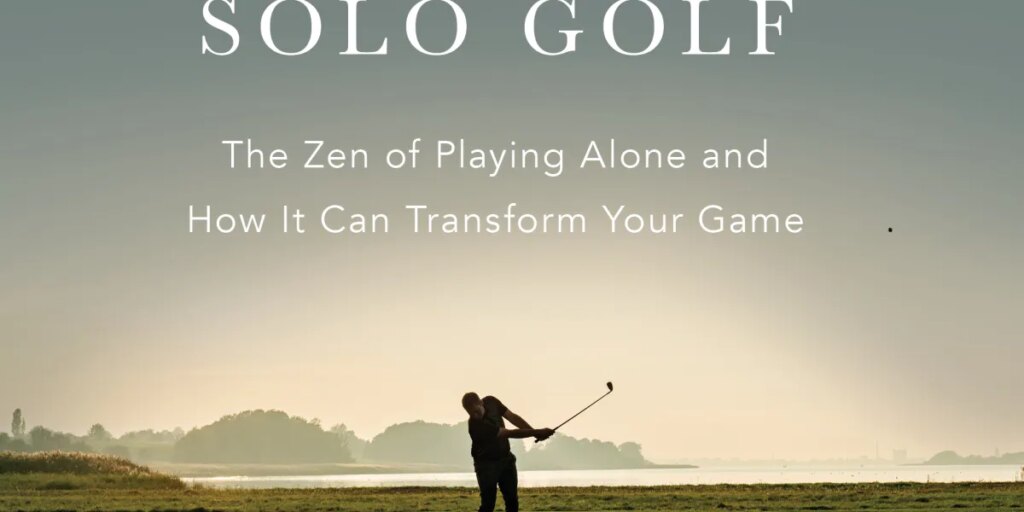
I have a book coming out this month called Solo Golf (Workman), which is exactly what it sounds like: a case for playing golf by yourself.
This has struck some people who know me as, if not contradictory, then at least a little ironic.
“You?” they say. “Aren’t you the great golf networker?”
They’re not wrong. For decades, golf has functioned as a kind of informal professional infrastructure — part networking event, part relationship builder, part slow-moving deal room. The cliché of golf as business lubricant exists for a reason. Entire careers have been nudged forward on tee boxes and sealed on greens. And historically, access to that world — particularly at private, often men-only clubs — was not just a matter of recreation but of opportunity, which is why it became a flashpoint in workplace equity debates.
In other words, the sport has long been less about solitude than about proximity — to power, to colleagues, to possibility.
Which is why suggesting that people should sometimes play alone can sound, at first pass, like a rejection of what makes the game professionally valuable — or valuable to professionals.
But solo golf isn’t a rejection.
It’s a complement.
The argument of Solo Golf is not that you should abandon the foursome, the client round, or the leisurely walk-and-talk with colleagues. Those experiences have enduring value, both human and professional. The argument is that adding a solo practice — occasional rounds played entirely by yourself — can make those social rounds more meaningful and, perhaps counterintuitively, make you better at the very business functions golf has traditionally served.
Because what golf offers in groups is connection. What it offers alone is something else entirely.
Clarity, for one.
Anyone who has spent time on a golf course knows that the game is as much mental as it is physical. It rewards focus, punishes distraction, and exposes the difference between intention and execution in ways that are often uncomfortably direct. But in a group setting, even a congenial one, one’s attention is necessarily divided. You are tracking other people’s shots, making conversation, managing pace, reacting to outcomes. You are, in short, operating in a social environment.
When you play alone, that layer falls away. There is no one to entertain or impress, no one to observe your mistakes or celebrate your successes. What remains is a stripped-down version of the game: one person, one set of clubs, and a series of decisions.
That simplicity has a way of sharpening the mind. It becomes easier to focus on the task at hand — this shot, this moment — without the cognitive clutter that accompanies group play. The result is something golfers sometimes describe as “flow,” a state in which attention narrows and performance, almost incidentally, improves.
In business, people spend a great deal of time trying to manufacture that kind of focus — through productivity systems, time-blocking, mindfulness apps. A solo round of golf delivers it more organically, and with a side benefit: you are moving, outdoors, and largely disconnected from the constant digital inputs that fragment attention elsewhere.
There is also the matter of space — mental space, specifically.
Modern professional life is not particularly generous in this regard. Meetings fill calendars. Notifications interrupt thought. Even downtime tends to be colonized by screens. The result is that sustained, unstructured thinking — the kind that often leads to new ideas — is surprisingly hard to come by.
A solo round creates that space almost by accident. Walking between shots, standing over the ball, navigating a course — through it all you occupy your body just enough to free your mind. Thoughts surface and dissipate. Problems are reconsidered from different angles. Occasionally, something useful emerges: a reframing of a challenge, a new approach, an idea that had been crowded out by more immediate concerns.
This is not mystical. It is simply what happens when you give your brain time and room to operate without interruption.
Then there is recalibration.
Business, like golf, has a way of compounding pressure. Deadlines, expectations, performance metrics — they accumulate, sometimes invisibly, until they begin to affect decision-making. One of the underappreciated benefits of stepping away — really stepping away — is the opportunity to reset.
Solo golf offers a version of that reset that is both active and contained. You are engaged, but not overloaded. You are challenged, but not judged. A bad shot is a problem to solve, not a failure to explain. Over the course of a few hours, the stakes of your professional life can shrink to a more manageable scale, if only temporarily.
And when you return, you often do so with a slightly different perspective.
None of this is to suggest that solo golf is a panacea for professional effectiveness, or that it should replace the social dimensions of the game that have made it so enduringly valuable in business contexts. If anything, the opposite is true. The better you are at being present, focused, and thoughtful on your own, the more you bring to interactions with others.
The foursome benefits from the “onesome.”
There are, of course, practical challenges (which I address in Solo Golf.) Golf courses are designed for groups, not individuals, and securing a solo tee time can require some creativity — early mornings, late afternoons, the occasional willingness to play in less-than-perfect conditions. But those constraints are part of the point. Solo golf tends to exist on the margins, in the quieter hours and overlooked moments, which is precisely where its benefits are most pronounced.
It is also worth noting that the experience itself is different in ways that are difficult to fully anticipate. The quiet of an empty course, the heightened awareness of sound and environment, the freedom to experiment without consequence — these are not just aesthetic differences. They shape how you think and feel over the course of a round.
And, over time, how you approach other domains.
So yes, golf remains what it has long been: a place where relationships are built and business is conducted, sometimes subtly, sometimes explicitly. That function won’t go away, nor should it.
But it is not the only way the game can be useful.
In an era where attention is fragmented, time is compressed, and the demands of professional life rarely abate, there is value in practices that restore focus, create space, and allow for recalibration. Solo golf, for those inclined to try it, is one such practice.
Not a replacement for the round with colleagues or clients.
But a quiet, surprisingly effective addition to the toolkit that makes those rounds — and the work that surrounds them — better.
The opinions expressed in Fortune.com commentary pieces are solely the views of their authors and do not necessarily reflect the opinions and beliefs of Fortune.
The post How playing golf alone can make you better at your job appeared first on Fortune.