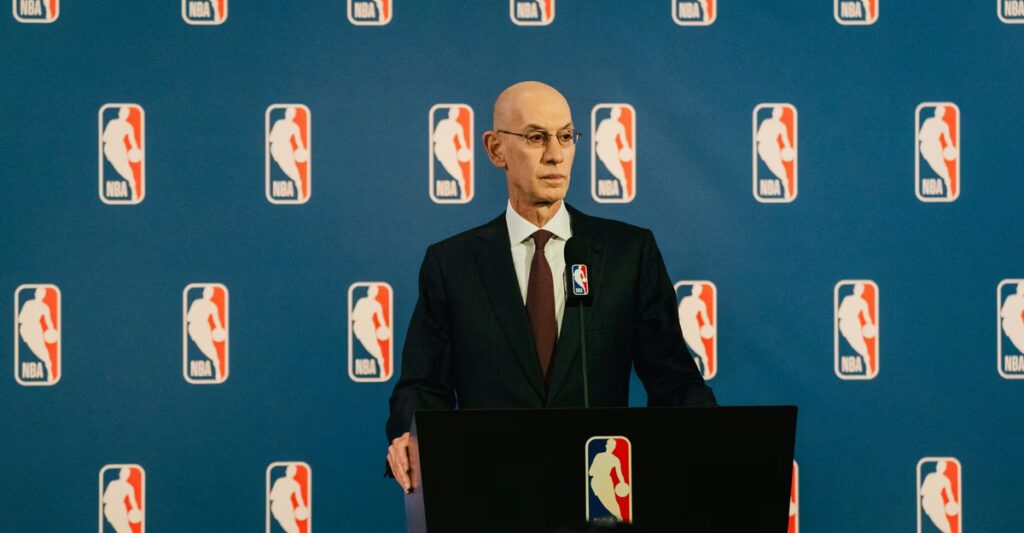
Photographs by Paola Chapdelaine
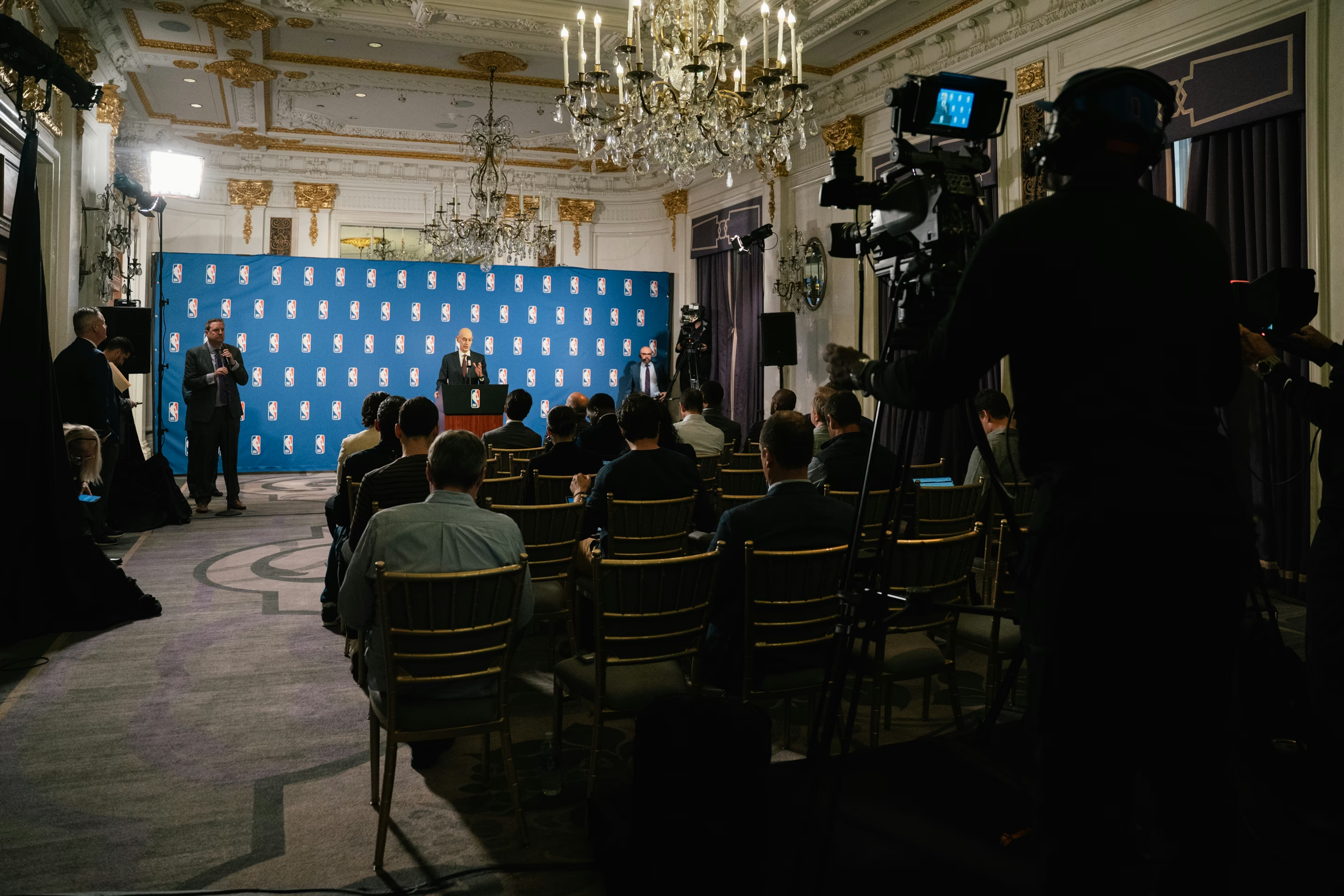
Adam Silver is one of America’s most powerful men. Part businessman and part diplomat, he leads a multibillion-dollar international conglomerate and exercises soft power across continents. But on the day we met, the commissioner of the National Basketball Association appeared aimless, drifting awkwardly through the roped-off VIP area of a sports-business conference in Nashville.
Silver had just concluded a keynote session. Unlike other headliners, such as Major League Baseball’s Rob Manfred and the Southeastern Conference’s Greg Sankey, who’d been interviewed onstage by journalists, Silver had been joined in conversation by his friend Bob Myers, a former Golden State Warriors executive, who opened by congratulating Silver on his decency, integrity, and “moral compass.” The commissioner is carefully stage-managed. Media engagements are rare; rarer still are the probing questions that might be asked of someone leading a business valued at roughly $200 billion. Early last year, I’d approached the NBA about a profile—not just of Silver but of the game itself, a holistic look at the evolution of professional basketball. The answer: a hard no. Hence the trip to Nashville.
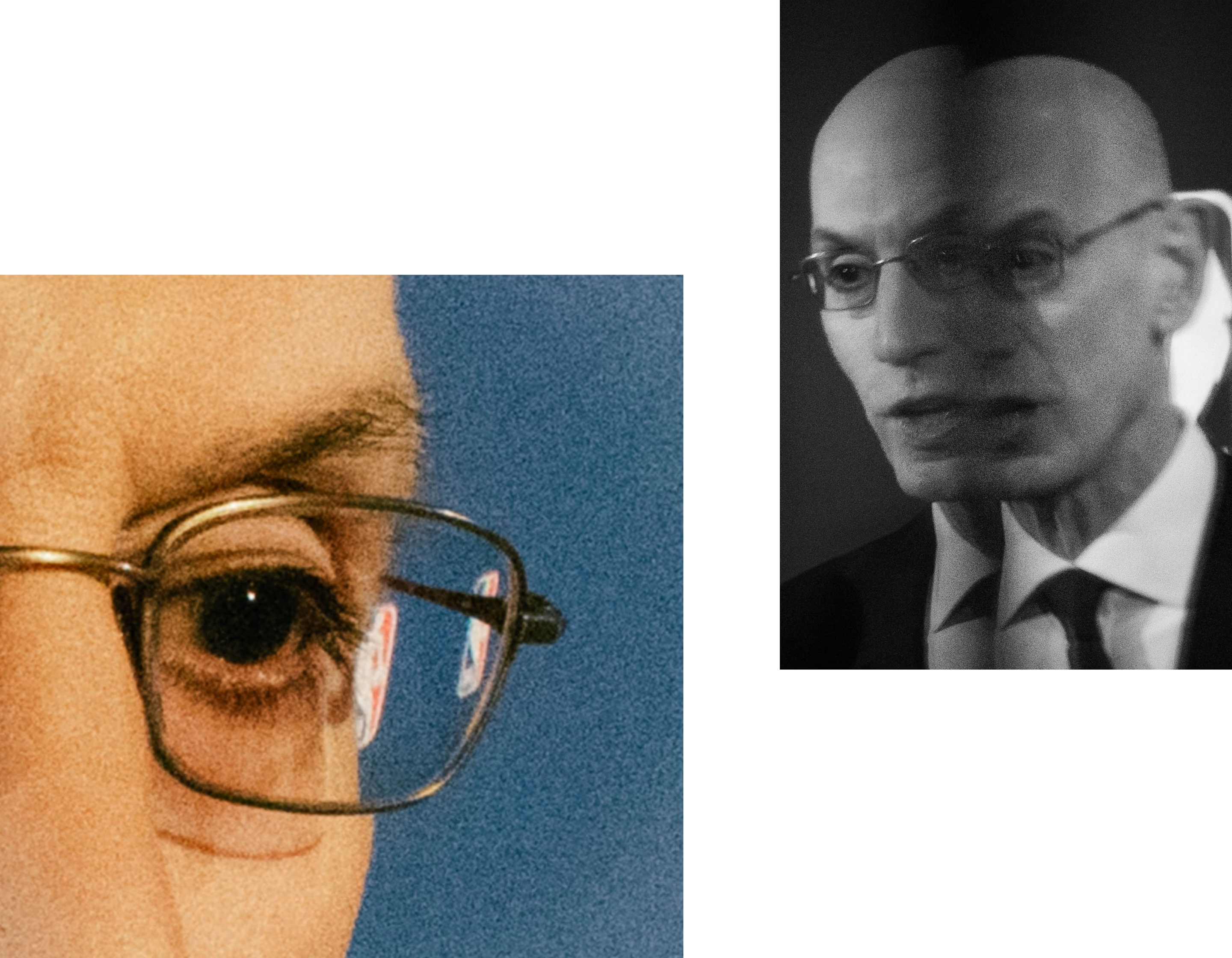
I had been warned, when talking with his contemporaries, that Silver is kept in bubble wrap. Now I witnessed it up close. Silver’s longtime flack, Mike Bass, was refusing to answer my texts—we stood 50 feet apart, separated by the VIP rope, as he stared at his phone—asking for an introduction. Meanwhile, officials from three separate teams, whom I’d planned to meet in Nashville, had all canceled. It seemed like a coordinated snubbing. Which left me no choice: When Silver wandered within reach, I slipped the rope and thrust an open hand in his direction. The commissioner, who is six-foot-three and wears a clean-shaven head, studied my name tag—The Atlantic—and then spun toward Bass, who looked exasperated. Silver’s complexion turned colorless, almost ethereal, as he shook my hand. I assured him that there was nothing to fear, that I’d tracked him to Tennessee because I wanted a proper interview.
“That’s up to Mike,” Silver said, glancing at his spokesman.
“C’mon,” I replied with a grin. “You’re the commissioner.”
Silver was expressionless. “Sorry, it’s not my call,” he said. Then Bass hustled him away.
The whole thing felt a bit pathetic. As a sports junkie, I’d always imagined commissioners as party bosses: indomitable, shank-wielding enforcers who win by any means necessary. Silver is not that guy. He is warm and dignified, a people pleaser who thinks in terms of negotiations and partners, not arguments and adversaries. He’s also an anxiety case, a born worrier who lives with constant apprehension about dangers to his league and its legitimacy.
Silver is right to worry. Professional basketball has entered a moment of institutional crisis. The commissioner is confronting urgent, headline-grabbing allegations of corrupt ownership and betting scandals and teams intentionally losing games. He is also confronting broader critiques of the sport’s very soul: a lack of rivalries, a lack of competition, and, just over the horizon, a lack of homegrown superstars. This would be daunting for any commissioner—much less one who dreads confrontation.
Standing in that Nashville hotel, I thought of Silver’s predecessor, David Stern. He might have agreed to do the interview then and there; he also might’ve cussed me out and had security escort me from the premises. What he wouldn’t have done was shrink at the sight of a reporter wearing a laminated name tag.
Every basketball fan is acquainted with Stern’s legend. An attorney who joined the NBA as general counsel in the late 1970s—when the league was flirting with extinction, its playoff games tape-delayed to air after local newscasts—Stern engineered an extraordinary comeback. It was Stern who brought blood feuds and first-name-basis players to the mass market. It was Stern who turned basketball into a global sensation. And it was Stern, toward the end of his 30-year run as commissioner, who groomed Silver as his successor.
Silver’s mandate was to do no harm, yet his tenure began with controversy. He’d been on the job two months when, in the middle of the 2014 playoffs, TMZ published audio of Donald Sterling, the Los Angeles Clippers’ owner, unleashing a racist rant. The response from Silver—he essentially forced Sterling to sell the club and banned him from the NBA for life—earned him so much goodwill that his first decade as commissioner felt like a honeymoon that would never end.
After that early intervention, Silver kept a low profile. He kept out of the way. He kept the superstars happy. And, most important, he kept the team owners rich. When the NBA announced a massive new $76 billion media-rights deal two years ago, the commissioner was celebrated for taking the league to new financial heights.
Now, however, with the 2026 playoffs under way—the capstone of the most turbulent regular season in modern NBA history—Silver for the first time faces real trouble. The quality of the product has diminished. Narratives surrounding the league are prevailingly negative. Things once taken for granted—commercial satisfaction, cultural prestige, national relevance—no longer seem guaranteed. Peacetime is a thing of the past; for the foreseeable future, the commissioner will be at war—with fans, with media critics, with players and coaches, with the game itself. I came to Nashville wanting to know: Does Adam Silver have the stomach for this fight?
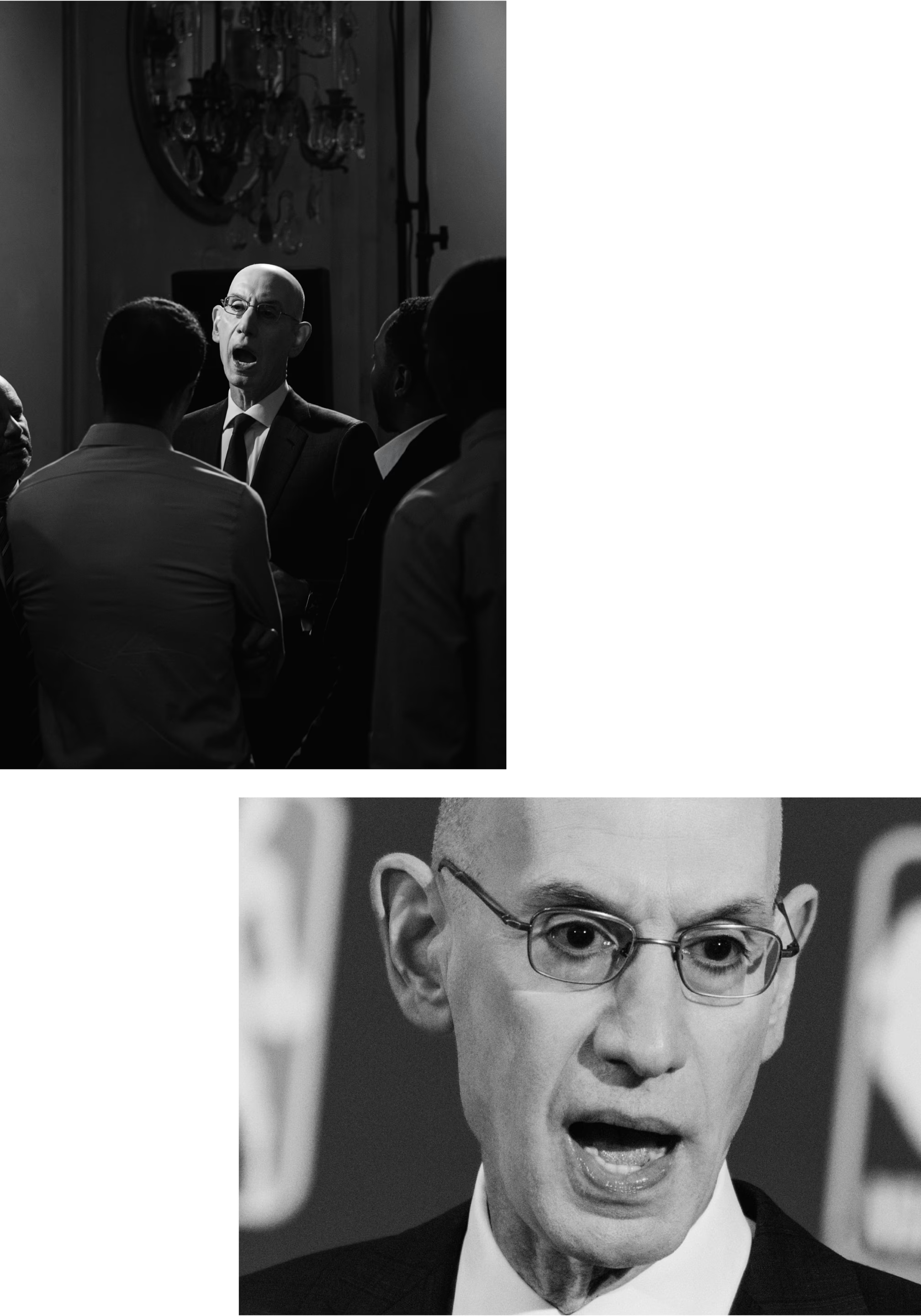
Soon after he was elected president of the National Basketball Players Association, Fred VanVleet, the stocky point guard of the Houston Rockets, walked to the front of a Las Vegas ballroom. It was July 2025, a few weeks removed from the Oklahoma City Thunder winning the NBA Finals, yet the ensuing season was already under way. Rookies had been drafted. Developmental prospects had come to Vegas for exhibition games. And with them had arrived a basketball establishment—coaches, executives, team owners—accustomed to flying high. Revenues were up. A collective-bargaining agreement was in place. The new media deal was kicking in. Nothing, it seemed, could stop the juggernaut inspired by James Naismith and his peach baskets back in 1891.
Yet when VanVleet addressed the room in Las Vegas, his first words were a warning. “Don’t fuck up the game,” he said.
Laughter filled the ballroom. Except VanVleet wasn’t joking. The 10-year veteran is a throwback: an unheralded recruit who grinded his way to All-American status at Wichita State, an undrafted rookie who willed his way to becoming a world champion. To him, basketball is not merely a business. It is a source of identity, the ticket he claimed to escape a troubled life. Anything that taints its beauty constitutes a threat.
This season has demonstrated that the threats are real—and they are multiplying. Teams lost countless games on purpose in the pursuit of better draft positioning. Players—and, even more troubling, a head coach—were caught up in gambling-related scandals. The NBA’s wealthiest owner, former Microsoft CEO Steve Ballmer, who bought the Clippers after the Sterling fiasco, was accused of funneling payments to his franchise player via a third party to circumvent the salary cap, an allegation that continues to shake the foundations of the league. (Ballmer has denied any wrongdoing; the investigative journalist Pablo Torre’s podcast, which exposed the alleged cheating, was recently awarded a Pulitzer Prize.)
Exigencies related to the game itself—some shaded by nostalgia, others by angst about the future—are no less dire. The leading men who have carried the NBA for a generation (LeBron James, Steph Curry, Kevin Durant) are nearing their curtain call, while a number of would-be American successors (Jayson Tatum, Anthony Edwards, Cade Cunningham) have yet to fully emerge from the wings. Meanwhile, all three of the NBA’s best players (Shai Gilgeous-Alexander, Nikola Jokic, and Victor Wembanyama) are imports. That the league will soon hand its eighth consecutive MVP award to a foreign-born player is, in theory, a boon to the NBA, evidence of the game’s international prestige. Yet it also testifies to serious trouble: American basketball stars were once among the most recognizable public figures on the planet, not just elite athletes but pop-culture pioneers who influenced fashion, music, and film. Who is the next Jordan or LeBron? Is there a next Jordan or LeBron?
Amid such uncertainty, the great debates that transcended sport—about eras and dynasties, about Wilt versus Russell and Kobe versus Shaq—have given way to narrower disputes about the sport itself. What happened to the fundamentals of footwork and boxing out? Why is everyone launching contested three-pointers and refusing open midrange shots? When did playing defense become optional? And, for crying out loud, how can the league ask fans to care about all 82 games of the regular season when the teams obviously don’t?
The NBA is missing something. Maybe it’s just intensity, the type that heats up rivalries and chills relations between players. There’s no use in denying that basketball has gone soft; just watch the latest viral clips of youngsters flopping and flailing in homage to their favorite NBA stars. The league has in recent years normalized a certain nonchalance that is unbecoming of a great game. Mostly this is an annoyance. At times, however, it can feel almost existential.
On March 10, when the Miami Heat forward Bam Adebayo scored 83 points—the second-most ever in an NBA game—the fans saluting his achievement were shouted down by those who felt that it was fraudulent. And with reason: The Heat, despite leading by 25 points in the fourth quarter, deliberately missed free throws, fouled opposing players, and manipulated the clock in order to feed Adebayo extra possessions as he sought to eclipse the 81-point performance of the late legend Kobe Bryant. All of this unfolded against an opponent, the Washington Wizards, that had spent the second half of the season trying harder to lose games than to win them. The muted reaction to Adebayo’s achievement from players and coaches around the league said it all. A night for the NBA history books turned into just another debate about basketball losing its way—or, as VanVleet might say, about fucking up the game.
The modern NBA was built on controversy. Its success owes to the otherworldly talent and maniacal drive of its players, of course—but also to the drama, exquisitely packaged and promoted over decades, that has captivated viewers and created incessant demand for more. This always seemed to be at the league’s direction, under its control. Not anymore. Circumstances have conspired to create a different kind of drama. And at center stage is a man with no taste for the spotlight.
The son of a prominent New York lawyer, Silver grew up a Knicks fan and graduated from Duke—biographical facts that somehow never endeared him to the basketball masses—before working as a congressional aide and attending law school at the University of Chicago. From there, he took the usual path for high-achieving J.D. holders: federal clerkship, then junior associate at a white-shoe firm. But as he approached his 30th birthday in the spring of 1992, he felt unfulfilled.
The NBA was killing it. Michael Jordan and his Chicago Bulls were about to win their second championship of a six-ring dynasty. The league’s iconic players—Jordan, Magic Johnson, Larry Bird—were forming a “Dream Team” that would dominate the 1992 Olympics. Stern’s league was having fun, something that Silver found himself envying.
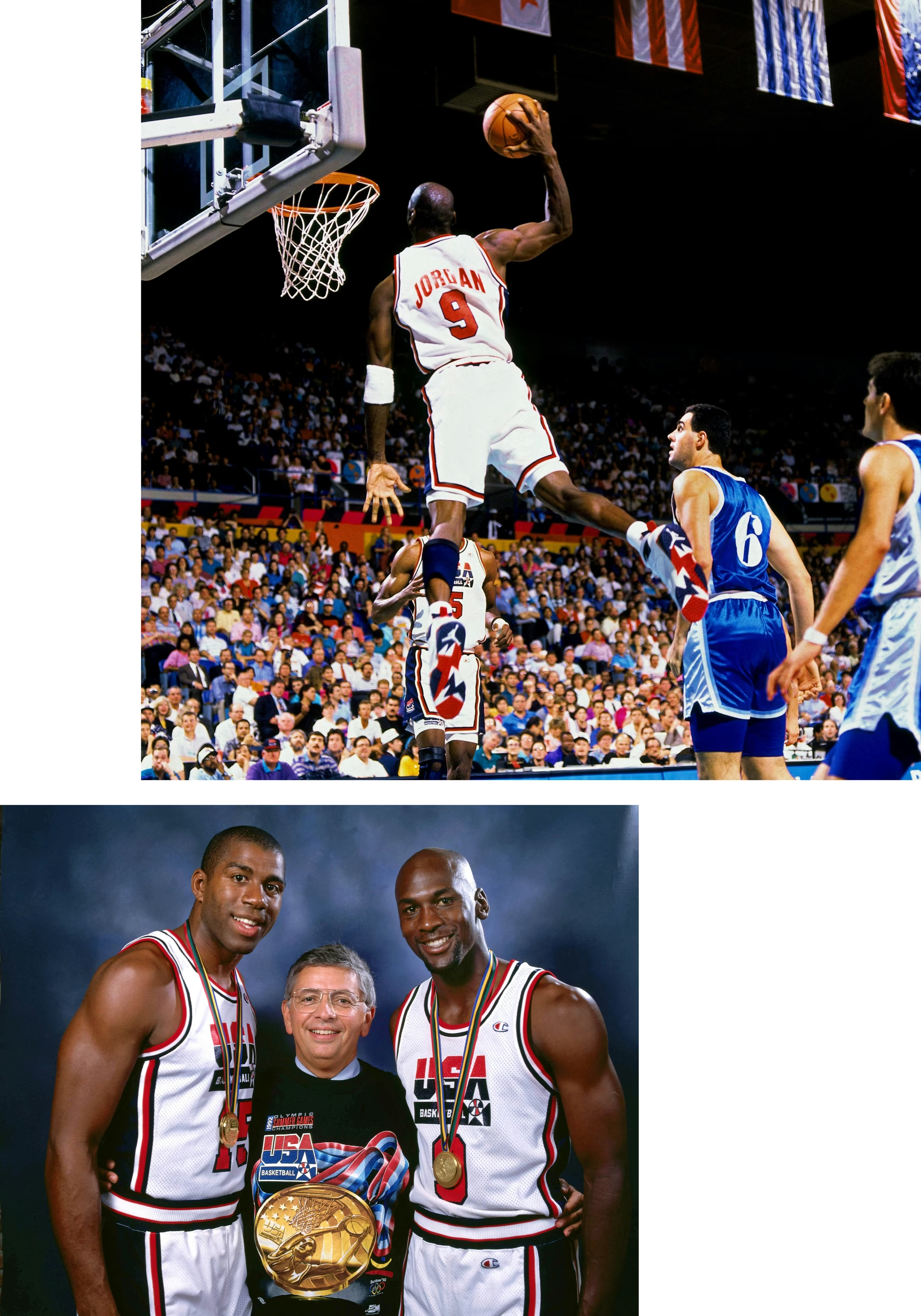
Silver’s father had once been a colleague of Stern’s, so the young lawyer wrote him a letter seeking advice. That letter turned into meetings; eventually, Stern offered Silver a job. The title was special assistant. The reality was less glamorous: Silver became the commissioner’s shadow, accompanying him practically around the clock and doing whatever research or grunt work needed to be done. “I think I had a separate desk somewhere,” Silver told me, allowing a smile, “but from morning ’til night, I sat in his office.”
We were gathered around a circular orange table with black channels—Silver, Mike Bass, and me—beneath dozens of basketballs suspended from an industrial ceiling, inside the NBA’s Manhattan headquarters. After months of pestering and cajoling, I had finally secured a sit-down with the commissioner. Reticent at first, Silver seemed to enjoy reminiscing about his mentor. They were an odd pairing. Stern, who died in 2020, was “loud, profane,” and “so different than anyone in my family,” Silver recalled. “I’d never met anyone quite like David in my life.”
For the next two decades, they were inseparable. Silver, a bachelor into his early 50s, lived to work. The understudy took note of his boss’s obsession with small details, his rapid processing of new information, his hunger for solving problems and staying ahead of the competition. He also learned what kind of boss he didn’t want to become.
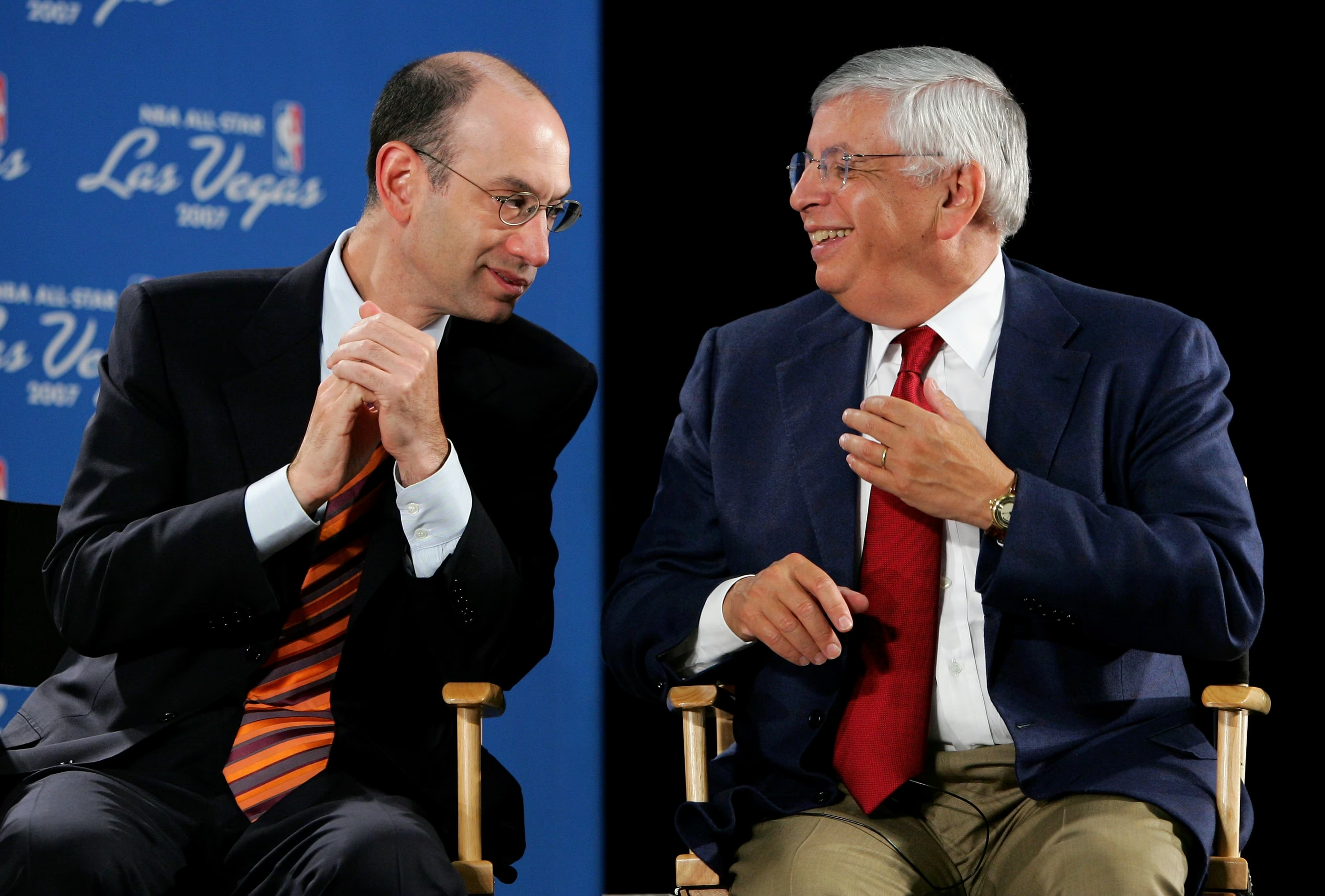
“David was really rough on some people. Not a secret. And I was often the one that after he ripped into someone and then left the room, I would be left picking up the pieces,” Silver said. “It was devastating to some people to be talked to that way, and it was unnecessary.”
Silver went on: “I think he also felt that, in many cases, he was the tough coach, with the tough love, getting the best out of people. And in doing that, it required a certain harshness—often that he would accuse me of not being up to.”
When things got out of hand, Silver told me, he would step in to play peacemaker, shielding someone from his boss’s wrath. The commissioner warned Silver that it was a weakness. “It’s too important to you to be liked,” Stern would say.
Silver did not appear to enjoy this particular memory. I sensed that he was trying to explain, however indirectly, that our strange encounter in Nashville was consistent with his approach to the job. The NBA, Silver wanted me to know, is not about him.
Modesty had not been an option when Stern joined the league. The NBA was fighting for survival; conflict and provocation were tools to achieve relevance. Stern made enemies with his brash behavior, but he also discovered a recipe for commercial success. In much the same way that another impresario, Vince McMahon of what is now World Wrestling Entertainment, was seducing audiences with gripping storylines and larger-than-life characters, Stern realized that athleticism was but a part of his product’s appeal. The target was no longer just devoted fans; Stern pitched his product to casual viewers as a soap opera on the hardwood, a tale of heroes and villains in which the domineering boss himself was always willing to play the heel.
[Read: How wrestling explains America]
A commissioner’s ultimate charge, Silver told me, is to protect the integrity of the game. Stern could be annoyed by innuendo and conspiracy theories—about a fixed draft lottery favoring the Knicks, say, or a rigged officiating scheme favoring the Lakers—but he also understood they were juicy subplots of a story arc. Silver can still remember the daily deluge of furious messages for Stern, left on his answering machine by fans who’d called the NBA switchboard and found their way to his extension, accusing him of manufacturing outcomes. But he never saw the commissioner sweat. “He would find humor in everything,” Silver said. “He never took himself all that seriously. He never took the NBA all that seriously.”
When it came time to name a successor, Stern seemed to perceive that audiences were tired of his act. There was nothing left to prove, no one left to vanquish. The torch of superstardom had been passed several times—from Magic and Bird to Jordan, from Jordan to Kobe and Shaq—and now LeBron and Steph were taking the game to a wider audience than ever before. The NBA didn’t need another conquering pugilist. It needed a caretaker.
“If more of a showman were necessary at this time, I probably wouldn’t be the right guy for the job,” Silver said. “Maybe David recognized that.”
Cards on the table: I am a lifelong Detroit Pistons fan—and a child of David Stern’s NBA.
I was a kindergartner in 1990 when I attended my first game at the Palace of Auburn Hills, home of the two-time defending champions. Better known back then by their nickname, the “Bad Boys,” the Pistons were a group of rugged, irascible competitors who bullied their opponents both physically and psychologically. From the moment I heard the PA man introduce our All-Star shooting guard, Joe Dumars—“Joe Duuuu-mars!”—I was hooked.
When I was a teenager, Dumars, who’d since become Detroit’s top executive, built his roster in the image of those Bad Boys. That led to the best years of my life as a hoops fan—none better than 2004. The Pistons won the NBA title that year by defying modernity: The team ranked near the league’s bottom in scoring and three-pointers attempted, but it led the NBA in total defense and allowed opponents to convert just 30 percent of three-point attempts—a figure that hasn’t been eclipsed since. Not even the heavily favored Los Angeles Lakers—Kobe, Shaq, and a supporting cast of future Hall of Famers—could score on the Pistons, who embarrassed L.A. in the 2004 Finals.
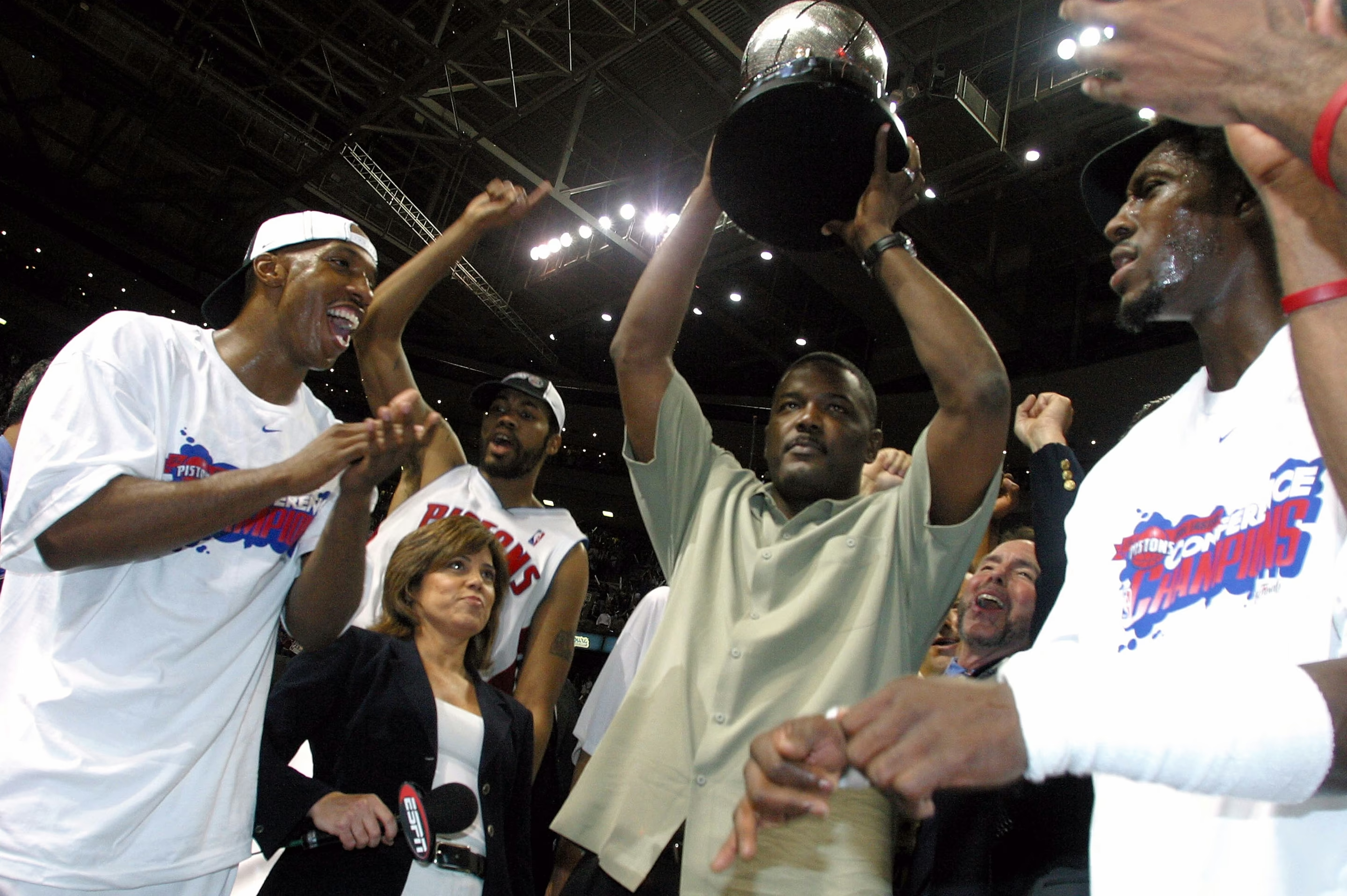
This was a troubling trend for the league. Teams such as Detroit and the workmanlike San Antonio Spurs, which won the 2003 Finals, had built a championship formula around slowing the pace and squeezing offenses. But nobody wanted to watch: The league’s two best teams were drawing some of its lowest ratings.
With the Pistons and Spurs on a collision course—they would meet in the 2005 Finals—the league was desperate for a remedy. Help arrived in serendipitous fashion. In November 2004, as Detroit began its title defense, an on-court altercation spilled over into the stands of our home arena. Scenes from the “Malice at the Palace” captured international attention: players decking fans, fans ganging up on players, coaches and referees and announcers frantically trying to end the melee. It was the ugliest episode in the history of modern professional basketball.
Embedded in this crisis was opportunity. Although the league had recently adopted new rules aimed at reducing physicality, officials were phasing them in gradually. But now the NBA had justification to crack down—and it did. No hands on a dribbler. No dislodging a player beneath the basket. No tugging on jerseys. Meanwhile, a sudden leniency was granted to ball handlers. Whistles for carrying, traveling, and double dribbling vanished as the league pushed for a faster, more exciting brand of hoops.
[From the May 2025 issue: D. Watkins on Dwyane Wade’s greatest challenge]
Scoreboards could barely keep up. Defense was out. Offense was in—and it was advancing. Teams began to fire three-point shots at a historic clip, season over season. There was a theory at work—namely, that an open three-point miss is often a better shot, analytically speaking, than a contested two-point make—but it struck many fans as a fad. And then along came Stephen Curry.
The son of the onetime Charlotte Hornets sharpshooter Dell Curry, Steph had wowed college audiences with his long-range accuracy. But he was small—three inches shorter and 30 pounds lighter than his dad—and durability concerns spooked some teams. Not the Golden State Warriors. The team was reeling when it selected Curry in 2009. Soon after, however, he would become the centerpiece of an organizational overhaul, with a front office that preached the principle of efficiency. That meant more than taking a high volume of threes; it meant featuring Curry and other snipers in an offensive system predicated on making them at such a clip that opponents would be forced to overcompensate, extending defenses and allowing easy buckets in the paint, essentially making the team impossible to defend.
By the end of his first full season as commissioner, in 2015, Silver was presenting the championship trophy to Golden State—and the league MVP award to Curry.
Golden State had reinvented the game with its sophisticated scoring attack. What the basketball world caught was something simpler: three-point fever. In 2004, teams across the league had attempted fewer than 15 threes a game. A decade later, when Curry was named MVP, that number was up to 22 a game. By the end of last season, it had ballooned to nearly 38 a game.
In some sense, this was long overdue. “There was a crisis with scoring and spacing in the ’90s and early 2000s,” Rick Carlisle, the head coach of the Indiana Pacers, told me. “The game had to evolve.” It happened faster than anyone could have predicted: Practically overnight, traditional assessments of a player—athleticism, toughness, finishing ability—took a back seat to the question of whether he could make threes. This helped introduce the modern phenomenon known as “positionless basketball,” in which some teams ask a seven-footer to orchestrate their attack from the perimeter and others deploy lineups with five shooters and no traditional big man at all.
This can make for thrilling offensive play. Yet its convergence with the post-Malice era of penalized physicality ushered in something less desirable: the decline of NBA defense. Since the Pistons’ championship in 2004, teams league-wide have gone from allowing 93 points a game to allowing 115. The evolution, Carlisle said, came at a cost. “Defending in today’s game is a task that has become—” The coach paused. “It’s not impossible. But it’s very, very difficult.”
Andre Iguodala, who won four championships with Golden State during its dynastic run, told me that he thinks about this era in terms of “unintended consequences.” I could see what he meant. Stern’s tenure had been a study in power. Drug testing increased. Lockouts were used as leverage to weaken the players’ union. Fines and suspensions were handed out wholesale. He even introduced a dress code, after the Malice, that banned accessories such as chains, medallions, and Timberland-style boots, kindling a racial tension that has long permeated professional basketball. Stern didn’t care. He would sometimes quip that although the NBA operated in the United States, it was not a democracy.
Silver corrected course. He promised to treat players as equals. He used the language of partnership and embraced how social media gave athletes greater control of the league’s image and presentation. The new commissioner made it known that his north star was not power. It was money.
In a previous posting before the commissionership, as president and chief operating officer of NBA Entertainment—the league’s media arm—Silver saw untapped investment potential, particularly overseas. (The NBA now allows sovereign wealth funds to acquire minority ownership of its franchises, which is just one source of growing international capital.) When he became commissioner, Silver pressed all of the right buttons, finding new and inventive ways to cash in on the NBA brand, such as expanding the playoffs and adding sponsorship patches to jerseys.
In the decade preceding Stern’s retirement, the NBA’s annual revenue hovered between $3 billion and $4 billion. After just a few years with Silver in charge, the league was making $8 billion, and franchise valuations were soaring. Last season, total revenue was $12.5 billion; this year, it’s projected to top $14.3 billion.
Those successes help explain Silver’s perpetual vigilance. He begins and ends his days with media briefings, but he also spends plenty of the intervening hours scrolling “NBA Twitter,” studying complaints and critiques the way a stockbroker monitors movement in the S&P 500. It’s an unhealthy habit. Silver finally married in 2015, at age 53; one person close to him told me that league employees, worn out by the commissioner’s neurotic disposition, rejoiced when his two daughters were born.
Silver does not dispute such portrayals. “There’s a lot coming at us all the time, and I think there’s plenty to be nervous about,” he said. “I think maintaining a state of mild paranoia is necessary.”
Sure enough, the current season wasn’t a week old when the news broke: Multiple people affiliated with the NBA had been arrested by the FBI and indicted on charges related to gambling, some stemming from an illegal betting ring with Mafia ties. One is a current player, the Miami Heat guard Terry Rozier. Another is Damon Jones, a onetime player and coach, who formerly had close ties to LeBron James and was once a sort of unofficial attaché of the Los Angeles Lakers. The third is Chauncey Billups, a Hall of Fame guard who was named MVP of the 2004 Finals—his iconic No. 1 jersey hangs in the rafters of Detroit’s arena and in the closet of my oldest son—and who, until the FBI arrest, was serving as head coach of the Portland Trail Blazers. Billups is charged with colluding to cheat opponents out of millions of dollars at an illegal, mob-run poker game; meanwhile, a person fitting his exact description, “Co-Conspirator 8,” is accused of leaking insider information about Portland’s roster decisions to bettors. (Jones has pleaded guilty to two counts of conspiracy to commit wire fraud. Rozier and Billups have pleaded not guilty.)
All of this was at once shocking and not quite surprising. Rozier had been investigated by the league back in 2023, when sportsbooks recorded an unusual volume of wagers pegged to his individual performance. (That he was allowed to resume playing, only to be busted by the feds, does not inspire confidence in the NBA’s system of justice.) Another person named in one of the indictments, Jontay Porter, had already received a lifetime ban in 2024 after a league investigation found that he tipped off gamblers, took himself out of a game to help bettors, and even wagered on NBA action himself. Porter’s brother, the Brooklyn Nets star Michael Porter Jr., explained on a podcast last year that young men who come from poverty see an opportunity to do something relatively harmless—faking an injury, perhaps—that can guarantee a windfall of cash for associates. “It’s bad,” Porter Jr. said of the NBA’s betting problem, “and it’s only going to get worse.”
The gambling issue is especially tricky for Silver: He was the first commissioner of an American professional league to advocate for the mass legalization of sports betting. Given the hazards that are now manifest—moral and financial and otherwise—I asked Silver, prior to the indictments, whether the league would come to regret getting into bed with the gambling industry.
His response was tortured. Silver argued that legalized betting has made it easier to catch people engaging in illegal schemes—but he would not concede that legalized betting has invited more of those illegal schemes in the first place. He said that he stands by his push to make sports gambling universal but that he is sensitive to the societal scourge of “problematic” gambling. By way of answering the initial question, Silver finally told me: “I’m not at the point where I’m saying I regret being in favor of this, but I think we should be learning every day from the behavior we’re seeing.”
Perhaps sensing my skepticism, the commissioner added, “I don’t want to be Pollyannish. I don’t want to say, like, ‘Isn’t this wonderful that everybody’s betting on our games?’”
I found myself wishing that Silver would spare us the anguished ambivalence and speak candidly: Yes, gambling can ruin lives, and yes, it jeopardizes the legitimacy of our game, but it’s making our league and its stakeholders rich. Reports suggest that the NBA collects some $170 million annually from sportsbook partnerships. When I asked him about all of the money being made, Silver downplayed the revenue as relatively insignificant. “The greater value to us is the engagement,” he said. “If you’re able to bet on a game or some aspect of a game, you’re much more likely to watch it.”
[From the April 2026 issue: McKay Coppins on his year as a degenerate gambler]
For a man so preoccupied with how his league is perceived, Silver seemed oddly lacking in self-awareness about the threats that gambling poses to the league’s legitimacy. (The commissioner has shrugged off concerns that Giannis Antetokounmpo, one of his biggest stars, owns a small minority share in the prediction market Kalshi, currently valued at $22 billion.) From the outside, cause for suspicion is self-evident. No major sport has as many late-game outcomes shaped by officiating. And no American league, aside from the NBA, has in recent memory been tainted by a referee admitting to betting on the games he officiated.
Silver spoke about that fixing scandal—after which an official, Tim Donaghy, ultimately went to prison—as if it’s a blip from a bygone era. But 2007 isn’t ancient history. And the league’s more recent troubles have done little to assuage concerns about basketball’s credibility. A November poll from Quinnipiac University asked self-described NBA fans whether they believe that players and coaches participate in illegal betting schemes. The results were damning: Only 19 percent of respondents believe that it happens “rarely if ever.” The remaining respondents think that it happens “very often” (12 percent), “somewhat often” (23 percent), or “occasionally” (46 percent).
For what it’s worth, I am part of the 19 percent. Despite the shameful spectacle of NBA personnel being cuffed by federal agents, I’m not convinced that there is a systemic culture of illegality in the league. Still, there is ample reason to distrust—and, it pains me to say, even dislike—today’s NBA.
Consider the question of “tanking”: teams doing everything in their power to lose games in order to rebuild through the draft, where the worst teams are awarded the highest picks. This strategy is not new, nor is it confined to professional basketball. But it has become something of an art form in the modern NBA. Teams in at least nine markets—one-third of the league—all but announced to their fans that losing games this season would be necessary to compete in the future.
“It’s the first time I’ve really wondered, like, Do we have the right guy running the league?” Bill Simmons, the dean of basketball’s influencer corps, said on his Ringer podcast in February. “Because he doesn’t seem interested in actually fixing real problems that everybody can see.”
The very next day, Silver abruptly fined the Utah Jazz $500,000. The commissioner declared that the club’s decision to rest a pair of star players during the fourth quarter of two recent closely contested games “undermines the foundation of NBA competition.”
It was hard to know what to make of this decision. Nobody likes tanking, but everybody can see that it works—it gives bad teams the requisite draft capital to build a championship roster. What Utah did was seemingly unprecedented, and some analysts argued that tanking via in-game benching was especially pernicious. But substitution patterns have never been a punishable offense. Given that the Jazz actually won one of the games in question—and outscored its opponent in that fourth quarter—the franchise’s owner suggested that Silver was unfairly making an example out of it, a view shared by others around the league.
Whether or not they agreed with the decision to fine the Jazz, most basketball pundits assumed that the commissioner’s punishment was a symbolic bloodletting. His tepid response to the twin crises at the start of the season—the gambling indictments and the allegations of corruption against the league’s wealthiest owner—had fueled the narrative of a feeble commissioner who’d been overtaken by events. Singling out Utah seemed a token attempt to rewrite the script.
But that assumption proved wrong. A week after fining the Jazz, Silver held a call with team officials across the league and informed them that sweeping reforms were on the way: potential structural changes to the draft, escalating punishments to offenders, a zero-tolerance policy for tanking beginning next season. The message was explicit. No longer would clubs deliberately disrespect the game and its fans in Adam Silver’s NBA. “He sounded more like Stern than Silver,” one person who’d participated in the call told The Athletic. The commissioner was, at long last, charging into the fray.
But what, exactly, are his battle plans? The anti-tanking ideas floated by his office were quickly panned as ineffective and potentially counterproductive; the formal proposal sent to teams in late April has skeptics worried about the creation of a permanent subclass of teams for whom losing with lesser talent becomes structurally self-perpetuating. In any event, if Silver is worried about the lack of competitive play, a surgical strike against tanking will accomplish only so much. There’s a more obvious barrier to keeping star players on the court: the NBA’s 82-game death march of a regular season. To many fans, this is the league’s fundamental flaw and the source of other major problems: the rash of injuries to marquee players, the “load management” strategy of resting healthy players on good teams to prevent burnout, and the anger from fans who pay top dollar to watch a watered-down product.
Punishing Utah was meant as a show of strength, but it exposed the NBA’s great weakness: a corporate mentality that views basketball decisions through a prism of profits and losses. The measures necessary to truly remedy the game—namely, shortening the season by 15 or 20 percent to keep the best players on the court and make every game more meaningful—would cost the league and its franchises money. This, in turn, would threaten Silver’s standing with the only people whose opinion of him truly matters: the team owners, known as “governors,” at whose pleasure a commissioner serves.
It’s hard to imagine Silver, for whom the answer has always been more—expanded playoffs, a new in-season tournament, three All-Star teams instead of two, and the impending, almost-certain launch of franchises in a pair of additional cities—settling for a lesser schedule. But it’s not implausible. If the outcry from fans, players, and coaches reaches a certain pitch, the commissioner could be left with no choice. It happened once before.
Two seasons ago, members of the NBA competition committee—players, coaches, referees, team executives, governors—gathered for a meeting. The vibe was tense. Critics of the league’s offensive bonanza were emboldened; even Steve Kerr, the Warriors coach, had voiced exasperation with the “disgusting” trend of ball handlers crashing deliberately into defensive players with the guarantee of a whistle and foul shots. After league officials gave a presentation, sharing metrics to demonstrate the scoring binge and the dissatisfaction of NBA viewers, Mike Krzyzewski spoke up.
“You know,” said the legendary Duke coach, who’d recently joined the league as an adviser, “fans like defense too.”
Silver described this comment—and the meeting itself—as a sort of road-to-Damascus revelation.
“We weren’t, I think, appropriately responding to the perception that we had let it go too far,” Silver told me. He later added, “To the extent that we were overly limiting on players’ ability to be physical on defense, I think that led to the perception in many cases that they were not as passionate about winning as they were in the old days.”
My childhood hero, Joe Dumars, was working in the league office at that time. He rejoiced at this epiphany. To Dumars, three components of basketball are intimately connected: physicality, intensity, and animosity. Teams that play a physical style on defense endear themselves to fans. They also piss off opponents, who respond by ratcheting up the intensity. The end result is two teams—and two fan bases—that hate each other. When the NBA was at its best, Dumars told me last year, players would walk off the airplane in a certain city ready for a brawl—metaphorical or literal.
“That’s what makes the game,” he said. “Fans today are missing out on what it feels like to be a part of a real rivalry.”
Dumars isn’t suggesting a rerun of the Bad Boys era. But he spent many years working for Silver—before he returned to the front office this season, taking over the New Orleans Pelicans—advocating for a rebalancing of the rule book, for giving defenses a chance against this historic offensive onslaught. I asked Dumars whether he thought the pendulum would ever swing back toward physicality, intensity, and animosity. His answer surprised me.
“I think the change you’re talking about has already started,” Dumars said.
Referees had called games somewhat more loosely during the 2025 season, in the aftermath of Krzyzewski’s guidance to the competition committee, but it was hardly perceptible to ordinary fans. So I was intrigued when Dumars assured me, on the opening day of the 2025 postseason, that defensive-minded reforms were already under way.
And then the playoffs began. The first week of games was downright gladiatorial. The increased contact was so dramatic that some players and coaches—including Kerr of Golden State—complained that officiating had now swung too far in the other direction.
The people who weren’t complaining: NBA fans. Viewership surged in the early rounds; the matchup between the Pistons and the Knicks, which featured constant shoving and scrapping, was a ratings jackpot. Why the spike in viewership compared with one year earlier, when those same Knicks drew fewer eyeballs? The young, surly, Bad Boys version-3.0 Pistons, who turned every game against New York into a dogfight.
More physicality, however, came with one apparent downside: more flopping. Against Detroit, the Knicks’ Jalen Brunson continually feigned injury in such farcical ways—and was so frequently rewarded with calls after crumpling to the floor—that Pistons fans serenaded him with chants of “Fuck you, Brunson!” every time he touched the ball. During the Western Conference finals, after Oklahoma City’s Shai Gilgeous-Alexander was awarded seven foul shots in the opening minutes of a game, ESPN’s color commentator labeled him a “free-throw merchant.”
It’s a serious problem—one that continues to irk fans. But evidently they’re not too bothered. The NBA reported record-breaking viewership during the opening round of the 2026 playoffs, after huge numbers a year ago. For all the differences between eras, and commissionerships, Stern’s maxim holds true: the more controversy, the more eyeballs.
Silver admitted to me that, as a fan, he was annoyed watching the antics of Brunson and Gilgeous-Alexander last postseason. And then he said something fascinating. “I think it’s part of the theater of the game, to a certain extent,” he told me with a shrug. “Even those chants at the Pistons games—I think that’s what fans come there for.”
This was a different side of Silver. Here he was in one breath, acknowledging that faked injuries and terrible calls are indeed an affront to the integrity of the game—and then in the next, wryly reminding me, and himself too, that basketball games are amusement for the masses, and that a touch of controversy is good for the product. In that moment, the commissioner of the NBA was telling an aggrieved Pistons fan to shut up, stop whining, and enjoy the show. Never had I respected the man more.
Sitting inside NBA headquarters, I thought back to how Stern would rebuke his protégé for being too soft, for caring too much about what others thought, for wanting too badly to be liked. I imagined a young Adam Silver, wide-eyed, listening to the incensed messages on the commissioner’s answering machine, only to see his boss wave them off with a cackle.
Companies take on the personality of their leader. For 30 years, the NBA was a reflection of David Stern: feisty, colorful, unpredictable, entertaining. Silver’s NBA has embodied his best qualities—competent, commercially successful—while also suffering from a certain dispassion, the type that suggests someone who has never fought to survive, only to maintain.
The commissioner isn’t in survival mode. Not yet. If that day comes, he might have to fall back upon the one lesson he refused to heed: how to be the bad guy.
The post Adam Silver Goes to War appeared first on The Atlantic.