As the school year draws to a close, the perennial worry about teenage misbehavior and how to keep youth occupied in the summer has a new name with ominous undertones: “teen takeovers.”
In Detroit, Chicago, Atlanta, the nation’s capital and elsewhere, large, quickly organized gatherings of youths have popped up in downtowns, parks and leafy neighborhoods. They can be noisy, boisterous and at times violent, their impact often amplified on television, especially in conservative media outfits like Fox News.
And city leaders have begun to pay more attention.
“It has gotten worse when it comes to the bad behavior,” Larry Snelling, the superintendent of the Chicago Police Department, said in an interview. “Kids just start to fight, so they get increasingly more violent.”
Societal anxiety over juvenile delinquency is not new. A family court judge told The New York Times in 1952, “The reasons for children getting into trouble are the same yesterday as forever — revolt, rebellion, the need for self-expression, denied to them somehow, in a natural way.” At that time, authorities attributed the “extreme behavior of youth” to the Korean War, national and international insecurity, and a lack of mental health treatment.
Now it’s social media and the long tail of Covid-19, with its resulting Zoom-from-home generation. But what is undeniably new is the role that platforms like Instagram and TikTok play in the speed of organization and the scale of assembly. And the larger the gatherings, the better the chance that something can go wrong.
“Detroit teens do have a thing for pulling out guns while fighting,” said Malaysia McCline, 15, who recalled stumbling into a teen takeover last month after the Tigers’ opening day.
She and friends had noticed a growing crowd at the city’s waterfront that included a former classmate she’d lost touch with. It was fun, but by nightfall, some became rowdier, yelling and running. Police officers moved in.
“I was scared,” she said.
Law enforcement officials around the country are enjoying a period of good news. Crime overall in cities including Columbus, Chicago, Houston and Los Angeles has dropped significantly in recent years. Homicides nationally are poised to hit their lowest rate in more than a century, data shows, a remarkable recovery from pandemic highs.
But the pandemic exacerbated a decline in the amount of time that teenagers spend going out and socializing, and socializing is a natural impulse, said Laurence Steinberg, a psychology professor who studies adolescent development. It is bound to burst out.
Just what should be considered a teen takeover is nebulous. On May 3 near Oklahoma City, at least 23 people were injured in a shooting at what police labeled an “unsanctioned” lakeside party. Like classic takeovers, it had been advertised on social media and drew a large crowd of teens and people in their early 20s.
Politics might be amplifying how adults are perceiving the threat. In a year when midterms loom and Republicans are facing stiff headwinds on the war in Iran, the economy, inflation and the cost of living, the issue of crime might be a bright spot for the party. A Pew Research poll last week found that by 17 percentage points, more Americans said they agreed with Republicans than Democrats on crime policy, a bigger edge than the party had two years ago.
Ahead of summer, some urban leaders have tried to make inroads with teens, hoping to channel their urge to socialize into more constructive activities that keep them safe and prevent bad actors from disturbing the peace.
After a pair of teen takeovers in Detroit last month, Mayor Mary Sheffield summoned the youthful organizers to her office. They hashed out ideas like late-night basketball at city recreational centers, new public space developments and a new youth advisory board.
“They wanted a place to get out, be free, have fun and hang out,” Ms. Sheffield said in an interview.
It’s not that easy, said Ashley Jennings, 17, who serves on the Youth Advisory Panel for the Detroit Board of Police Commissioners. It takes money and transportation to get to the suburbs, where teenagers can bowl or watch a movie and avoid the city’s 10 p.m. curfew. Teen takeovers, by contrast, are free and accessible.
The panel provides Ms. Jennings with a platform to authorities that most teens don’t have.
“When somebody shuts you up so much, you have no choice but to think your voice is not important,” she said.
Louis Custard, another Detroit teenager, agreed. What adults call teen takeovers, he called breaking free of the constraints that social media, gangs and excessive policing impose on teen lives.
“What I see is a bunch of kids trying to escape from the modality of their regular day-to-day life,” said Mr. Custard, 16.
Some of the panic over teen takeovers has echoes in worries over “wilding” in the late 1980s and “superpredators” in the 1990s.
“There was a lot of dog whistling there about the fact that these are Black kids who are gathering together in these large groups, and we should be afraid of them,” Mr. Steinberg said.
Black and Latino youth gatherings are more likely to be assumed as criminal, said Kristin Henning, a Georgetown University law professor who specializes in juvenile justice. White children in skate parks in the 1980s and 1990s did not generate nearly the same level of surveillance and arrests as Black gatherings, she said.
That doesn’t mean concerns over rowdy teen gatherings are confined to white people or conservative media outlets. Small business owners and neighbors of all kinds are vexed.
“Every bar and restaurant, corner store or hamburger shop or pizza slice place, they want customers, and customers don’t come back when there are kids jumping on top of hoods of cars, running down the street, knocking people over, threatening people,” said Chuck Thies, a political consultant in Washington, D.C., who advised a former mayor, Vincent Gray.
In the nation’s capital, the issue has been made more urgent by the district’s Democratic mayoral primary in June, an economy sagging under the weight of Trump administration job cuts, and the threat of still more budget cuts by Congress.
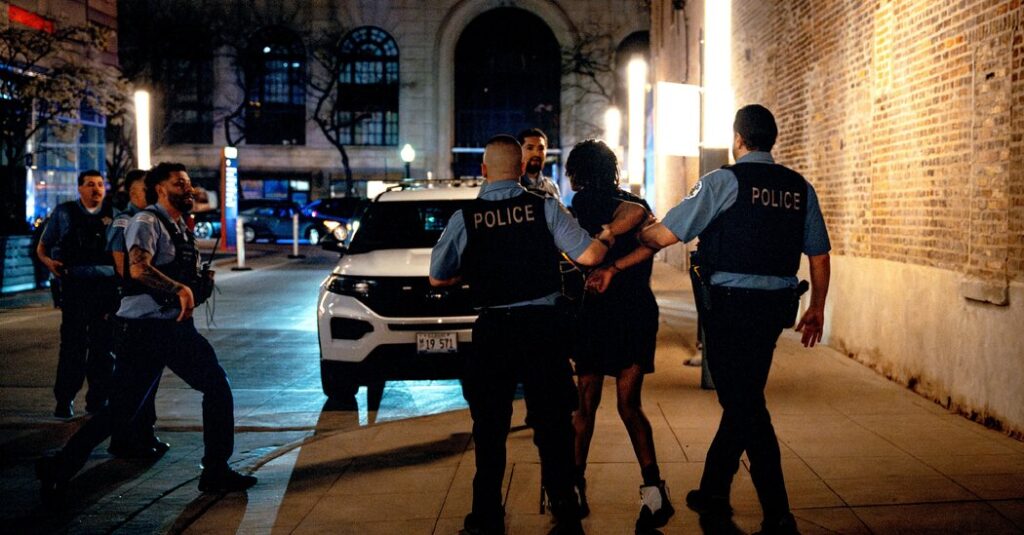
Police are taking notice. Officers in Chicago monitor social media for what they call “teen trend” announcements, and receive tips from parents, community organizers and school officials when a takeover is posted.
They first try to stop it from happening, talking to teenagers, parents and principals. Superintendent Snelling estimated that the department has headed off “hundreds” of takeovers — in the heat of summer in Chicago, there can be several planned each day, he said.
For takeovers it doesn’t stop, the police department makes sure that officers are stationed at the scene.
“There’s zero tolerance for when we see crimes being committed,” Mr. Snelling said. “We will take someone into custody and charge them accordingly.”
In March, a takeover in Chicago’s Hyde Park neighborhood, near the University of Chicago, left a trail of property damage after teens stomped on car hoods and broke windshields. Two weeks later, parents and educators on the city’s South Side decided to organize a “parent takeover,” which drew more than 60 people who stood outside a coffee shop and monitored the area.
Trez V. Pugh III, the coffee shop owner, thinks the kids are just bored. “Some kids are just looking for attention, and they don’t realize there are repercussions, consequences for their actions,” he said.
All of this had brought back a fierce debate over curfews, in Detroit, Chicago and elsewhere. This week the District of Columbia Council voted 8 to 5 to give the mayor authority to declare 8 p.m. “curfew zones” to prohibit large teen gatherings in certain areas and require youth event programming whenever the mayor or police chief establishes such zones. The measure still needs approval from the mayor and Congress and likely wouldn’t be in effect at the beginning of summer.
Last summer, Mayor Brandon Johnson in Chicago vetoed a curfew measure passed by the City Council.
Even proponents say such curfews are at best a temporary solution. Teens are especially leery.
In Atlanta, Haile Irving, 17, and Devin Mitchell, 16, delivered a speech in March titled “Re-Imagining Third Spaces” at a conference for the city’s public school students. In front of school board members, a superintendent and aides for Mayor Andre Dickens, Ms. Irving and Mr. Mitchell argued that teenagers needed their own spaces, modeled after co-working spots downtown, to do homework and art projects, host charity events, or hold pop-up shops to sell goods and services.
The mayor’s chief of staff awarded the duo a $50,000 grant to help make the concept happen.
“The issue is having to deal with being seen as a criminal when you’re trying to access fun as a kid,” Ms. Irving said. “There are issues with safety when safety isn’t adequately built for you.”
Kim Bellware contributed reporting from Chicago.
Clyde McGrady reports for The Times on how race and identity shape American culture.
The post What Are ‘Teen Takeovers’ and Why Are Police Struggling to Stop Them? appeared first on New York Times.