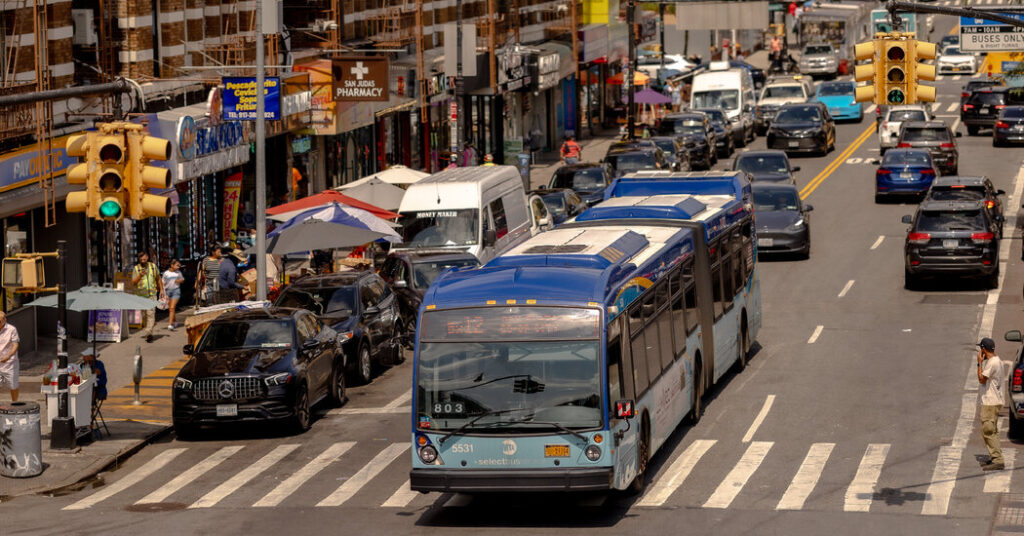
With few signs of progress on Mayor Zohran Mamdani’s promise to make New York City’s buses free for all riders, the City Council and some transit advocates are pushing for a more targeted alternative: focusing on the riders who need the help the most, now.
City officials are seeking to revamp an existing and underutilized city program called Fair Fares, which provides half-price subway and bus fares to low-income New Yorkers. Transit riders, advocates and elected officials have argued that in its current form, it excludes many of the roughly one million residents who qualify and need support.
Nodding to those concerns, Julie Menin, the Council speaker, said at a news conference on Wednesday that she supported plans to automatically enroll eligible lower-income New Yorkers into the program, and to make public transit completely free for them.
Fair Fares currently charges New Yorkers who make less than 150 percent of the federal poverty level half price — or $1.50 — to take bus, subway and paratransit rides. Individuals must make less than $23,500 a year to qualify; a family of four needs a household income of about $48,000 or less. Citizenship status is not considered.
Though nearly 380,000 New Yorkers receive the discount, about 575,000 more qualify for the program and do not take part. Supporters of the plans note the application process requires complicated paperwork that they say has stunted enrollment.
The City Council’s push comes as a number of transit advocacy groups have raised concerns about Mr. Mamdani’s free bus plan, which has been projected to cost nearly $1 billion a year, at a time when the city is facing a $5.4 billion budget deficit.
The Council proposals, in contrast, would be more targeted and cost less. Mr. Mamdani’s office did not respond to requests for comment about the plans.
The mayor angered some advocates this year when he did not include funds in his preliminary budget to expand the Fair Fares program.
He has pitched free bus service as a public good, similar to libraries, that would benefit all New Yorkers, regardless of financial need.
Making buses free is key to Mr. Mamdani’s goal of making the fleet, one of the slowest in the nation, faster and more reliable. As an assemblyman, Mr. Mamdani championed a 2023 pilot program that made a select number of bus lines free. (Ridership increased, but the speed of service did not.)
Still, Mr. Mamdani’s plan faces challenges from Gov. Kathy Hochul, who could be vital to its funding. She has been unwilling to raise taxes on the rich at the scale proposed by Mr. Mamdani. And the Metropolitan Transportation Authority, the state agency that controls the city’s buses, has distanced itself from the plan, at a time when it is trying to crack down on fare evasion.
The lack of movement on the free bus plan has opened the door for more specific proposals from the City Council.
Ms. Menin, speaking at the news conference on Wednesday while surrounded by transit advocates on the steps of City Hall, said there was an urgent need to expand the program, amid a growing affordability crisis.
“People are literally forgoing meals because of this cost,” she said. “It is shameful.”
About one in five New Yorkers struggle to pay for public transit, a burden disproportionately borne by Black and Latino commuters and working mothers, according to a 2024 report from the Community Service Society of New York, an economic justice group.
The Fair Fares program, which began in 2019, currently costs the city less than $100 million a year. The proposal to automatically enroll qualifying residents, and to make public transit free for that group, could more than double that price tag.
Several transit advocacy groups are seeking more changes to the program.
The Citizens Budget Commission, a fiscal watchdog group that is skeptical of Mr. Mamdani’s free bus plan, said it instead supported raising the income limit for Fair Fares to 250 percent of the federal poverty level. That would include individuals making up to $39,900 a year, or a four-person household making $82,500.
At that threshold, two million New Yorkers would be eligible for the half-fare discount, and it would cover one in four working adults in the city, the group said.
Others want to make the program even more inclusive.
The Community Service Society has called for raising the income threshold to 300 percent of the poverty line, or about $99,000 for a family of four.
“It’s not capturing the real need,” said Rachel Swaner, a vice president at the organization, noting that there are many families who make marginally more than the current income limit. “They make too much to be eligible for public benefits, but they are really struggling to make ends meet.”
At the news conference on Wednesday, supporters of the Council’s proposals said the need for immediate economic relief was urgent.
Susie Kamara, 39, a home health aide living in the Bronx, said she applied for the Fair Fares program but was denied, because she makes about $1,000 more than the current income threshold.
So she pays full fare for the Bx12 bus and the No. 2 train she takes on her commute, despite the economic hardship. “I don’t have a choice, because my patients are waiting for me,” she said.
To a loud round of applause, Ms. Kamara said she supported raising the income threshold for the program to 300 percent of the poverty line.
Then, she directed her words to an audience of one.
“Mayor Mamdani, expand Fair Fares,” she said. “Make it fair — now.”
Stefanos Chen is a Times reporter covering New York City’s transit system.
The post Mamdani Wants Free Buses for All. The City Council Has Different Ideas. appeared first on New York Times.