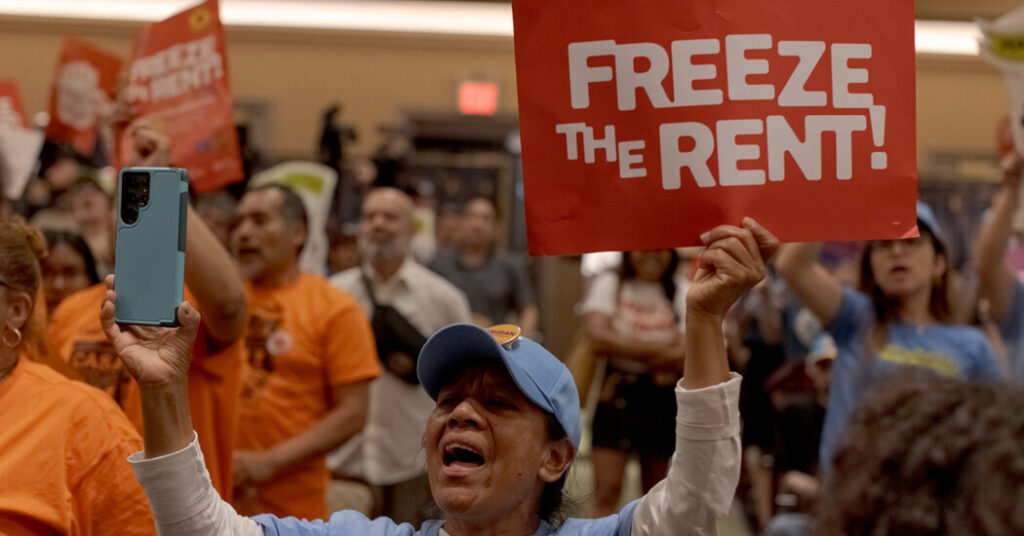
Mayor Zohran Mamdani’s push to freeze rents for nearly one million rent-stabilized New York City apartments will reach a crossroads on Thursday, when the panel that decides whether rents should go up casts its preliminary vote.
The panel, known as the Rent Guidelines Board, is expected to agree on ranges for potential increases for one-year and two-year leases. If the panel is open to backing a rent freeze, the ranges approved at Thursday evening’s meeting are expected to begin at 0 percent.
The board will officially approve either a rent increase or a freeze when it votes again on June 25. It will analyze the economics of rent-stabilized buildings, renter incomes, wage data, inflation and changes in the city’s housing supply, among a host of other metrics, to reach its decision.
The city is facing one of its starkest affordability crises ever, as the worst housing shortage in nearly 60 years continues to send housing costs soaring. The median asking rent on a new lease was about $4,120 in April 2026, according to the renting platform StreetEasy, up from $2,800 in April 2019.
The Rent Guidelines Board voted last year to allow increases of 3 percent on one-year leases, and 4.5 percent on two-year leases.
The panel’s decisions are always contentious. But its work has attracted even more attention this year, given Mr. Mamdani’s campaign promise of a rent freeze and landlords’ ongoing complaints about the increasing costs of owning and maintaining property in New York City.
All nine members of the board are appointed by the mayor, and Mr. Mamdani has appointed a majority of its current members, making it more likely that the panel will back a freeze. Still, the board is supposed to operate independently and free of the mayor’s influence.
“I trust that they will consider all the factors facing the city’s rent-stabilized tenants and come to an appropriate decision,” Mr. Mamdani said in February when he announced his board appointments. “Together we are building a city where every person can afford a roof over their head.”
Ann Korchak, the board president of the Small Property Owners of New York, a landlord advocacy group, said in a statement on Wednesday that if the board members “concede to the politics of a rent freeze or insignificant rent increase, they will be following a path of defunding rent-stabilized housing.”
Some tenant groups, perhaps unsurprisingly, called for the board to approve a rent reduction.
“For far too long, landlords have been sitting on mountains of profits while our buildings are falling apart,” the Rent Justice Coalition, which is made up of dozens of tenant groups, said in a letter to the board on Tuesday. “When landlords raise our rent, that money goes to line their pockets and buy new buildings, not fixing our homes.”
The board’s research showed that between 2023 and 2024, the most recent period for which data is available, the “net operating income” — a metric of a building’s financial health that takes into account revenue from rent and some costs like insurance — increased in every borough except in the Bronx, where it dipped slightly. Citywide, it increased by more than 6 percent.
Rent stabilization is a form of rent regulation that was created in the mid-20th century to protect New Yorkers from sharp rent increases.
Forty percent of all rental apartments in the city are rent stabilized, and they are home to a vast and diverse set of New Yorkers.
A median rent-stabilized studio apartment rents for about $1,360, and a two-bedroom rents for about $1,530 a month, according to city data. The median rent for a market-rate studio is $2,000, and for a two-bedroom it is $2,200.
Most rent-stabilized apartments are occupied by people with lower or middle incomes: The median household income for rent-stabilized tenants is about $60,000, compared with $90,800 for market-rate households, according to a 2023 city survey.
But people with higher incomes can live in rent-stabilized apartments, too, and many do. About 7 percent of rent-stabilized households — amounting to tens of thousands of people — earn between $150,000 and $200,000, according to an analysis of city housing data by the Citizens Budget Commission, a nonprofit fiscal watchdog.
Many new, expensive units are kept rent stabilized by developers in exchange for property tax breaks. According to the board’s most recent analysis, the city added nearly 15,000 rent-stabilized units in 2024, which had a median rent of more than $3,100.
The economics of these buildings may be very different than those of older, more affordable rent-stabilized buildings. Older buildings tend to have lower net operating incomes than newer ones.
The diverging trends are most apparent in the Bronx. Between 2023 and 2024, the net operating income rose by 1.5 percent in buildings there that were constructed in or after 1974, but decreased by 0.8 percent in those built earlier.
Mihir Zaveri covers housing in the New York City region for The Times.
The post Will New York Freeze the Rent? A Panel Will Cast Its First Vote. appeared first on New York Times.