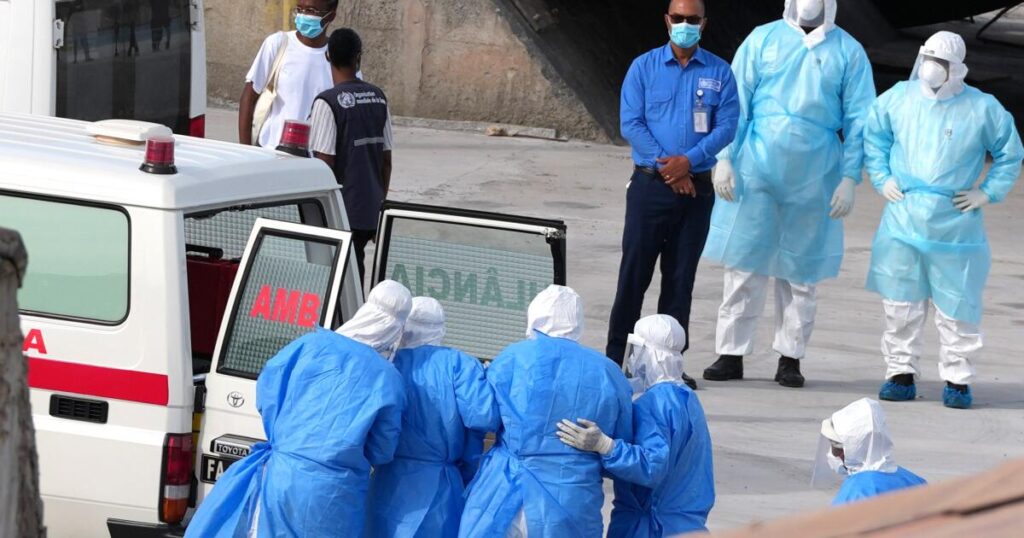
Some California residents were among the 147 passengers and staff aboard a luxury cruise ship stricken by a suspected outbreak of hantavirus that has left three people dead and several others severely ill, officials confirmed Thursday.
California public health officials say they are currently monitoring the situation after being notified by the U.S. Centers for Disease Control and Prevention that some state residents were passengers on the MV Hondius. The precise status of those individuals, however, remains murky.
Hantavirus is a rare but deadly disease that attacks the lungs and is typically contracted by humans through inhalation of particles contaminated with the urine, feces or saliva of a wild rodent.
However, Dr. Tedros Adhanom Ghebreyesus, director-general of the World Health Organization, confirmed Thursday thatthe Andes virus — a form of hantavirus that can spread from person to person — was involved in the outbreak.
Here’s what we know.
As its name suggests, the Andes virus is typically found in South America. The Dutch-flagged MV Hondius was on a 46-day journey that traveled from Antarctica with stops in Argentina.
In the case of human-to-human transmission, a person would first be infected by a wild rodent’s contaminated particles and then pass the infection to someone else, said Dr. Gaby Frank, director of the Johns Hopkins Special Pathogens Center.
“In previous outbreaks of Andes virus, transmission between people has been associated with close and prolonged contact, particularly among household members, intimate partners and people providing medical care,” Ghebreyesus said. “That appears to be the case in the current situation.”
California passengers on the cruise
On April 1, 114 guests boarded the cruise ship in Ushuaia, Argentina. Twenty-three days later, 30 passengers — including six people from the United States — disembarked on a stop in Saint Helena, a remote island about 1,100 miles off the coast of Africa, according to the cruise operator Oceanwide Expeditions.
Among those who left was a woman accompanying the body of her husband, who had died on April 11 while the ship was at sea in the Atlantic. At the time, the cause of the man’s death could not be determined, the ship operator said.
The woman also became ill, and died on April 27.
Public health agencies in California, Georgia and Arizona were notified by the CDC that some of their residents were among the passengers on the cruise. It’s unclear whether these individuals disembarked on April 24, however.
The CDC is assisting local health authorities with monitoring California residents who were aboard the cruise, Robert Barsanti, a spokesman for the California Department of Public Health, told The New York Times. Barsanti did not disclose how many Californians the department is monitoring.
“There is no information that the California residents are ill or infected,” Barsanti told the New York Times. “At this time, the risk to public health in California is low.”
A public health spokesperson did not immediately respond Thursday to a request for comment from The Times.
In a statement Wednesday, the CDC said that the risk to the American public “is extremely low” at this time.
“We urge all Americans aboard the ship to follow the guidance of health officials as we work to bring you home safely,” the agency said.
The others who exited the ship on April 24 were individuals from Canada, Denmark, Germany, the Netherlands, New Zealand, Switzerland, Sweden, Singapore, Saint Kitts and Nevis, Turkey and the United Kingdom.
How many people have been infected?
The number of lab-confirmed hantavirus cases has risen to five, according to the WHO. There are three additional suspected cases.
A timeline of reported cases of hantavirus aboard the cruise ship can be found here.
What we know about hantavirus
There are roughly 50 identified species of hantavirus. The virus that’s found in the Americas tends to cause a cardiopulmonary syndrome, a condition that affects the heart and the lungs, according to Frank.
There have been 890 laboratory-confirmed cases of hantavirus disease reported in the U.S. since surveillance began in 1993, according to the most recent data from the CDC.
Between 1993 and 2023, there were a total of 79 cases of hantavirus in California. Among those who were infected, 24 died.
CDC officials said 38% of people who develop respiratory symptoms may die from the disease.
Still, the data suggest that contracting hantavirus is rare, said Dr. Afif El-Hasan, member of the American Lung Assn.’s national board of directors.
There is no vaccine or specific antiviral medicine for hantavirius.
Intensive-care treatment may include intubation and oxygen therapy, fluid replacement and use of medications to lower blood pressure, according to the American Lung Assn.
The signs of hantavirus
Early symptoms of hantavirus are similar to the flu and include fatigue, fever and muscle aches, according to the CDC. Symptoms start to develop within one to eight weeks after contact with an infected rodent.
Half of those who contract the virus also experience headaches, dizziness, chills, nausea, vomiting, diarrhea and abdominal pain.
Four to 10 days after the initial phase of the illness, another round of symptoms can develop, which include coughing, shortness of breath and possible tightness in the chest as the lungs fill with fluid.
Even though contracting hantavirus in the U.S. continues to be a rare event, El-Hasan said, people should take these initial symptoms seriously and promptly seek medical care.
How to protect yourself
Hantavirus cases can occur year-round, but the peak seasons in the United States are the spring and summer, which coincide with the reproductive seasons for deer mice.
To lessen your risk of infection, keep wild rodents out of your home and other enclosed spaces by sealing any holes and placing snap traps.
If you find evidence of mice, wear personal protective equipment and disinfect the area. When you’re done, put everything, including cleaning materials, in a bag and toss it in your trash bin.
The post Californians were aboard hantavirus-stricken cruise ship. Is there a risk to the public? appeared first on Los Angeles Times.