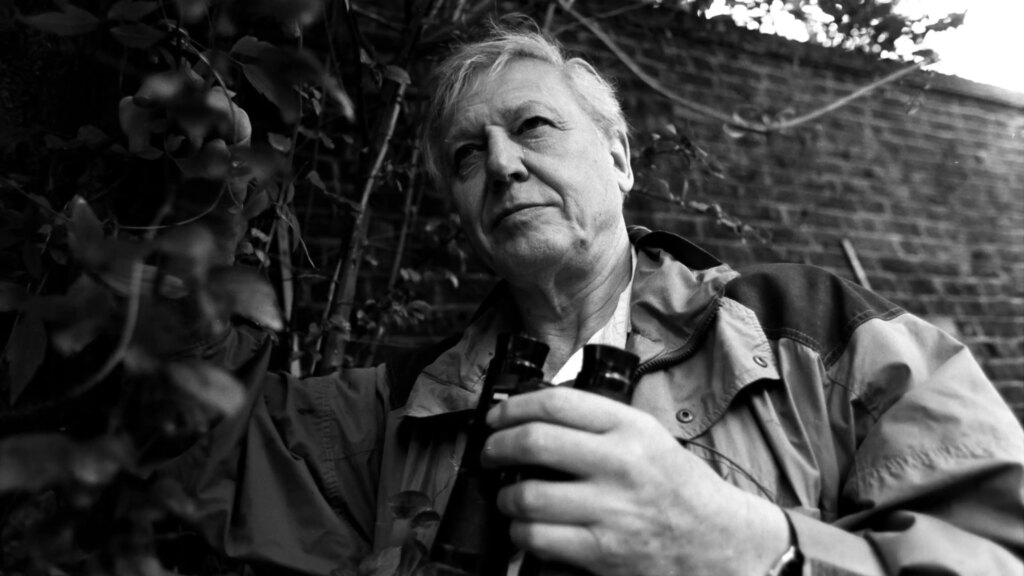
For almost anyone who grew up in the United Kingdom, Sir David Attenborough is more than a broadcaster; he is a secular saint. He is an institutional pillar as essential to the national fabric as a cup of tea. His almost-whispers have been the soft soundtrack of the home—a shared experience that turned the weekend nature documentary into a national ritual.
For Americans, I imagine, Attenborough shows up not as a personality so much as a standard. He is the “Voice of Nature,” the invisible, elegant authority narrating the high-definition spectacles of Planet Earth or Blue Planet.
Whether you grew up enjoying “biscuits” or “cookies,” he is the man who showed you the world through a uniquely spectacular lens. He has earned the world’s trust by simply showing us that our environment is worth appreciating. He didn’t demand our attention, but drew us in with the wonder of nature all the same. In Attenborough’s approach, we find a vital lesson for our time: that wonder is a powerful precursor to protection, reminding us that we may only care for a world that we have first learned to truly value.
As we reflect on Attenborough’s 100th birthday, on May 8, I find myself thinking less about the extraordinary scale of his work and more about the moments that revealed his humanity within it. The flashes of amusement when things went wrong. The unmistakable delight when an animal treated him not as a presenter, but as part of the environment itself—catching him off guard, interrupting the perfect narration, reminding us that nature cannot be scripted. Those moments always felt important, because they revealed something deeper than expertise: genuine reverence and curiosity. And I suspect they brought him the greatest joy of all—those rare moments of feeling completely at one with the natural world, where the creatures he was studying treated him as one of their own—perhaps the purest form of acceptance nature can offer.
Attenborough’s measured demeanor and lack of any conceivable agenda mean that the alarm bells he sounds signify all the more urgency. When a man who has quite literally seen it all begins to describe the loss of the planet’s stability, he isn’t being provocative. He is reporting from the front lines of a planet he has known longer, and more intimately, than almost anyone alive.
His most significant contribution has been the systematic dismantling of the notion that climate issues are happening “somewhere else.” For most people, the natural world is often a destination visited through a screen, safely removed from the pressures of daily life, offering a rare sense of calm, perspective, and escape. Attenborough has made that distance impossible to maintain, and his work has helped us to connect the dots, showing that distant glaciers, forests, and rivers are far more than beautiful landscapes—they are part of the delicate systems upon which our own communities depend. Through his work, we have also come to better understand how forms of modern consumption that appear far removed from nature can nevertheless place enormous strain on the ecosystems sustaining it.
This shift in how we view our relationship with nature has hit hardest for the generation that grew up alongside his work. These children did not learn about extinction from dry textbooks. Rather, they watched it happen in high definition and narrated by a voice they trusted. His voice.
Now, even as the message has continued to darken, Attenborough’s ability to draw in the youth has only deepened. He has bypassed the generational gap by embracing the platforms where young people live, reaching millions through social media and streaming. He doesn’t preach or lecture but shares a perspective that spans a century. To a generation overwhelmed by noise and uncertainty, Attenborough represents credible authenticity. Young people continue to listen to him not just for the spectacle of nature, but for a sense of continuity in an unstable world. From him, they can learn that environmental stewardship is a lifelong commitment rooted in observation and the courage to remain present even when the data is disheartening.
Attenborough’s authority was accumulated over decades of consistency and a quiet refusal to look away from the truth, even as it became harder to watch. He has provided the global audience with a map of the damage alongside a vision of what remains. For today’s decision-makers, emulating his lens—a rare blend of childlike wonder and clear-eyed realism—is essential to any progress.
I suspect that a lifetime spent so closely observing the natural world has deepened in him the very qualities that make us most human: humility, curiosity, patience, and reverence for life itself. By adopting these traits, the younger generation can feel empowered to channel their concerns around the climate into disciplined, purposeful advocacy.
At 100, Sir David Attenborough has spent a lifetime delivering us the facts with patience, honesty, and wonder. He has shown us the world in all its brilliance and fragility, and in doing so has left humanity with both a gift and a responsibility. The question now is whether those with the power to act will choose to lead before more of our world—our life support system—is lost.
The post At 100, David Attenborough’s Voice Is a Lesson in Wonder and Planetary Stewardship appeared first on TIME.