When the Trump administration talks about the future of education, it tells on itself. Beneath the language of “innovation” and “fostering the future together” is a clear agenda: weaken public education, turn it into a revenue stream for billionaires, and create a docile generation unlikely to challenge its blatant authoritarianism. That agenda is evident in every move it makes, from promoting private-school voucher schemes, to whitewashing history, to dismantling the Department of Education. To this administration, education is both a threat and a market opportunity.
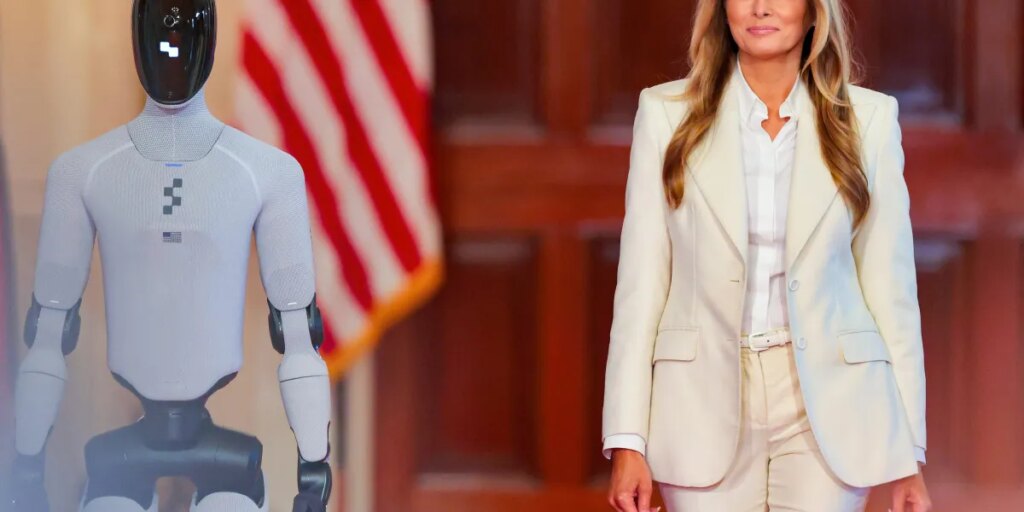
In a recent tactical blunder, the first lady’s farcical rollout of a teacher robot made unusually clear what this administration really thinks of children, teachers and schools. But what it revealed most was a profound lack of humanity.
The robot’s unveiling included nothing about the responsibility of helping a child learn. Nothing about building trust between students and teachers. Nothing about the daily judgment educators use to steady an overwhelmed child, adapt a lesson, stoke critical thinking, de-escalate a conflict or help a student who comes to school hungry. There was no humility about the immense weight public schools are asked to carry, and no respect for the people who carry it.
A fair number of educators responded with mirth because the absurdity was impossible to miss, and because humor is a defensive tactic in the face of a threat. Educators are acutely aware of how dangerous it is that this administration consistently dehumanizes children and discounts their needs. Children are seen as neither a treasure nor the future flag bearers of this country’s immense potential and responsibility. They are treated as a market.
That was reflected in the first lady’s familiar language of gross domestic product growth and shoutouts to the tech billionaires who stand to reap significant financial rewards. She offered a hollowed-out vision of education shaped not by educators or families, but by people who see children as data points, classrooms as markets and teachers as a barrier to profit.
If administration officials spent a day in a real classroom, they would see that teaching is so much more than information transfer. They would see teachers like our member in Minnesota, who keeps a beanbag chair in the back of her classroom because one of her students is unhoused and sometimes needs a safe place to rest. They would see our member in Kansas, who steps into the hallway to help a 10-year-old regulate his emotions so he can return to class ready to learn. They would see our New York member at the National Academy for AI Instruction training special education teachers to use artificial intelligence thoughtfully and responsibly to support all students, when every single one has a different set of needs. They would see that educators spend their own money to stock classroom libraries because students do not have books at home. And they would know that school staff are currently organizing grocery deliveries for families too fearful of Immigration and Customs Enforcement to leave the house.
They would also see that subjecting children to the whims of unregulated AI can fail disastrously. Parents in Brownsville, Texas, enrolled their children in the private Alpha Schools which dispense with face-to-face classroom teaching and replaces it with screens and software. There are “guides”—adults who are not required to have an education background—in the room to troubleshoot if needed. The result? Third graders who did not know how to hold a pencil, who could read individual words but not sentences or paragraphs, and who were so anxious they engaged in self-harm. When one Alpha parent finally returned her 8-year-old to public school, he was reading at a kindergarten level. Another child frequently misspelled words longer than three letters.
The “AI-first” model fails because children need more than a daily download of information. Education helps young people learn to reason, to question, to distinguish fact from fiction. It enables them to encounter people unlike themselves, and to imagine a future bigger than fear. Education helps students focus on knowledge application, not just knowledge acquisition.
That is what teachers do every single day. They do the complicated, deeply human work of helping young people grow.
The first lady’s robot rollout was about creating a model of education that’s easier to monetize, easier to control and easier to strip of its democratic purpose. If public education can be reduced to a product, it can be sold. If teaching can be deprofessionalized, expertise can be replaced by vendors. If critical thinking can be pushed aside, power faces less resistance.
We should be clear about what is at stake. This is not a debate between innovation and nostalgia. It is a fight over whether education will remain a public good rooted in human relationships and democratic purpose or be reduced to an online marketplace where billionaires profit and children pay the price.
We should be investing in brick-and-mortar public schools, not technological fantasies. In smaller classes, not bigger screens. In counselors, paraprofessionals, special education services and well-prepared teachers, not gimmicks designed to line the pockets of tech companies. We should be establishing guardrails for AI and social media and helping educators use technology that supplements, rather than supplants, their expertise.
Human teachers are irreplaceable because teaching and learning is a human endeavor. If we allow this administration to keep hollowing out public education, treating it as both a revenue opportunity and a threat to be contained, we will not be modernizing schools.
We will be abandoning the very thing that makes learning possible.
The opinions expressed in Fortune.com commentary pieces are solely the views of their authors and do not necessarily reflect the opinions and beliefs of Fortune.
The post Teachers union chief: Melania Trump’s robot reveals what this administration really thinks of children appeared first on Fortune.