NEW YORK — At the gate, guests slipped their phones into little cloth bags, putting them away for the evening. As the sunlight faded on a cobblestone street, more than 200 students from New York University gathered at a table nearly as long as the city block. It was cold — so cold that they ate wrapped in plush blankets and clutching handwarmers — but they leaned in to talk with strangers, laughing and trading stories.
“This is amazing,” junior Grant Callahan said after conversations about philosophy, AI and Shanghai.
That’s because in his experience, something once quintessential to college life has been completely changed by technology. Instead of the socializing that American college culture is known for, many students walk around campus looking down at their phones, scroll through elevator rides and sit in classrooms glued to their laptops.
Many college leaders are concerned about the amount of time students spend on screens and social media, worried that it is increasing isolation, loneliness and anxiety, shattering attention spans, and preventing social connections.
New York University is one of the places trying to change that, with a global effort that they’re calling NYU IRL — or NYU “in real life.”
It’s not like the movement sweeping K-12 schools to ban cellphones in classrooms. It’s both more ambitious and less heavy-handed. NYU leaders are hoping to encourage a student-led culture change, a shared effort to spend less time online and more time living life. They want students to have more fun in person, together. The university president’s goal: “Collective effervescence.”
“If you’re someone who went to college 20 years ago,” Callahan said, “I don’t think you understand how different the experience is now, how much harder it is to interact with people.”
After growing up with screens and the coronavirus pandemic, he said of his generation, “We’re socially illiterate.”
School leaders have already ensured there’s a welcoming space for people to unplug on their campuses in New York, Shanghai and Abu Dhabi, the capital of the United Arab Emirates. They plan to infuse the idea of using devices more consciously into orientation, and promote a 30-day phone breakup plan.
Now students are dreaming up phone-free parties and events in saunas, gardens and dance studios.
It won’t be easy to change the culture, said Hank Leipart, a sophomore who helped pull off a phone-free house party for NYU IRL earlier this spring, and an outdoor salon with charcuterie and yerba mate on Monday. “But I do think it is something that is really possible.”
It will require intentionality. Half of teenagers spent four or more hours looking at screens every day for things other than schoolwork, according to a 2024 report from the National Center for Health Statistics, and the percentage of teens reporting symptoms of depression or anxiety in the past two weeks of the survey was higher among that group compared with those with less screen time.
There is some hope and self awareness. Young people have become more wary of social media, according to Pew Research Center findings. Nearly half of teens in a survey last year said social media sites have a mostly negative effect on people their age — up from just under a third in 2022.
To deal with these issues, IRL ideas are bubbling up at schools across the country. Yale University has an “Offline Oasis,” full of sunlight and plants, where students hang out without screens. The University of Alabama offered “Tech Free Thursdays” at its student center this spring.
At the University of California at Berkeley, students helped create a class on limiting technology use. It quickly hit its enrollment limit — 450 students — and filled the wait list, as well. They formed a Project Reboot club that hosts events like phone-free hikes. And a crowd gathered on the school’s central lawn recently for what they called a reclamation of the in-person social life their generation has lost, sealing their phones into plastic bags, playing volleyball and listening to live music.
“Actually connecting with people … or allowing yourself to sit with your own thoughts, doing things that were normal, is an act of defiance now,” said Dawson Kelly, a junior who helped organize the event and hopes to help build a national student effort to change the culture around technology use.
NYU, in many ways, is the center of this movement.
The school’s president, Linda G. Mills, is a professor of social work who for many years oversaw mental health and wellbeing at the university. She said she believes that students are missing “spontaneity, and the opportunity of the collisions that happen in college that are so fundamental, whether you’re going to meet your life partner or you’re going to change your mind about something.”
The lack of connection can be particularly pronounced at a sprawling, roughly 60,000-student school like NYU, where it’s easy to stay anonymous and the city offers a million lures from college life.
The IRL effort here is based on research by NYU professor Jonathan Haidt, whose book “The Anxious Generation” helped prompt phone and social media limitations and bans around the world.
After seeing an increase in anxiety and depression levels among students, Haidt created a class called “Flourishing” in which students change their habits to feel happier. One student hadn’t realized she was getting more than 400 notifications a day on her phone, and shut them off. Another deleted Instagram and TikTok from his phone after realizing he was scrolling for 10 hours a day. (“The course does, by the end, sometimes have a kind of a church revival feeling to it,” Haidt said: “‘And I threw out my crutches and I could walk!’”)
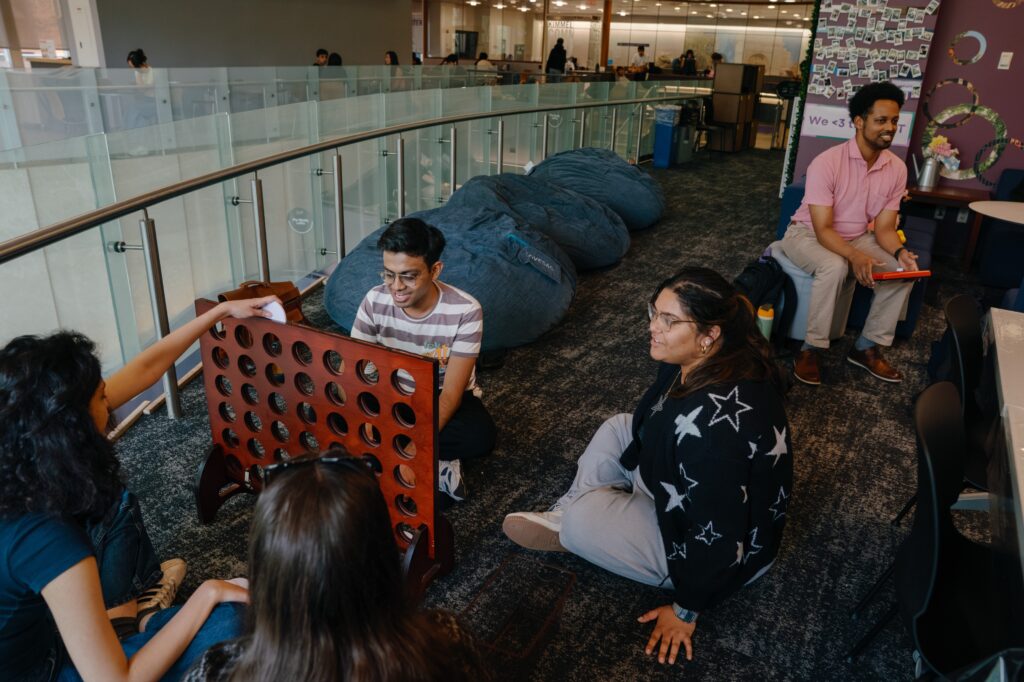
Inside the student center on a recent afternoon, many people wore earbuds and tapped on laptops. But two students walked into an area called the Nest, put their phones into a charging tower, and sat down to color tiles — the analog version of an online game — and catch up. At a nearby table, a group sat with plates of cookies to decorate, squirting brightly colored frosting onto them, piling on sprinkles and getting to know one another.
Yash Sharma, a graduate student, said he’s addicted to his phone, but he is trying to use it less. “Trying to, at least,” he said. “You also see other people trying to get off their phones, and that helps.”
The Nest is part of NYU IRL, a spot students can stop by if they want to meet others, work on crafts, read or nap on a beanbag between classes.
The effort keeps growing, both intentionally and organically. When people overseeing dining at the university heard about NYU IRL, they asked if they could designate some device-free tables, to get people talking more at meals.
Callahan and Hannah Swartz created a group they named the Human Connection Club. A hundred people signed up in two hours. Lots of people came to their board game and line-dancing events this spring.
Reservations also filled quickly for the “Around the Longest Table” dinner. People introduced themselves as they sat down — mostly students, but some faculty and staff members as well, people from all over the world interested in all sorts of different things. Alejandro Ojeda Olarte, a graduate student from Colombia studying robotics, said he sometimes struggles to unplug, because he needs to be hyper-connected to do his research.
“The best connections I’ve made with people have been face-to-face,” said senior Berivan Ibrahim. She made her closest friend at NYU when the WiFi went down, she said; they were both freshman resident advisers, and trying to figure out what to do.
The dinner guests filled plates with falafel, chicken, fettuccine, sweet potatoes — steaming in the cold air — and talked about Paris, film, Japan, nursing, cats, radio journalism and how everyone remembers their freshman resident adviser.
“Do you want to share my blanket?” Ibrahim asked Runting Luo, a graduate student in management and analytics, who was shivering next to her. They spent the rest of the meal with it wrapped around both their shoulders.
Nearby, former strangers were laughing about a new inside joke and debating AI ethics. Long after the dinner ended, despite the cold, people kept talking, even as workers pulled purple tablecloths off the long tables pushed together.
Swartz came over to Callahan, and told him people at her stretch of table agreed they wanted to meet more people in college. One of them told the group he would be playing at a jazz club in the Bowery soon. “We should go,” she said.
“Hell, yeah,” Callahan replied.
All around them, people were taking their phones out of the bags: They were making plans, and trading contacts.
The post How college students are learning to socialize without cellphones appeared first on Washington Post.