Another California baby has contracted measles — this time, in Orange County — raising questions about what parents should do to protect their youngsters as the notoriously contagious disease continues to spread nationwide.
It’s at least the state’s second infant case of measles so far this year. Officials in San Francisco reported last month that a baby under 1 year old had been infected. Both the San Francisco and Orange County infants traveled internationally before falling ill.
Orange County also reported a confirmed measles case in a toddler in January. That youngster had not traveled before getting infected.
One of the most contagious diseases known to humanity, measles can be especially dangerous for babies and young children. Not only can measles cause pneumonia — the most common cause of death from the virus in young children — it can lead to brain swelling that poses a risk of triggering convulsions, leaving a child deaf or with an intellectual disability, according to the U.S. Centers for Disease Control and Prevention.
In babies, the measles virus can also cause a rare condition called subacute sclerosing panencephalitis, or SSPE — when a weakened form of the disease remains behind even after symptoms seem to clear.
SSPE infects the brain, leading years later to mood swings and behavioral problems, followed by convulsions, coma and, ultimately, death. The risk of developing this disorder is as high as 1 in every 600 children who are infected with measles as babies.
A school-age child in L.A. County who had contracted measles as an infant died of SSPE, health officials said in September.
There is no cure for SSPE. The only way to prevent the disease is to stave off measles infection — and officials emphasize that the best way to do that is to get vaccinated against the disease. Doing so, officials say, helps protect not only those rolling up their sleeves but those who cannot get vaccinated, such as the very youngest children.
The child who died of SSPE in L.A. County, for instance, was not old enough to be vaccinated at the time of initial measles infection.
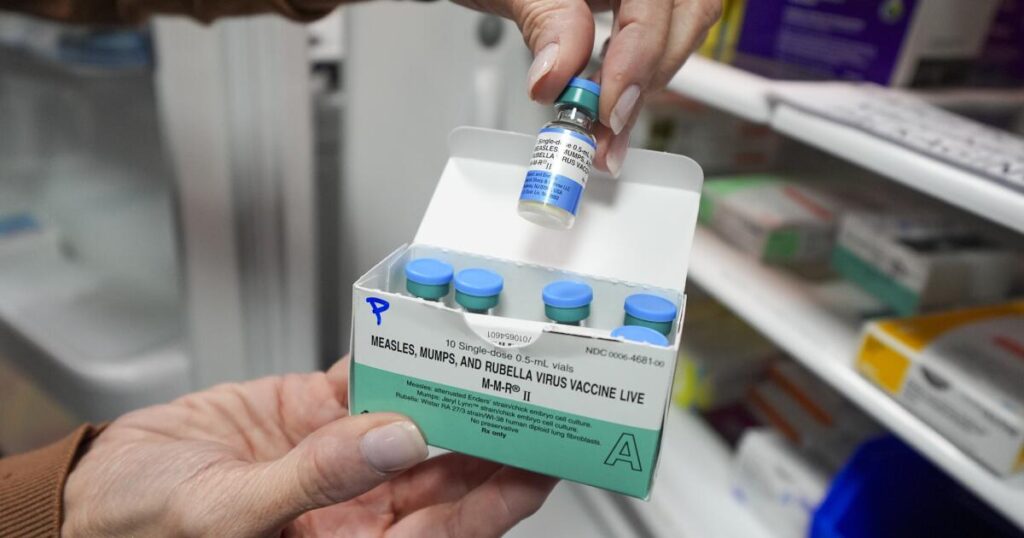
It’s typically recommended that parents get their babies a first dose of the MMR vaccine — which protects against measles, mumps and rubella — when they are 12 to 15 months old, and follow with a second dose between 4 to 6 years of age.
Infants younger than 6 months can’t get the vaccine.
But the CDC does recommend vaccinating infants when they are between 6 and 11 months old if they’re either traveling internationally or at risk of measles exposure during an outbreak. In those cases, federal health officials say the baby will still need to follow up with the standard two-dose series later, as well.
The CDC and California Department of Public Health also recommend that everyone 12 months or older receive two doses of the measles vaccine before traveling internationally — meaning younger toddlers heading out of the country should get a second dose earlier than they otherwise would.
The second vaccine dose can be taken 28 days after the first.
“For the best protection, you should plan to be vaccinated against measles with two doses of MMR at least two weeks before you depart,” the CDC said. “If your trip is less than two weeks away and you’re not protected, you should still get a dose of MMR.”
In addition, “families with children traveling to regions in the United States with ongoing outbreaks should consult with a healthcare provider about following immunization recommendations for international travel,” California health officials said.
Administering early vaccines to young children was part of Texas’ response playbook for recent measles outbreaks. Last year, Texas health authorities suggested that all babies age 6 to 11 months old who live in or visit counties with an active outbreak should immediately receive an early vaccine dose.
And for children age 1 and up, officials in Texas recommended another shot at least 28 days after the first.
One dose of the vaccine is 93% effective at preventing measles; a second dose boosts effectiveness even further — to 97%, according to the CDC.
With measles cases spiking in the U.S. this year, it’s reasonable for California parents to talk with their pediatrician about getting their babies vaccinated earlier than usual, even if there are no plans for international travel, according to UC San Francisco infectious diseases expert Dr. Peter Chin-Hong.
“A couple of recent measles cases in infants in California reflect growing vulnerabilities to unvaccinated individuals, including infants in communities where MMR vaccination rates are less than 95%,” Chin-Hong said. “This increases the chance that imported measles cases can spread locally and expose infants who are too young to be routinely vaccinated.”
Recent years have seen a startling rebound of a disease that has been considered officially eliminated in the U.S. for a quarter-century.
So far this year, 1,814 measles cases have been confirmed nationwide — including 48 in California. That national count is fast approaching the 2,288 cases that were documented all of last year, CDC data show.
Before last year, the highest national annual measles caseload in recent memory was in 1992, when 2,126 infections were reported. The U.S. is already fast approaching that figure, with eight months still to go in 2026.
Three people have died since measles began to surge nationwide last year. Two were unvaccinated school-age children in Texas who had no underlying medical conditions, and the other was an unvaccinated adult in New Mexico.
The U.S. had seen only three total measles deaths over the preceding quarter-century combined: a 28-year-old immunocompromised adult in 2015; and, in 2003, a 13-year-old immunocompromised child who recently had a bone marrow transplant and a 75-year-old infected in Israel who suffered measles pneumonia and brain damage.
Last year, 1 in 8 measles cases in the U.S. resulted in a patient needing to be hospitalized.
Nationally, 92% of confirmed measles cases so far this year have been individuals who were unvaccinated or whose vaccine status was unknown. An additional 4% had received just one of the two recommended MMR doses.
An early dose of MMR vaccine between 6 and 11 months offers “partial but meaningful protection, but is less effective than vaccination at 12 months or older, because of an immature immune system in the infant and residual maternal antibodies,” Chin-Hong said.
In places where measles vaccination rates are less than 95%, the threshold considered necessary for herd immunity, unvaccinated people — including infants too young to be vaccinated — are especially at risk.
So far this year, places where Californians could’ve been exposed to measles have included Los Angeles International Airport, Disneyland, stores, restaurants, an emergency room, an urgent care center, a gym and what authorities described as an educational enrichment program for children.
“It is safe and reasonable for families to discuss an early vaccination strategy with their providers. This is particularly true if families live in areas with low MMR vaccination coverage and/or have potential exposure risk,” Chin-Hong said.
The post Another California baby gets measles. How can kids be protected? appeared first on Los Angeles Times.