When “Fashion Is Art,” the dress code for the Met Gala on Monday night, was announced, it seemed like a risk. After all, fashion has been trying for decades to prove its bona fides as an equal of the other fine arts at the Metropolitan Museum of Art.
The gala has increasingly been walking the line between elegant and absurd, as guests attempt to one-up one another in the attention economy. Giving celebrities “art” as a theme could have inspired a host of old masters and Impressionism cosplay rather than any sort of consideration about what it actually means in fashion terms. In this case, clothes that have their own point of view on the body and the person and relate to that living thing inside, not clothes that think they have to take their cues from a pre-existing, institutionally approved painting or sculpture.
And it did, in some cases.
Julianne Moore in Bottega Veneta, Claire Foy in Erdem and Gwendoline Christie in Giles Deacon were likewise inspired by the painting, which hangs in the Met. And that doesn’t include all of the guests who arrived in various paint-splotched and scenery-etched extravaganzas.
But more than flirt with costume, the dress code also did something else. It acted as a reminder of the distinction between fashion and art — at least what we think of when we think of art hanging on the walls of the museum: something made to be admired from a safe distance, placed on a pedestal; something that serves as representation without practical function, as pure idea. Fashion is something altogether more intimate and dependent on the person who wears it. It has a practical dimension that is valuable in its own right.
That’s not a bad thing; it’s a defining thing. And it doesn’t have to be dependent on associations with someone else’s art to merit attention.
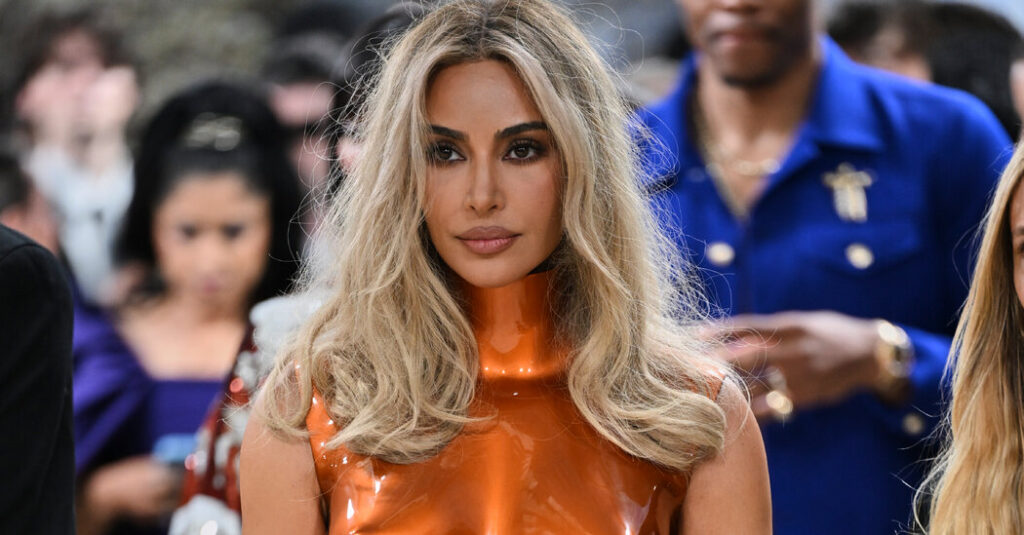
Just consider the outfits of two women who were actually wearing art — or at least pieces by artists. First Kim Kardashian, in an orange fiberglass breastplate by the British pop artist Allen Jones, which she wore with a leather skirt. She looked like a cross between Barbarella and Wilma Flintstone. And then Natasha Poonawalla, the businesswoman and philanthropist, in an “orchid pectoral sculpture” by Marc Quinn, another British artist, worn atop a Dolce & Gabbana dress, as if Audrey II from “Little Shop of Horrors” had morphed into a phalaenopsis and gone couture.
In each case the piece was so clearly constructed that it seemed divorced from the individual within (not to mention somewhat unwieldy to wear). More like a compromise between opposing forces than a complementary form of clothing. It was hard not to look at them and wonder, “But how do you sit”?
But for real corporeal presence, the attendees that stood out were not the ones who wore their bodies, or the representation of bodies, on their sleeves, but the ones who looked at ease in their clothes. As if they had just slipped them on and could slip them off, like Charlotte Gainsbourg in leather Saint Laurent or Teyana Taylor in silver-fringed Tom Ford.
The irony is that this is exactly the point of the exhibition the gala was celebrating: that it is the body that animates the clothes that makes fashion special — that makes it an inspiration for artists — rather than the art of the outfit itself. That fashion can lead to art rather than the other way around. Which is why it was notable that the one designer no one wore was the one designer whose work is generally considered an art form in itself, the first living designer to have her own retrospective at the Met in this century: Rei Kawakubo of Comme des Garçons.
(Of course, Comme des Garçons isn’t a part of the celebrity-fashion industrial complex and doesn’t typically lend its clothes for free, so that may say more about how the current Met Gala has developed than about the guests’ taste. And not all the garments Kawakubo makes are actually … well, garments.)
In any case, it was Rihanna, arriving late in the evening in a cosmic vortex of metallic Maison Margiela, who seemed to really get that memo. Her gown didn’t look like anything in particular — at least anything hanging in the museum — but it did look extraordinary. It looked, in fact, like its own kind of art.
And it suggested that perhaps next time the dress code should simply be great clothes.
Vanessa Friedman has been the fashion director and chief fashion critic for The Times since 2014.
The post Was It Art? Was It Fashion? Was It Good? appeared first on New York Times.