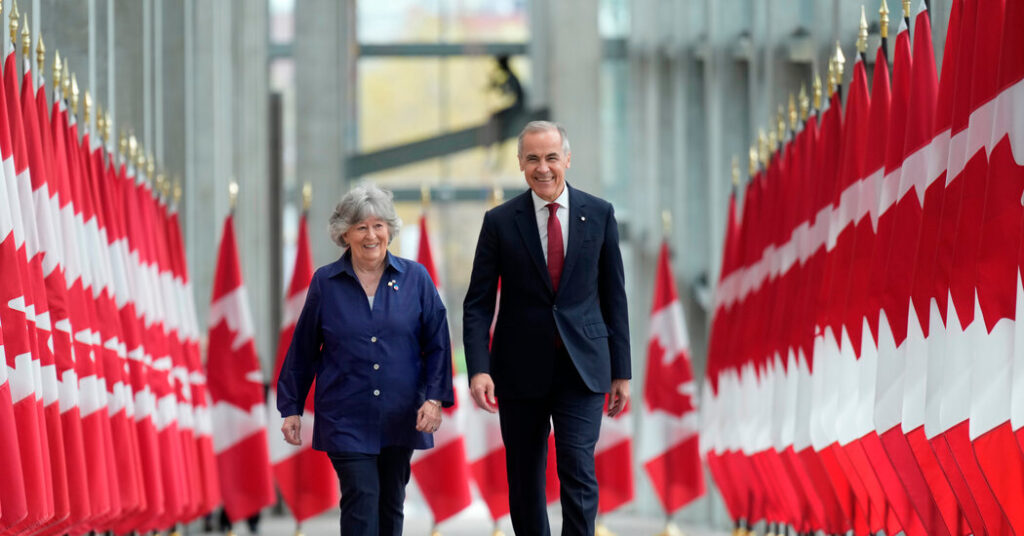
The governor general of Canada, Canada’s head of state on behalf of King Charles III, is a post largely about symbolism. That significance was conveyed Tuesday when Prime Minister Mark Carney said that the next holder of the position will be Louise Arbour, a former justice of the Supreme Court of Canada, war crimes prosecutor and United Nations human rights high commissioner.
“At a time when much of the world is buffeted by crises and the worst are full of passionate intensity, Canada’s history, our institutions, and our enduring traditions matter more than ever,” Mr. Carney said as he announced the appointment in the spacious atrium of the National Gallery of Canada. “We retain our convictions. We reinforce our institutions.”
Ms. Arbour, he said, “will represent the best of Canada to Canadians and to the world. A country that’s a bastion of security, prosperity and justice, a beacon to a world lost at sea. A Canada that is cleareyed about the challenges we face and steadfast in the values we uphold. A Canada not just strong but good. A Canada, that’s not just prosperous but fair. A Canada that is not just for some most of the time but for all, all of the times.”
Ms. Arbour, 79, who is from Montreal, has a résumé that distinguishes her from many of the previous governors general since 1952, when the Canadian government began selecting them rather than having them sent from Britain. A disproportionately large number of those appointees had backgrounds in politics or journalism.
After working as a civil liberties advocate and law professor, Ms. Arbour was a judge on two high courts in Ontario before being appointed to the Supreme Court of Canada in 1999. During her time there, Ms. Arbour was associated with several cases upholding human rights, including a decision lifting a ban on books featuring families with same-sex parents introduced by a school board in British Columbia on religious grounds.
She was also the chief prosecutor for the U.N. international criminal tribunals, where she investigate war crimes in the former Yugoslavia and Rwanda. Her work helped lead to the indictment of Serbian president Slobodan Milosevic and successfully established that sexual violence is a weapon of genocide and a crime against humanity.
Ms. Arbour also conducted inquiries into abuses at Canada’s then principal prison for women and into widespread sexual misconduct in the Canadian Armed Forces, both of which brought about significant reforms. In her new role, Ms. Arbour will also be the commander in chief of Canada’s military.
When asked how President Trump might view to the appointment, Mr. Carney said: “As his majesty King Charles observed just last week when he spoke before Congress to great applause, that the United States is a country founded on the rule of law, the right of individuals. And this is what we are reinforcing, celebrating today: an institution at the core of our constitutional system with someone whose entire career has been dedicated to those principles.”
Like King Charles, Ms. Arbour must now avoid offering overt political opinions or views that could be interpreted as controversial.
She did not directly respond when asked in French if she was a monarchist. Most polls suggest that since the death of Queen Elizabeth II, most Canadians, particularly in Quebec, no longer wish to have a British noble as their monarch. But there’s little clear agreement on what do about it.
“This term is unfortunately very often used in a pejorative way,” she said. “What I can say is that I will accede to a function in which I will be the representative of the crown in a constitutional arrangement that I think has served Canada extremely well.”
Similarly, she would not revisit her characterization of the American and Israeli attack on Iran as “pure folly,” as she put it in a recent television interview.
“I was a private citizen who had freedom of expression,” she said. “I am very, very aware of all the privileges and powers that come with certain functions and the constraints.”
Ms. Arbour’s duties will include signing legislation and cabinet orders into law, swearing in prime ministers and their cabinet members, and the awarding of civil and military honors. Prime ministers must have her permission to call elections, form governments or restart Parliament although precedent will likely preclude her from defying them.
Ms. Arbour will host state visits by other leaders and will likely be sent by Mr. Carney on quasi-diplomatic foreign trips.
During an interview with a law review in 2015, Ms. Arbour reflected on why she has taken on a wide variety of roles. She chalked it up to enjoying a challenge.
“It’s very clear,” she said. “I really like that phase where I don’t really get it. I’ve never walked away from anything I’ve done — from teaching, trial work, appellate work, international work — because I didn’t like it and even less so because I was bored. There is nothing boring about it. It’s just that I seem to have this irresistible attraction to taking on something for which I’m entirely unqualified.”
Ian Austen reports on Canada for The Times. A Windsor, Ontario, native now based in Ottawa, he has reported on the country for two decades. He can be reached at [email protected].
The post For Canada’s Ceremonial Head of State, a Symbol of Rights and the Rule of Law appeared first on New York Times.