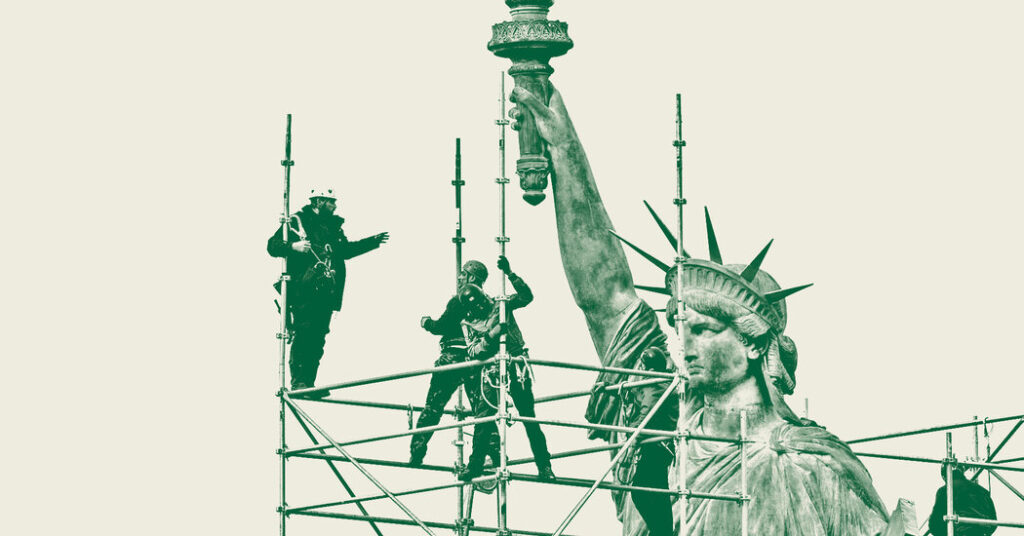
As the United States approaches its 250th anniversary, the columnist David French sits down with a fellow originalist, the Supreme Court justice Neil Gorsuch. The two discuss the radical nature of the country’s founding, its continuing influence on the court and why David sees the justice’s jurisprudence as “a combination of originalist and anti-bully.”
Below is a transcript of an episode of “The Opinions.” We recommend listening to it in its original form for the full effect. You can do so using the player above or on the NYTimes app, Apple, Spotify, Amazon Music, YouTube, iHeartRadio or wherever you get your podcasts.
The transcript has been lightly edited for length and clarity.
David French: I’m David French. I’m an Opinion columnist at The New York Times.
When I had the opportunity to interview Justice Neil Gorsuch and his co-author, Janie Nitze about their new children’s book about the Declaration of Independence, I jumped at the chance for a couple of reasons.
One, I’m always happy to talk about the American founding. And two, it’s always a wonderful opportunity to talk to a justice of the Supreme Court, and to get to know more about where they’re coming from and what they think. So, the conversation you’re about to hear was very interesting, but I have to give you some caveats. When you talk to a judge, it is not like talking to a politician. You cannot talk about pending cases. You can’t talk about facts or circumstances that might be pending cases, and you definitely, absolutely cannot talk about politics. But the conversation was very rich and very interesting even with those caveats.
I talked to Justice Gorsuch about his approach to originalism. I talked to him about his Native American jurisprudence. I talked to him about his approach to writing opinions. There is a lot in here.
Justice Gorsuch, thanks for being here.
Neil Gorsuch: David, it’s a pleasure to be with you.
French: I have to say, it was a really fun trip down memory lane for me to read your book, which is called “Heroes of 1776.”
It’s arriving right at the 250th, and it’s about the Declaration of Independence. And for me, it was a trip down memory lane, because it reminded me of my childhood. What ignited my love for American history were books just like this — they were called “American Heritage Illustrated History of the United States.” I remember them. And it made me curious, what is it that instilled your interest in the Constitution of the United States and our founding?
Gorsuch: David, my story is very much like yours. And that’s exactly why Janie and I wrote this book: to try and inspire the next generation, to see the great ideas in our declaration, their promise, and also the responsibilities that come with it. And maybe inspire them — through some stories about some of the framers they know, but maybe some they don’t know — to pick up the baton themselves.
French: Yeah. I mean, for me, that was the effect. I would read these stories, it would capture my imagination. And in reading your book, and going through your book, there were two parts that really stood out to me, and I want to dive into both of them: the process and the results. Which is exactly how lawyers think about these things — process and result.
The first was the process of actually writing the Declaration, and the way in which John Adams handed the pen to Thomas Jefferson, and how much of this Declaration really was coming from the mind and heart of Thomas Jefferson. And so, talk to me a little bit about this process. How is it that Jefferson got the pen?
Gorsuch: Well, they fought over it. And not the way you’re thinking though, right? Just the opposite.
So, the story goes — and this is from Adams, his own letters that he wrote about it afterwards — he said, “Jefferson, you need to do it.” And Jefferson said: “No, I will not do it. You must do it. You’ve been the leader of this cabal up in Boston, creating all this. You should do it.” And Adams said, I will not. And you should do it for three reasons. What other reasons? He said, “One, I am suspected, obnoxious and unpopular. You are very much otherwise. Two, you’re a Virginian and a Virginian should be seen to be head of this business.”
French: Can I stop you right there?
Gorsuch: No, let me finish three. Let me finish three. We can talk about two. Two is very important. But so’s three. He said: You write 10 times better than I do. And Jefferson said, oh, all right, I’ll do it. All right, now you can tap in.
French: OK. Well, was that humility or strategy or a combination to say that Jefferson writes?
Gorsuch: Well, I think No. 1 is humility, for sure, and probably true. No. 2 was strategic, for sure, right? I mean, you had had the Boston Tea Party, and all the goings-on in Lexington and Concord. What is it to a Virginian, right? You’ve got to drag everybody along, and you have to remember — everybody thinks we live in divided times, fine, we can talk about that, but back then, only about 40 percent of the colonists were backing the Patriot cause, even in June and July of 1776. Another percent were devoted Loyalists. And then the balance of the country was somewhere in between. Sound familiar? Yeah.
French: Yeah, absolutely. So, Virginia nationalizes this, in other words. It takes it away from being a Massachusetts rebellion, those ornery Puritans, and it turns into an American Revolution.
Now, the other thing that struck me is that Jefferson kind of squirrels away and does the writing on his own. And so, these really seminal words, this American mission statement, we’re “endowed by their creator with certain inalienable rights.” This really does seem to be Jefferson’s heart expressed on paper, not writing by committee.
Gorsuch: Well, there’s some of that too, right? This is later on, and he called the “mutilations” what people did to it, all right? You know, we think of the Declaration as this wonderful — “mutilations.” Anyway, but yes, he locked himself in rooms he had rented from a bricklayer on the outskirts of Philadelphia, and he did it in two weeks, and he said he didn’t consult any book or pamphlet. He tried merely to come up with an expression of the American mind. And I don’t think he was thinking about just his mind. I think he was thinking about how people were thinking at the time. And in that, he came up with three, I think, perfect ideas: that we’re all created equal, every one of us, and that each of us has inalienable rights given to us by God, not privileges from government, and that we have a right to rule ourselves.
And those ideas were incredibly radical at the time. We forget that. We think of them as the air we breathe, but in 1776 Europe, it was a shock wave, right? A British newspaper said Americans had declared for themselves an unalienable right to speak nonsense.
French: So, the second part, we talked about the process. There’s also results, outcome. What was striking to me about the last third of the book is about the costs that were paid that we had. We look back on the Revolutionary War, of glorious victory, and it was, but at terrible cost. So, talk about a little of the cost that the signers of the Declaration endured.
Gorsuch: Before we leave process ——
French: OK. All right. Let’s not leave process too soon.
Gorsuch: Lawyers, sorry, you know? You forget that it wasn’t like the snapped judgment that was unanimous, right? We don’t talk about this nearly enough, the people behind the Declaration. And, to my mind, it’s always the people and the humanity of them that inspires me.
A third of them lost their homes, the signers — destroyed by the British. Many of them were jailed. Some of them had their wives jailed, their children jailed. When they said they devoted one another, their sacred honor, their fortunes, all of that, they meant it. They spent their fortunes on the Revolutionary cause. One of my favorite stories in the book is Thomas Nelson Jr., one of the signers from Virginia. He was head of the Virginia militia at Yorktown, and when he saw that the British were using his home as a headquarters, he didn’t hesitate to have men fire on it. And when he died, impoverished, many years later, having spent much of his fortune on the Patriot cause, so poor that they buried him in an unmarked grave so his creditors couldn’t use his body as collateral. Think about that. He was asked, do you have any regrets? And he said, I’d do it all over again.
French: There is an interesting symmetry here between this book and your last book, “Over Ruled.” Hang with me here.
Gorsuch: I’m waiting.
French: OK, I promise you I’m going to connect these two, because I think there’s an interesting way they connect to me with your jurisprudence and ——
Gorsuch: Oh, wow. Now, that’s a trifecta.
French: Oh, we’re going for it. OK. So, here’s what I see in “Over Ruled,” and here’s what I see in, especially the last bit of the book, where there’s such an emphasis on the punitive power of the state attacking and depriving the rights of vulnerable people.
“Over Ruled” was a lot about a more peaceful version of this, where you have very large bureaucracies, very complex webs of rules and regulation that trap regular folks in their web. And it has always struck me, I have always seen your jurisprudence — and forgive me if this is something that you’re going to completely disagree with — as a combination of originalist and anti-bully.
And I see that in both of these books, and I have seen this in many opinions that you’ve written. And so, I just wanted to float that idea past you about your own jurisprudence.
Gorsuch: Well, that’s like saying, “Hey, Gorsuch, lie down on this couch and analyze yourself.” But I’ll take a shot at it, OK?
I don’t know, I don’t know. You’re allowed your theories. But I would say that one of the most striking and inspirational things about the American experiment, to me, is the emphasis it places on the individual and its intrinsic value. You’re not valuable as a cog and a machine to others’ ends. You have value in your own right. You are my equal. You have inalienable rights. You have every bit as much right to rule yourself as I do. And those ideas, I just think those are perfect ideas. Are they imperfectly executed? Do we have a ways to go, even today? You betcha. But those ideas speak to every human heart. They exclude no one and they inspire me, yes.
French: Well, and I’ve also noticed — you’ve written a book about the 250th anniversary of the Declaration, but I’ve read many, many of your opinions, and you really focus a lot on history in case after case. And I’ve been particularly struck by your focus on history in the Native American cases.
You have developed a reputation as maybe the greatest friend to Native Americans who’s ever sat on the Supreme Court. And what I wonder is, has that careful attention to history, has that alerted you to a lot of the legal injustice that has been visited upon the Native American population in the United States for so very long?
Gorsuch: Well, without getting into cases — yeah. I’m just trying to abstract from it a little bit in the answer. I do not know how you run this country without knowing its history. I do not know how you can be a good citizen, exercising the responsibilities, without knowing something about how it operates.
How do you work a machine if you’ve never read the how-to manual, right? We were talking about this beforehand. History is endlessly fascinating, and it has so much to teach us. So many mistakes that were made it’s like an example of iterative responses to problems, and you can see what’s worked and what hasn’t worked over time if you bother to open the book. And the problem today, I think we would agree, is that too few people open the book. So, I’m hoping instead of maybe “Goodnight Moon”— a parent’s a little tired of that — perhaps they’ll try “Goodnight, Ben Franklin,” you know? “Heroes of 1776.”
French: I love it. But let’s stick with the history thing for a minute, because I’ve long thought of myself — and have described myself since probably my first year of law school — as an originalist. That’s how I describe myself to people when I talk about how I think about the law.
But there’s this phrase that we use, when talking about originalism: “text, history and tradition.” And the history part, to me, is both promising and perilous. The promising part is obvious: You’re going to learn more. The more you dive into history, it’s going to bring the words to the Constitution to life.
You’re going to understand what they meant when they said what they said. But also, history is incredibly complicated and often contradictory. So, here comes the perilous part. When you are looking at the history portion of this text, history and tradition analysis, how are you adjudicating what is aberrational and exceptional versus consensus? And how do you decide which people to listen to? Such as, like an early American legislature isn’t an interpretive body. They’re not interpreting the law the way, say, a judge was, but how relevant is what they do? So, how are you sorting through this incredibly complicated history that bears on so many of our cases?
Gorsuch: David, you ask a very good question, of an originalist, about methodology. It’s an important question. Answering it is complicated, difficult and long. I would say only this: You’re asking the right question. Instead of asking what the judge ate for breakfast or what he thinks a perfect world should look like, he’s trying to answer what are the words the people of the United States, in their Constitution or the laws, adopted.
And in that way, he’s bringing real the promise of the Declaration of self-rule, rather than ruled by judges. So, yeah, we can have a long, fun, academic conversation about sources and sorting mainstream from aberrations, but that’s the project of trying to figure out what the original meaning of the law is.
French: As a journalist, I’m very keenly aware of when I write something if people are interested in it and not interested in it. And I’ve noticed this big flip over the last five years. We’ve gone from a situation where, if I’m writing and talking about Supreme Court cases around some of the classic hot-button culture war issues — such as abortion, free speech, the conflict between religious liberty and gay rights, etc. — there has been much less interest and, by contrast, much greater interest around separation of powers.
And when we’re looking at the Declaration — this is a book about the Declaration of Independence, not the 1787 Constitution, but it’s got this core American promise to it about we’re “endowed by their creator with certain unalienable eights, that among these are life, liberty and the pursuit of happiness.”
It’s the role of the government to protect that. How does separation of powers protect life, liberty and the pursuit of happiness?
Gorsuch: Well, first of all, I think it’s fascinating what you say, that people are interested in the separation of powers, and I’m delighted to hear it. And the way I think of it is this: OK, the Declaration’s our mission statement. It’s what we’re aiming for. Imperfectly, through lots of hardships and battles, but that’s what we’re hoping for. And we’re a credal nation, right, David? I mean, we don’t share a religion, we don’t share a race, we share an idea, OK? And that idea has to be passed down generation to generation through history, as we discussed.
The Constitution, with its separation of powers, is our how-to manual. And the one thing James Madison knew, in devising the Virginia Plan basis of the Constitution, is that men are not angels, all right? And you have to separate power assiduously to keep us free, to ensure that everybody is treated equally, to make real the idea of self-rule, and certainly to protect your unalienable rights.
French: So, I’m going to float an idea by you, and I would love to hear your reaction. When I like to say that I’m a free speech advocate — I don’t like the whole concept of trigger words, except I do say I have one trigger phrase — I do not like to hear “coequal branches of government.” And I tell you why I’m ——
Gorsuch: That’s the good English grammarian in you.
French: Yeah, I don’t like that, but I don’t like it because I don’t think they are exactly coequal.
Gorsuch: Oh, interesting.
French: I think of Article I. It’s Article I for a reason, that you might say first among equals would be the congressional branch. And it strikes me that one of the reasons why — and I’m not going to ask you to cast shade, as the kids say, on another whole branch of government — but it strikes me as one of the reasons why the Supreme Court is so much in the center of the national conversation right now is that in many ways, the Congress has taken steps back. And a lot of your decisions have been: Wait a minute, this is something that Congress has to decide. That this is a role for Congress only.
So, in separation of powers, it is just not the case that when one branch steps backwards, another one has to step forward.
Gorsuch: Well, I do think that it would be crazy to say we are a democracy or a republic, and yet simultaneously entertain the notion that nine old judges in Washington should govern us all. Now, you’d want nine wise old judges to decide the meaning of a law independently, without fear or favor to anyone, and vindicate your rights in a trial. Absolutely, that makes perfect — but to rule everybody? To pass the laws? To amend the Constitution? That would make a mockery of the Declaration and of the Constitution.
And so, yes, it is their responsibility. Now, I want to defend Congress a little bit, because ——
French: Please, because I don’t.
Gorsuch: Because they pass about two million words in new legislation, I think, every year. But they’re doing a lot and they’re keeping us pretty busy, David.
French: So, when I think of — and your book is about the Declaration of Independence, not the Constitution — when I think about the relationship between the two, I think of the Declaration of Independence as a — to use a corporate analogy — mission statement, and the Constitution is the bylaws. It effectuates the mission statement. But my question is, how much do the sweeping principles of the Declaration of Independence inform your work at all, or is that more of historical interest than it is sort of practical?
Gorsuch: I think they inform the work of every citizen, right? And we talk about this at the end of the book, right? OK, here are these three ideals. Were they real for everybody? And so, certainly not, right? But the women at Seneca Falls in 1848 could appeal to the nation and say that, yeah, all men are created equal, so are all women and men, all right? And Abraham Lincoln could say in the Civil War, how can you possibly maintain a system of slavery when you say all men are equal?
Come back to the truths in the Declaration. Martin Luther King Jr. down the Mall here in 1963 could call it “a promissory note” that had come due, and he was right, all right? They inform all of us, don’t they?
French: There’s another aspect of the book that was very interesting to me, and you talked about the varied backgrounds of the signers of the Declaration. Let me ask you this about the court itself: Do you think there is value in having people of maybe more — and when it comes to future justices, is there value to have, say, more people with legislative experience as opposed to coming out of the executive branch — a greater diversity of legal backgrounds? There seems to have been an interesting professionalization of the path to the court, where there’s now sort of a judicial career path that’s a little bit different from when I was younger.
And I was just wondering what you thought about the possibility of varying in different backgrounds and what that might bring to the court, if anything.
Gorsuch: I think we’ve got a very varied court as it is, right? You’ve got nine different justices from all over the country. Well, the Acela corridor may be ——
French: Slightly overrepresented.
Gorsuch: Slightly overrepresented. Appointed by five different presidents over 30 years, and some of us are originalists, and some of us are very much not, OK? Yet, we’re able to talk to one another and listen to one another, and find common ground a surprising amount of the time. I mean, 40 percent of our cases we decided unanimously, right?
You give us the 70 hardest cases in the country every year, where lower court judges have disagreed, and we’re able to reach unanimity that much. I think that’s a miracle, right? And a third, maybe a third of our cases are 5-4, 6-3, but only half of those are the 5-4, 6-3s you might be thinking about.
And then you compare those numbers back to 1945, when Franklin D. Roosevelt had appointed eight of the nine justices, and the figures are the same today as they were then. And when I think about that, and the diversity of the court was different then than it is now, it does remind me — and going back to the men at the Declaration or at the Constitutional Convention, coming from around the country with different perspectives, different voices — the rabble-rousers from Massachusetts, the folks down in South Carolina were not sure at all about this project — and they debated and they disagreed.
It shows you that people from different perspectives, different walks of life, along whatever axis, when they listen to one another, they can work together in good faith and assume that the guy across from me loves this country every bit as much as I do. Great things can happen.
French: So, one thing that is striking about your work is you write a lot of concurrences, and I’m thinking of the tariffs concurrence. You just had the tariffs decision; you wrote a pretty long concurrence that was really taking a look at the arguments of the other justices.
What is the decision-making process that you undertake, whether you’re going to write a concurrence or not? What are the steps you go through, and what are you hoping to accomplish when you write a concurrence?
Gorsuch: Well, I took an oath to essentially call ‘em like I see ‘em, without fear or favor to anyone.
And so, that’s my job. When I need to do that, I need to do that. If I don’t need to do that, that’s all the better, right? It makes for an easier day at the office, but sometimes you have to do it. And when I think about that, I think about, actually, the Declaration. One of the list of grievances against the king was that he had taken away independent judges and juries, right? And sent them to vice admiralty courts, colonists — essentially judges who were answerable to the king. And they wanted to send cases even back to Britain, so that there would be juries there rather than in the locality.
And I just think what a treasured gift we have, where no matter how unpopular you are — rich, poor, doesn’t matter — the judicial oath says, administer justice without respect to persons, rich or poor. Any difference. That’s my job. What a beautiful job it is to just come into the office and say, what does the law, as best I can tell — as difficult as it sometimes is, the dangling modifiers and some of the statutes that we’re given are — but to fulfill that oath and to try and realize what the framers of the Declaration had in mind when they listed it as that as one of their grievances against the king. To discharge that job is a privilege and it’s humbling.
French: So, last question, when we’re talking about the 250th, earlier we were also talking about the 200th, the bicentennial. And there’s a lot going on right now in our country at 250. There’s a lot of division. There’s a lot of contention. There was just recently a poll where Americans are the only people of an advanced democracy who don’t like each other. We don’t like each other as much as we used to.
Canadians still love each other, 90 percent. We don’t like each other. And we were talking earlier about the potential of the 250th to bring us together. And I would just love it if you would reflect back on — we’re both old enough to barely remember the 200th — can the 250th have the same effect on us that the 200th did?
Gorsuch: David, I hope so, right? I mean, I don’t want to be Pollyannish about it, right? We are always going to be divided over things. They were divided over the Declaration.
Even during the Revolution, they were divided. I mean, Ben Franklin and his son were divided over the Revolution. We tell that story in the book. You know, William winds up living in England, as he was a Loyalist. They barely spoke for years.
So, of course, we’re going to have our disagreements. Open up a page of history, America’s always going to have its disagreements, but can there be moments and ideas that unite us? And I do think the Declaration has that power, because it does speak to every one of us.
And this anniversary has a little power in that regard. What does semi-quincentennial mean?
French: It doesn’t roll off the tongue, does it?
Gorsuch: It means halfway to 500. It’s a journey. We’re not at our destination. We are not a perfect union. We have work to do. And this is one of the things we have to work on being able to listen to one another, trust one another, recognize that the person I disagree with is usually operating in good faith and loves his country, too.
But the 200th, we do remember that. And it did have that power. You have to remember, as tough as things might seem to date to you and me, how did it look in 1976? We just came out of Watergate. Men were coming home from Vietnam who were very different from the ones who left. We were suffering from stagflation.
French: Oh, yeah. Yes.
Gorsuch: Oh, and by the way, we had an unelected president. And it was a moment. I remember going around and painting fire hydrants red, white and blue. I remember the Gemma family, across the street in Denver, took their Volkswagen bus. It was red and they painted the Stars and Stripes on it. And I do think it has a potential for a moment where we can remember that more unites us than divides us in this country.
Those three great ideas are perfect and they unite us.
French: Thank you so much, Justice.
Gorsuch: David, thank you very much. I really appreciate it.
Thoughts? Email us at [email protected].
This episode of “The Opinions” was produced by Jillian Weinberger with help from Derek Arthur. It was edited by Kaari Piktin and Alison Bruzek. Mixing by Pat McCusker. Video editing by Arpita Aneja, Kristen Williamson with help from Jan Kobal. The postproduction manager is Mike Puretz. Original music by Carole Sabouraud, Isaac Jones and Pat McCusker. Fact-checking by Julie Beer, Mary Marge Locker and Kate Sinclair. Audience strategy by Shannon Busta and Kristina Samulewski. The director of Opinion Video is Jonah M. Kessel. The deputy director of Opinion Shows is Alison Bruzek. The director of Opinion Shows is Annie-Rose Strasser.
The Times is committed to publishing a diversity of letters to the editor. We’d like to hear what you think about this or any of our articles. Here are some tips. And here’s our email: [email protected].
Follow the New York Times Opinion section on Facebook, Instagram, TikTok, Bluesky, WhatsApp and Threads.
The post ‘Not a Perfect Union’: Neil Gorsuch on America at 250 appeared first on New York Times.