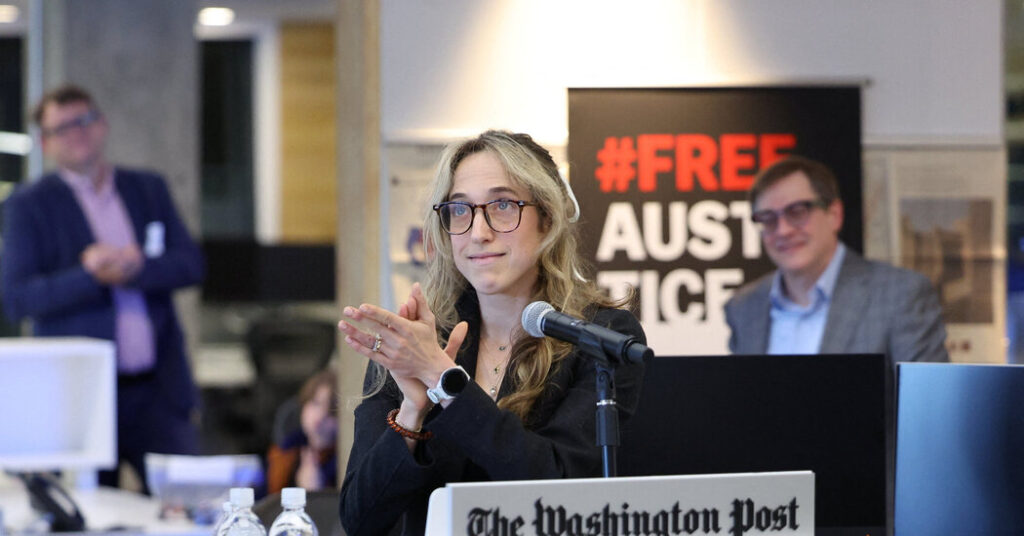
At 6:05 a.m. on Jan. 14, agents from the Federal Bureau of Investigation converged at the door of Hannah Natanson, a reporter at The Washington Post. They had a search warrant and entered her home, seizing her iPhone and other devices.
For the previous year, Ms. Natanson had reported on the Trump administration’s efforts to shrink the federal work force and cut programs. The F.B.I. search was part of an investigation into a government contractor who the Justice Department said had leaked her classified information.
The event put Ms. Natanson’s name among the targets of the Trump administration’s aggressive campaign against news organizations. There was no precedent for the Justice Department searching a reporter’s home in connection with a national security leak investigation, according to the Reporters Committee for Freedom of the Press.
But on Monday, Ms. Natanson was recognized for something else: a Pulitzer Prize. Her work anchored a package of articles for The Post that won the public service award, considered the most prestigious Pulitzer Prize, for what the Pulitzer board described as “piercing the veil of secrecy” of the Trump administration’s overhaul of the federal government.
The award is the latest twist in a tumultuous several months for Ms. Natanson, 29, a high-intensity reporter who published more than 200 articles last year. In one of the articles submitted for the Pulitzer Prize, a first-person essay, Ms. Natanson wrote that she had amassed 1,169 current and former government sources after sharing her contact information online.
“She was working so hard, I worried about her,” recalled Lynda Robinson, a former Post editor who worked with Ms. Natanson. “She probably has two years’ worth of comp time.”
The F.B.I. search upended her professional and personal lives. The seized devices contained wedding plans she had made with her fiancé and communications with her physician, as well as her journalistic work. She and The Post continue to fight in court to get back her devices and limit the government’s review of the files on them. On Tuesday, a federal district judge rejected the Justice Department’s appeal to have the F.B.I. examine the devices instead of a magistrate judge.
When Ms. Natanson, who declined to be interviewed for this article, was asked at a recent event if journalism had gotten more dangerous in recent years, she responded: “I think you can read publicly about what happened to me and draw your own conclusions. I’ll leave it there.”
Growing up, Ms. Natanson attended the prestigious Georgetown Day School in Washington, and her parents would find her in the morning at the kitchen table after she had worked through the night — often crashing on deadlines for The Augur Bit, the school’s newspaper.
“She didn’t let things slide,” said Richard Avidon, who served for 23 years as the newspaper’s faculty adviser and mentored students who now populate major U.S. newsrooms.
She joined The Harvard Crimson newspaper as a freshman at Harvard University, and rose to become the top editor. After two summer internships at The Post, the company hired Ms. Natanson in late 2019 for a full-time job covering education in Virginia, a beat heavy on culture-war school squabbles in Loudoun County.
Around the Post newsroom, she’s known for bringing in “some ginormous salad thing” every day, according to the religion reporter Michelle Boorstein. Between calls and meetings, she would crack open doorstop tomes on such figures as Paul Gauguin, James Baldwin and Nancy Reagan.
By 2025, as the incoming Trump administration started to overhaul the government, Ms. Natanson began posting tip requests on a Reddit forum for federal workers, along with her contact information on the messaging app Signal. “We are looking to speak with anyone willing to chat about what they’re seeing in their agencies,” she wrote in one of them.
Trump Administration: Live Updates
Updated
- The Trump administration is investigating Smith College over admitting transgender students.
- The trade deficit grew in March after the Supreme Court struck down many tariffs.
- The U.S. struck another vessel in the Caribbean, killing 2.
Federal workers, it turned out, were quite willing to chat. The resulting articles turned heads, including the ones making hiring decisions at The Atlantic, which made an offer to Ms. Natanson a year ago, according to several people with knowledge of the interactions who would speak only anonymously. The Post countered, and she stayed put.
The first-person essay that was part of the winning Pulitzer package was headlined: “I am The Post’s ‘federal government whisperer.’ It’s been brutal.” Assigned to her and published in December, the essay included details on the technology she used to conduct her reporting and showcased her sprawling source base.
The essay was a compelling read for journalism junkies and, it so happens, government agents.
An entire section of an F.B.I. affidavit cited the December essay to claim that a search of her home would net materials bolstering the case against the government contractor, Aurelio Perez-Lugones. In a court hearing, Magistrate Judge William B. Porter seized on the essay and its revelations about Ms. Natanson’s work “process,” suggesting that her writing had given the government a basis to seek a search warrant. The Post declined to comment about its decision to include reporting details in the essay.
One January morning, days before agents searched her home, a federal agent tracked Ms. Natanson from her home in Virginia to a nearby train station, according to court documents. The agent documented her location and the technology she had with her: “an Apple iPhone,” the documents said.
“It is an extra level of creepiness,” said Jill Abramson, a former executive editor of The New York Times who taught Ms. Natanson at Harvard.
Then, on Jan. 14, the doorbell rang at Ms. Natanson’s home. Agents prohibited her from “moving freely within her own home,” said her lawyer, Amy Jeffress, in a court hearing. She left for a walk and stayed away until she heard that the agents were wrapping up their work.
They left the residence but didn’t go far. When Ms. Natanson eventually wandered back home, the agents emerged from their vehicles to confront her with a laptop that they had found in the search. According to court filings, she told them that she did not use biometrics to open her devices, but her right index finger unlocked the device. The government cited that inconsistency to claim that Ms. Natanson had “misled” the officers. Ms. Natanson responded in a court filing that she was “surprised” that the computer had unlocked.
Another blow: The agents walked away with a Garmin Forerunner watch, which Ms. Natanson, a committed runner, used to monitor her exercise. In a court document, the government said that the watch “was presumed to contain classified information.”
In court papers, The Post argued that the F.B.I.’s actions violated Ms. Natanson’s First Amendment rights, since she needed her technology to deliver on pending projects — all 14 of them.
“I was in particular working on three short-form stories which I expected to publish soon,” she wrote in a court document, “along with four medium-term stories, four long-term, sensitive stories, one audio project, and two narrative/investigative story series intended to span 2026.”
Ms. Natanson recently switched to a new beat as a narrative enterprise reporter, meaning that she’ll be writing long, character-driven stories about major national issues. In addition to the Pulitzer honor, she is a finalist for the Livingston Award, which celebrates the work of young journalists. And she and two colleagues recently won the Toner Prize for national political reporting for their stories on the federal government.
In a celebratory speech to Post colleagues on Monday, Ms. Natanson said, “To every government worker who risked so much to confide in me, I want you to know your trust is the highest honor I will ever receive,” according to a Post account.
Her colleagues have helped her move past the early morning visit from the F.B.I. John Woodrow Cox, a fellow enterprise reporter, gave her a Garmin watch to replace the one in federal custody.
And Ms. Natanson and her fiancé didn’t wait to tie the knot; they wed at D.C. Superior Court two days after the F.B.I.’s intrusion.
Kirsten Noyes contributed research.
The post First, the F.B.I. Searched Her Home. Then, She Won a Pulitzer. appeared first on New York Times.