It is perhaps the world’s most exclusive party, a spectacle of fashion and extravagance that draws a secretive roster of famous people, charges $100,000 a ticket and drapes a carpet down the steps of one of Manhattan’s oldest cultural institutions.
But this year, the Met Gala is facing stiff headwinds, most notably for the decision to name Jeff Bezos, the Amazon founder and one of the world’s wealthiest men, and his wife, Lauren Sánchez Bezos, as honorary chairs.
Opposition to the Bezoses started almost immediately after they were announced as financial sponsors in February, and comes amid a surging anti-rich sentiment nationwide and in New York City, the event’s liberal home. The outrage seemingly gained momentum after the city’s newly elected mayor, Zohran Mamdani, a democratic socialist, declared in mid-April that he would skip the gala, breaking with many of his predecessors, saying that his focus is on “affordability.”
And in the weeks leading up to the event on Monday, an avid anti-Bezos campaign has erupted on New York’s streets, in subways and online, where social media users have described the event as the “Amazon Prime Gala” or “Bezos Ball.” Reports of skittish stars and upset fashionistas have peppered tabloid pages, including rumors of some past guests steering clear.
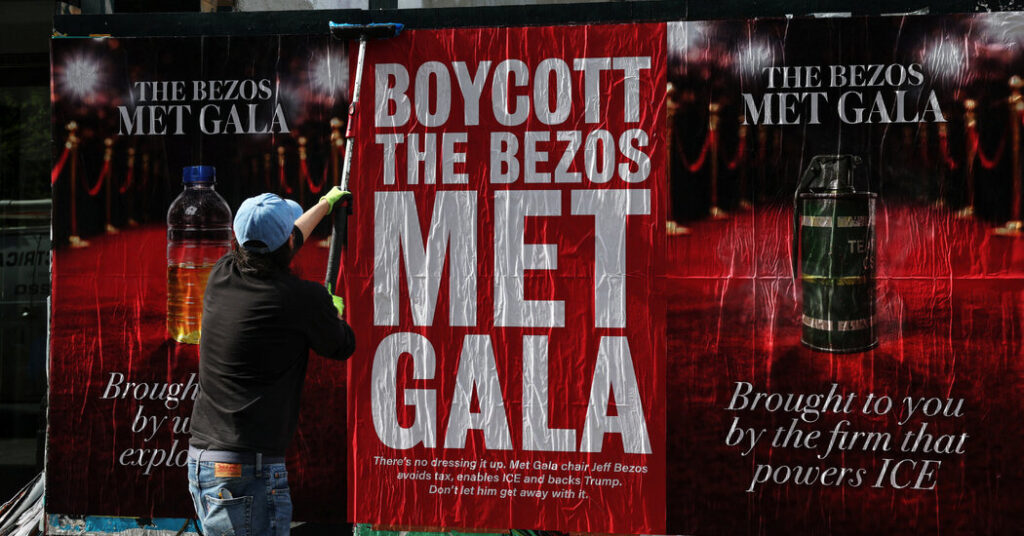
A guerrilla activist group called Everyone Hates Elon — a reference to another controversial billionaire, Elon Musk — has been calling for a boycott of the event, with a steady drumbeat of eye-catching campaigns around the city, including plastering posters on subway cars and bus stops. On Friday, in a nod to complaints by Amazon workers of having to skip bathroom breaks and urinate in bottles instead, the group placed close to 300 bottles of fake urine inside the Metropolitan Museum of Art.
Then, on Sunday, the eve of the gala, the anti-billionaire group projected video interviews with Amazon workers onto the Empire State Building, the Chrysler Building and the Bezoses’ penthouse near Madison Square Park.
“If You Can Buy the Met Gala, You Can Pay More Taxes,” read one of the projections beamed from the back of a van, along with a picture of a laughing Bezos.
Some people stopped and snapped photos, while others simply chuckled.
“What does Jeff Bezos,” asked one passer-by, Mayan Rajendran, “have to do with fashion?”
He wasn’t the only one asking that question. Other critics have included past boosters like Blakely Thornton, an influencer who interviewed celebrities on the red carpet last year. This year, Thornton skewered the gala on Instagram, criticizing the decision to align with Bezos, adding in a text message that he would rather be dragged through broken glass “than participate in this oligarch orchestrated clown show.”
The gala, which dates to 1948, acts as a fund-raiser for the Metropolitan Museum of Art’s Costume Institute and ushers in its major spring exhibition, which this year focuses on the dressed body. The fashion house Saint Laurent is sponsoring the exhibition catalog. Designers are known to spend months preparing outfits for the famed guests, who are often in surreal and spectacular fashion.
Fern Mallis, the creator of New York Fashion Week, called the Met Gala “the biggest ball of the year,” whose influence has far outgrown its roots as an event for well-heeled philanthropists and patrons “who lived nearby and loved the museum” and were often escorted by the designers they wore.
Now, she said, “it’s really about the celebrities and the musicians and the athletes and all these cultural icons of the day.” But, she thought that much of the starry guest list had little connection with the museum itself. “I’ll bet many of them have never even been there,” she said.
In recent years, too, protests have become as commonplace as the carnivalesque swirl surrounding the event, with demonstrations focused on issues like the war in Gaza or climate change. In 2024, the gala drew rebukes from lawmakers for naming TikTok as a sponsor at a time when the social media giant was facing a potential ban in the United States amid allegations of its political entanglements with China.
In Bezos, however, progressive protesters have seemingly found a perfect foil: a singular figurehead whose rightward political drift, $250 billion bankroll and anti-union efforts have made him an object of scorn on the left.
“He’s obviously one of the great avatars for, you know, just endless, rapacious accumulation of wealth and exploitation of workers at the expense of the rest of us,” said Micah Uetricht, the editor of Jacobin, a socialist magazine.
“So kudos to them,” he said of the Met Gala organizers. “If they were looking to make the worst choice possible, it seems like they’ve succeeded.”
The Bezoses’ unapologetic embrace of the luxe life, including a $50 million wedding last summer in Venice, with a $500 million yacht bobbing nearby, have not helped their image in some quarters, either.
“It’s not like a situation of the quiet rich,” Jon Reinish, a veteran Democratic political strategist, said. “This is the loud rich. And in a populist moment, that creates tension.”
Both the Metropolitan and representatives for the Bezoses declined to comment.
At the same time, the gala is grappling with other uncertainties, including a transition of professional roles for the longtime editor of Vogue, Anna Wintour, whose control over the event — from the seating charts to the finger food — is famously ironclad.
In the last year, the 76-year-old Wintour stepped aside from her role as editor in chief of American Vogue, and named as her successor Chloe Malle. Wintour remains in a top position at Condé Nast, Vogue’s parent company, as chief content officer, and global editorial director of Vogue.
As the world’s most famous magazine editor, Wintour has been credited with transforming the gala from a clubby New York society event into a global phenomenon, attracting a star-studded A-list and generating a healthy revenue stream for Condé Nast, said Amy Odell, a fashion journalist who wrote a biography of Wintour, “Anna: The Biography.” In fact, the gala, which is streamed exclusively by Vogue, brings the media company so many advertising dollars, Odell said, that “they can’t not have it.”
The Met’s Costume Institute is financially dependent on the gala. Last May, it raised a record $31 million, dwarfing similar benefit events at other institutions. This year’s take is expected to surpass that.
The gala’s place in the New York City and global social calender — traditionally the first Monday in May — is also unparalleled, with immense power to cement the importance of up-and-coming stars, both in fashion and the world of celebrity. Wintour has also argued that the gala — by, for example, drawing guests who stay at hotels and hiring multiple behind-the-scene vendors — is ultimately a shot in the arm for the city’s economy.
Ms. Mallis echoed this. “At the end of the day, it’s an enormous fund-raiser,” Mallis said, adding, “and that is a very positive thing.”
Wintour’s eventual departure from the scene, combined with the news last week that the gala might soon have raised enough money for the Costume Institute to not rely on the gala for annual funding, has also raised questions about the event’s future.
Cultural institutions have long courted wealthy benefactors, even as they have “leveraged public displays of philanthropy to augment their image and grow their social standing,” said Rachel Feinberg, a consultant who has worked on galas in New York City.
But, she added, that dynamic has become even more difficult when “the majority of individual gifts are coming from a smaller and smaller group of exceedingly wealthy people.”
The Bezoses have been increasingly active in fashion in recent years, including sitting in the front row of fashion shows and donating tens of millions of dollars in grants and scholarships devoted to sustainable fabrics and other initiatives.
The Met has dealt with criticism over donors in the past, including members of the Koch family — conservative political backers who also donate heavily to cultural institutions — and the Sacklers, whose now-disbanded company, Purdue Pharma, produced the painkiller OxyContin, a culprit in the opioid crisis. (The Sackler name was removed from several Met galleries in 2021; despite protests, the plaza in front of the Met is still named for David H. Koch, who funded its redesign and died in 2019.)
The split screen of the gala’s opulence juxtaposed with the economic struggle for many living in New York City, where an estimated 1 in 4 residents live in poverty, has long been evident. And while Bezos seems emblematic of those living at the top of the spectrum, even his critics say the problem is larger than this one billionaire.
“It’s easy to make him the villain when in reality the villain is the system,” said Molly Gaebe, co-founder of the annual Debt Gala, a four-year-old fund-raiser, inspired by the Met Gala, to help alleviate medical debt. “We’re in favor of building a system where working people can actually afford to live in the cities that they’re running.”
By the same token, Mayor Mamdani has actively campaigned for tax hikes on the wealthy, a policy that, polls show, a majority of New Yorkers seem to support. The mayor’s early and successful embrace of affordability helped it become a potent issue for Democrats, who hope it will help fuel victories in this fall’s midterm elections.
Critics of Bezos’ involvement with the gala cite a long list of concerns, including major layoffs and editorial decisions at The Washington Post, which he owns; Amazon’s donations to the president’s inauguration fund; and Amazon’s backing of a $40 million documentary about the first lady, Melania Trump.
“The Met Gala is now giving Bezos exactly the kind of reputation laundering and cultural rocket fuel he needs to keep destroying America,” said Cynthia Nixon, the “Gilded Age” actress and progressive activist who ran for New York governor in 2018. “My hat is off to the mayor for not attending.”
Mamdani is not the only mayor to have qualms about the event. Former Mayor Bill de Blasio, a two-term Democrat, long avoided the gala before attending in 2021 as a sign of solidarity, he said, with a city and institution recovering from Covid.
In an interview, de Blasio said the gala had always been “an elitist event,” noting that “the sense that elites are living a life so far away from the rest of us, the sense that the system is rigged,” is not limited to liberals like himself. “There’s a lot of MAGA supporters who could look at something like the Met Gala with discomfort,” he said.
For all of that, the show will go on, and is likely to command the attention of all manner of commentators, on the red carpet and online. Indeed, Michael Gross, the journalist and author who has long chronicled the ways of the rich, said that even if the Bezoses were to draw protesters, the gala will still probably come out on top.
“Every eye in the world is going to be on that,” Gross said. “Even the haters can’t help but be fascinated.”
Vanessa Friedman contributed reporting.
Jesse McKinley is a Times reporter covering politics, pop culture, lifestyle and the confluence of all three.
The post The Met Gala’s Embrace of Jeff Bezos Causes a Backlash appeared first on New York Times.