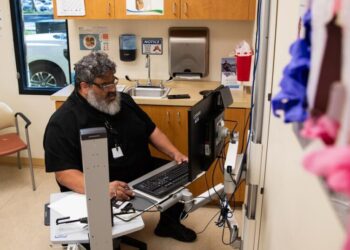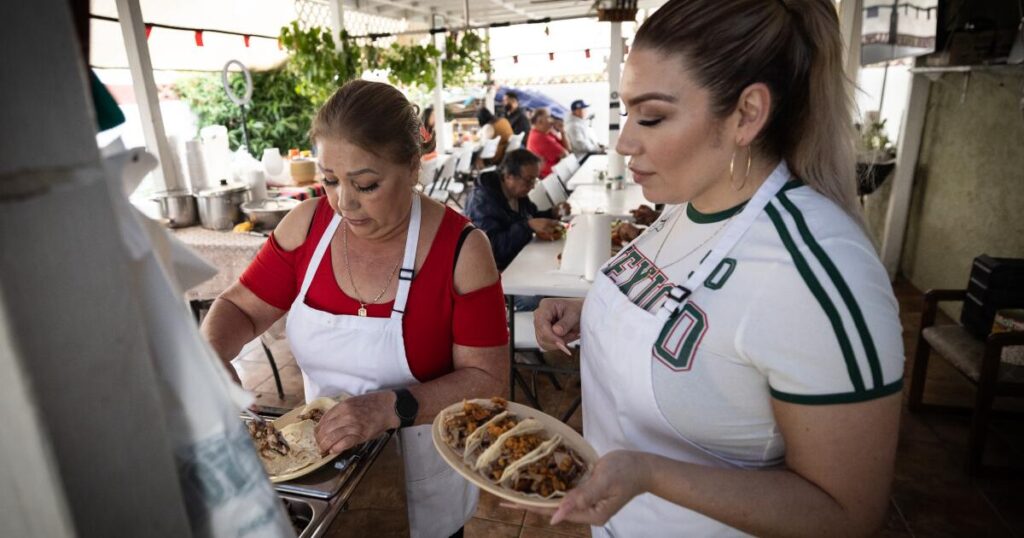
A radical deregulation of restaurant requirements is turning hundreds of backyards into booming businesses and reshaping how Los Angeles eats.
A state initiative to make it easier to start home food businesses has taken off in the last year. It is not only bringing more options to food deserts, but also empowering smaller, local entrepreneurs who were operating illegally, says Roya Bagheri, executive director of the Cook Alliance, the nonprofit behind the home restaurant law.
“People are already doing this,” but without licenses, she said. “This is really an example of the government meeting the people and the community where they are.”
On any given weekend, a line snakes around the block for Carnitas El Bigoton Becerra, a Mexican food spot in Norwalk.
Customers spill into the street, drawn to the joint’s handmade tortillas, slow-cooked pork and aguas frescas, but it has no sign, parking lot or industrial kitchen.
The entire operation is run out of the family’s home.
Roberto Preciado Jr., his two siblings and their parents began selling food out of their home four years ago. They operated without the required licenses and government monitoring and had to regularly pay thousands of dollars in fines.
Then, a new L.A. County ordinance legalized home-based restaurants in late 2024.
The Microenterprise Home Kitchen Operation program loosened restrictions on selling food, officially recognizing an important gray market and allowing L.A. residents to operate restaurants from home — a novelty here but reflecting a long tradition in Mexico.
More than 320 permits have been issued in the county, helping create jobs and affordable food options while diversifying the food scene, said James Dragan, a branch director for the L.A. County Department of Public Health, which oversees the program.
“This offers an opportunity for somebody to start using their skills and support their families, while they also serve food to their community,” he said. “It’s a safe option for people to use and find different types of foods, things that maybe they’re not finding locally.”
The state law legalizing home restaurants passed in 2019, but it required each region with a health department to pass its own ordinance to establish the program. Since then, 18 regions across the state have opted into the program, including L.A., Riverside and San Diego counties.
Backyards across the state now host intimate dining experiences, including authentic French food tastings and Sri Lankan-inspired dinners. Home kitchens are used to prep such offerings as Louisiana Cajun food and Texas-style barbecue. Some residential driveways are pickup spots for new coffee and matcha shops.
Corazon Coffee bakes fresh conchas made daily from scratch, with specialty churro and Mexican chocolate flavors. In a backyard in Pomona, cow head meat is cooked until tender, then served with melted cheese inside warm, handmade tortillas.
On Sundays, a coffee shop in Norwalk offers specialty coffee drinks using Oaxacan coffee beans. Asados To Go in Sylmar cooks barrel-style beef on a dome-shaped grill shipped from Colombia. El Patio Cafe offers a taste of Oaxaca with its tlayuda, a crispy tortilla topped with beans, cheese, meat, avocado and more.
“There’s so much creativity. It’s not just the food that is different, but also the way that they operate is completely different,” Bagheri said.
A black metal door to the right of an unassuming residential garage in Norwalk is left slightly ajar on weekend mornings. It is an invitation for customers to step inside Carnitas El Bigoton Becerra.
After making it past the garage, customers are met with rows of foldable white tables, adorned with cups of salsa, cilantro, onion and limes.
It took years for Preciado and his siblings to convince their mom to sell her famous carnitas. She learned the recipe from her father as a child, when she would help him sell the dish out of their home in Zapotiltic, a town in Jalisco state, Mexico.
Containers filled with salsas, varying in color and spice, crowd the corner of the family’s dining room table, its tangy smells rivaled only by tubs of chopped onion and cilantro. To-go plates line the counter space as the siblings race to fulfill orders.
Preciado’s mom, Leonila, is the head cook, in charge of creating most of the sprawling menu, including their famed menudo, and prepping the salsas.
Preciado’s dad, Roberto, cooks the carnitas, the joint’s star dish. His siblings help wait tables and press the tortillas. Preciado mans the social media account and chops the carnitas before serving.
The popular local business wasn’t registered with the county until July.
Bringing a taste of his grandfather’s cuisine to Norwalk, where the family settled more than 30 years ago, without fear of getting shut down by the city has been a blessing, Preciado said.
“We were able to get my mom to take a chance,” he said. “I’m sure my grandpa would be really happy.”
The novel program, a first of its kind in the country, is meant to encourage entrepreneurship among residents looking to start their own businesses or earn extra income in today’s costly economy.
The program does have its own restrictions. Businesses aren’t allowed to sell more than 30 meals a day and can sell only up to 90 meals per week. The operation also can’t make more than $100,000 in gross profit annually.
Though the program was slow to start, it has picked up steam, with 220 permits granted in 2025 and more than 50 this year as of mid-April.
The L.A. permit costs $597, only a fraction of the hundreds of thousands of dollars that opening a restaurant can cost. The permit fee is also waived by the city until June 30 to encourage more applications. The city has funds to subsidize 470 more businesses, Dragan said.
The permit requires a couple of food handler certifications, a few chemical tests and an inspection, much less than the mountain of state and county licenses needed to open a brick-and-mortar restaurant.
“Opening a restaurant is an insurmountable task for probably the majority of people,” Dragan said. “It offers a lot of economic opportunity for individuals who have a home kitchen to work out of and they don’t have a lot to invest.”
Home-based restaurants might be a new trend in the U.S., but they’re a tradition in Mexico, said Reme Jimenez, who operates a taco and Mexican seafood spot, Tacos El Arbitro, out of his backyard in Arleta.
“A lot of people are not used to it yet,” Jimenez said. “So, once the customer bypasses that initial shyness, we make them feel at home.”
Jimenez, who once owned a restaurant in Mexico, returned home to Los Angeles two years ago, just after his father and two brothers died. Needing to care for his aging mother, Jimenez considered opening a restaurant here, but the mounting costs made it impossible.
He started selling food on the street until the city shut him down, and he obtained a permit to sell from home. He sells from Thursday to Sunday.
The business makes enough to sustain himself and his mother, without the typical demands of running a traditional restaurant. The four-day workweek allows him to spend more time caring for his mother, Jimenez said.
Well over a thousand home-based businesses are operating statewide, Bagheri said. Similar legislation has since been passed in Utah, and states such as Washington and Minnesota have considered similar laws.
Long Beach, one of just a handful of cities with its own health departments, could soon follow suit. The City Council greenlighted its own home restaurant program in April after years of activism, said Jacqueline Perez, an economic justice manager at Órale, an immigrant-led nonprofit in the city.
For years, Magdalia Pereyda designed elaborate dessert tables for the parties of family and friends, cooking up cheesecakes and flans for little to no money.
The 60-year-old hopes the upcoming program in Long Beach, where she lives, could provide much-needed income for her and her husband and fulfill a lifelong dream of owning her own business.
“We’re one step closer to achieving what we want,” Pereyda said in Spanish. “Not just for me, but for all the people who have the same dream and the vision of one day setting up shop and having everything legal without any problems.”
The post How once-illegal backyard restaurants are coming out of the shadows to redraw L.A.’s culinary map appeared first on Los Angeles Times.