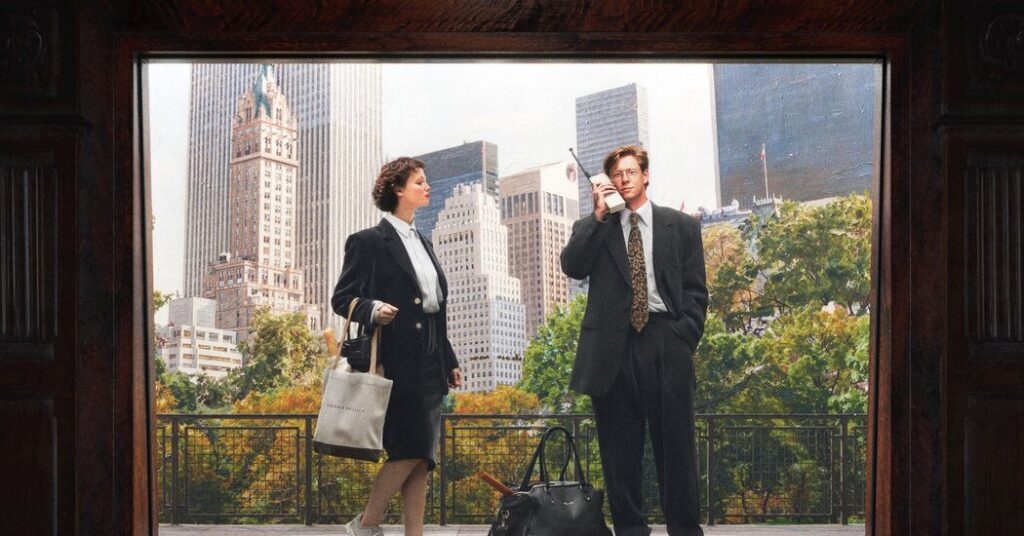
You’ve surely seen them: the packs of 20-somethings stalking the sidewalks of Manhattan in button-down shirts and vests embroidered with the name of an investment bank. Or perhaps you’ve stood behind them in line at a coffee shop, counting the minutes as they order a matcha latte with oat milk. Maybe you’ve listened to them discuss their punishing Pilates regimen, or the amazing Wagyu short ribs they ate last night.
The status signifiers may have changed, but these eager knowledge workers are best understood as yuppies. Short for “young urban professional,” the term can be traced back to the 1980s, when it was used to describe a new cohort arriving in cities: the bankers and lawyers who earned high salaries, coveted loft apartments, trained for marathons, owned Cuisinarts and loved sushi, Brie, and chardonnay. The yuppies were both envied for their pleasures and derided as shallow, consumerist and status hungry. The word became a weapon: Across cities, phrases like “Die Yuppie Scum” were scrawled onto the sides of buildings.
But perhaps we were too dismissive of the yuppies. So much of what we take for granted today — from our meritocratic rat race to our gentrified neighborhoods to our culture of overwork, fitness training and foodie obsession — was born in the yuppie-made 1980s. In that moment, they fashioned a bargain that we are still living with: An increasingly diverse professional class signed up for a life of hard-won affluence, at the cost of deep inequality for everyone else.
Yuppies were called into being by the forces that were remaking the economy in the 1980s. After the Carter and Reagan administrations loosened the regulations governing Wall Street, finance began to generate a greater share of profits than manufacturing or services. Investment banks and law firms now shaped the fates of the corporations they had once served. As America hitched its fortunes to finance, those banks and firms began to chop up, spin off, merge, offshore or otherwise squeeze short-term value out of the nation’s legacy corporations. But to do it, they needed legions of employees to handle the grunt work: the proofreading, drafting and document review that kept the takeover machinery in motion.
To find those employees, recruiters flooded the campuses of America’s elite universities. In 1976, less than 5 percent of surveyed seniors at the University of Pennsylvania’s Wharton School were headed to Wall Street for investment banking. By 1987, it was one in three. At Yale, 40 percent of the entire graduating class of 1986 applied to work at the investment bank First Boston. At Princeton, hopeful students waited all night to secure a spot on recruiters’ schedules. In his book “Liar’s Poker,” Michael Lewis describes trying to get an interview with Lehman Brothers in the early ’80s: “I had stood in six inches of snow with about 50 other students, awaiting the opening of the Princeton University career services office.”
The number of WASPy white men at elite schools was simply too small to keep up with the torrent of financial deal-making. Chasing rapid growth, banks and law firms began to hire all sorts of graduates — first Jewish and Irish and Italian men, then, as the women’s and civil rights movements diversified the university-bound population, a growing number of white women and Black, Latino and Asian men and women. In an age of ruthless competition, identity mattered less than workers’ credentials and willingness to work grueling hours.
Robert Jen, who grew up in a Chinese immigrant family in New York, was one of those new hires. As a student at Columbia, Mr. Jen saw John Gutfreund, the chief executive of Salomon Brothers, speak at an event. Even though Mr. Jen had had no background — or even much interest — in finance when he arrived at Columbia, he accepted an offer from Drexel Burnham Lambert’s New York office, where by 1981 he was working long hours as a junk-bond trader. “That’s how I came to the Street,” he said later. “It was basically by accident.”
Once they were hired, aspiring yuppies were expected to work more hours, often on smaller and less intellectually demanding piecework. They were also given less meaningful training, all for narrower chances of promotion to partner. As the professional world was beginning to diversify, it became an increasingly miserable place to work. This was no accident: The legal and financial bosses who were commanding these diverse armies of young professionals sought to extract maximum value out of their labor.
This early wave of yuppies contains the origins of our present-day meritocratic competition, which turned college admissions into something akin to “The Hunger Games.” As top universities became the key credentialing institutions for lucrative professional careers, parents and children fought multiyear battles for a finite number of precious spots. In an era of inequality, families of all backgrounds found themselves pitted against one another in zero-sum competition for a place in the upper-middle-class elect.
On the job, newly minted yuppies were also sold a particular story: Upward mobility was open to anyone with the right degree and the right work ethic. Take the experience of Nancy Lieberman. After graduating from the University of Chicago Law School in 1979, she was eventually hired by Skadden, an upstart law firm specializing in mergers and acquisitions. Soon she was logging 60-to-75-hour weeks working on multibillion-dollar deals. At Skadden, she believed that merit trumped gender. “I never thought to myself, ‘Poor me. I’m a woman, and I’m trying to make it in a man’s world,’” she said in a later podcast. “All they wanted was for you to be a really great lawyer.”
That dogged pursuit of the strenuous life extended from the workplace into yuppies’ leisure time. They developed a passion for road races like the New York City Marathon. This wasn’t the casual jogging that countercultural types had embraced in the late 1960s. It was distance running, and it required the same self-control and long-range planning that characterized yuppie careers. “Some races you fell flat on your face, some races you did great. It’s the same thing in the trading world,” the former bond trader Mr. Jen told me. “There are no excuses. You either perform or you go home.” Here are the seeds of the self-optimization culture that blossoms in our own era, in which fitness trackers and peptide stacks are dinner-party topics. For yuppies then as now, leisure is just another form of work.
The marathon also appealed to another key constituency: the city leaders, real estate moguls and corporate types who hoped to burnish New York’s image as it emerged from the fiscal crisis of the 1970s. What could be a better advertisement than the marathon, whose participants were overwhelmingly white-collar professionals? In the 1980s, television broadcasts beamed images of yuppies running through the city’s boroughs to millions of spectators around the world. The marathon was just a harbinger. Inspired by the success of that experiment, New York decided to stake its future on yuppies: paying them, housing them and entertaining them. Decades later, cities remain their playgrounds — venues to splash their disposable income and demonstrate their class and taste.
The yuppies also helped forge our modern foodie culture: one that required wealth but also the cosmopolitanism to know that, say, balsamic vinegar, sun-dried tomatoes and Manchego cheese were foods worth savoring. The Zagat guide — created by two corporate lawyers in 1979 — helped educated professionals to demonstrate this expertise. (The guide was designed to fit in the pocket of a business suit jacket.) Grocery stores transformed themselves for yuppie tastes, too. Shopwell, a middle-class market with roots on the Lower East Side, rebranded dozens of its stores as the Food Emporium. The executive behind the idea, Glen Rosengarten, called his new concept “the Bloomingdale’s of supermarkets” — a high-end store for a well-heeled clientele. It joined a raft of other upscale markets, from the Silver Palate to E.A.T. to Dean & Deluca, that trained an entire generation on the pleasures of the gourmet life.
Yuppies also redrew our political map. They helped to shift the Democratic Party away from the unions, Black Americans and urban bosses of the New Deal coalition and toward the interests of metropolitan professionals. During the 1980s, a new generation of politicians and donors — people like Gary Hart, Chuck Schumer and Bruce Wasserstein — remade liberalism for the postindustrial era. The meritocratic ethos of the trading floor, they reasoned, should govern society at large. Innovation, not regulation or redistribution, would drive growth. And the sclerotic regulatory state was only hampering it. What was needed instead was a nimbler government that oversaw a technology-heavy economy, with yuppies at the vanguard.
In the 1984 Democratic presidential primary, yuppies threw in their lot with Mr. Hart, whose youthful vigor and technocratic platform were catnip for the professional class. While Mr. Hart didn’t capture the Democratic nomination that year, his supporters and their money would come to dominate the party in the 1990s and beyond. By the end of the century, no national candidate could consider running for office without first capturing the imaginations of yuppies — or their dollars. Goldman Sachs employees and their families donated more to Bill Clinton’s 1992 campaign than any other firm. In 2008, Barack Obama would raise more money from Wall Street lawyers and law firms than any presidential candidate in history.
The rise of the yuppie was not without its costs. The upper echelons of our society became more inclusive in terms of race, ethnicity and gender — but only for those who ran a gantlet of educational and professional challenges on their way to the top. By admitting women and members of racial minorities, the new yuppie elite helped obscure the skyrocketing economic inequality that would soon become a central fact of American life. Since the 1980s, upwardly mobile yuppies have left blue-collar, pink-collar and less-educated service workers further and further behind.
A similar story of inequality played out in the neighborhoods yuppies moved to. From SoHo to Park Slope, San Francisco’s North Beach to Chicago’s North Side, their arrival was accompanied by rapid and intense gentrification. Soaring real estate values created strong incentives for owners to renovate their buildings for yuppies — a process that usually began with aggressively displacing poorer tenants.
Sometimes owners offered sums of cash to get people to relocate. But all too often, they harassed tenants until they vacated. Most distressingly, they used arson to empty entire buildings of Latino families in Hoboken, N.J., a bedroom city across the Hudson River from the office towers of Manhattan. A series of fires ripped through tenements and rooming houses there, killing 56 people and displacing more than 8,000. Almost all of the displaced residents were Puerto Rican.
The yuppies who bought or rented those apartments consoled themselves with the idea that violence was a regrettable byproduct of the generally positive process of neighborhood change. In 1982, a reporter for The Jersey Journal approached a table of people who were discussing their commutes over oysters and white wine. The journalist asked them what they thought of the wave of arsons in Hoboken. “I don’t want people to be burned,” one woman said. “But I wouldn’t mind a nicer element of people here, if you know what I mean.”
From their neighborhoods to their retirement portfolios, yuppies enjoyed the spoils of a society that was growing more unequal over time. Even as the industries that employed them evolved — from finance in the 1980s to consulting in the 1990s and tech in the 2000s — the trend only accelerated.
After decades sitting atop this brutal hierarchy, yuppies and their arrogance bred new resentments. In the 2010s, a brand of populist conservatism opposed nearly every tenet of the yuppie dream, from racial and gender diversity to educational meritocracy to frictionless finance and globalization to gourmet culture and the very idea of urban living itself.
This response was unsurprising given the real harm done by Wall Street firms to blue-collar America. But the wounds were as much psychic as they were economic. Racial grievance gave the movement its power. So did geographic and class-based resentment of the cosmopolitan elite that yuppies embodied. After all, locally rich but less educated white people — owners of car dealerships and construction companies across the South and Midwest — were among the fiercest populist conservatives.
Their tribune, Donald Trump, shared their antipathy toward liberal yuppies. As a developer and playboy in 1980s New York, Mr. Trump had pursued upward mobility in a way that was too grasping and uncouth to win the respect of Manhattan society. And his consumption was too conspicuous and his manner too outer borough to gain the esteem of many of New York’s snobbier yuppies. But that brash style and bitterness over past rejections served him powerfully in electoral politics. Mr. Trump’s hatreds rhymed with the hatreds of his supporters, whether they lived in Ohio or on Staten Island.
Today, the class of people once known as yuppies are both everywhere and under threat. The Trump administration’s attack on diversity, equity and inclusion and affirmative action might damage the recruiting pipeline that has conveyed women and members of racial minorities into the professions. Employers will have to rely on more informal and more discriminatory forms of hiring: personal connections, nepotism and cultural “fit,” all of which tend to favor the privileged. Our professional class may shrink, welcoming only the sons and daughters of the already rich.
What’s more, the rollout of A.I. threatens to decimate entry-level professionals — a reprise of the same kind of deskilling and “downsizing” that Wall Street visited on America’s industrial workers in the 1980s and ’90s. Forget upward mobility: Even a moderately secure upper-middle-class lifestyle might soon be out of reach.
What happens when yuppies realize they could be headed toward extinction? One hope is that they recognize that they have more in common with other precarious workers than with the corporate elite they have long been content to serve. The Zohran Mamdani coalition, which unites downwardly mobile yuppies with working-class strivers, is one sign that this may already be occurring. The coming A.I. revolution will only add more white-collar casualties to that growing constituency.
But even for the yuppies who made it, all was not well. The exhausting meritocratic contest that furnished them with nice apartments and private-school tuitions had real psychic costs. Between the long hours and the constant pressure for upward mobility, few yuppies actually felt triumphant. They felt burned out.
Yuppies were the first class of young people to be drawn into the sweatshop of the meritocracy. Now is the time to rethink the bargain they made, which offered diversification and affluence at the cost of exploitation and broader inequality. If history teaches anything, it is that if a class can be made, it can also be unmade.
Dylan Gottlieb is a history professor at Bentley University and the author of the forthcoming book “Yuppies: The Bankers, Lawyers, Joggers, and Gourmands Who Conquered New York.”
The Times is committed to publishing a diversity of letters to the editor. We’d like to hear what you think about this or any of our articles. Here are some tips. And here’s our email: [email protected].
Follow the New York Times Opinion section on Facebook, Instagram, TikTok, Bluesky, WhatsApp and Threads.
The post Speak, Yuppie appeared first on New York Times.