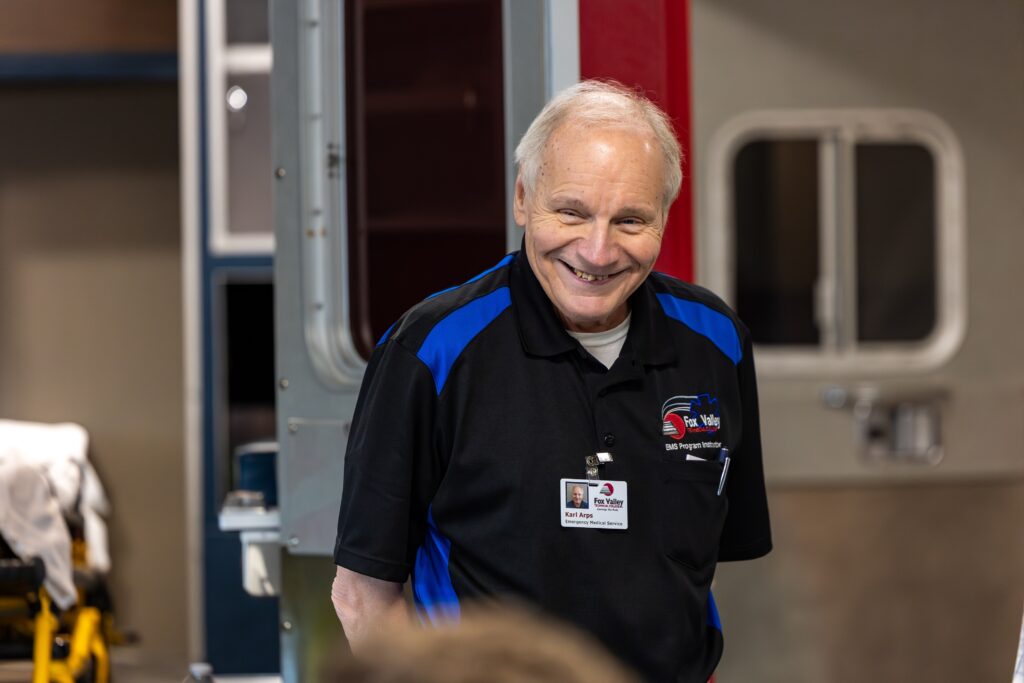
Initially, Karl Arps was just pretending, imitating a patient with chest pain as he tested his emergency medical technician students.
But minutes into the March 25 demonstration, the lesson abruptly stopped being a simulation.
Arps — an EMT instructor at Fox Valley Technical College in Appleton, Wisconsin — began gasping for air before losing consciousness. At first, students thought he was still faking it.
“I heard him making snoring-sounding respirations. My initial thought was that this was a new symptom,” said Logan Lehrer, 26, a firefighter who is training as an EMT. “About 10 seconds went by and I had a feeling in my stomach this was not part of a scenario, this was starting to feel real.”
In fact, Arps was experiencing a heart attack that led to cardiac arrest. As the practice training became a real emergency, students summoned another instructor for help. They moved Arps out of the mock ambulance and onto the open floor, knowing CPR needs to be performed on a hard surface. Several students took turns doing chest compressions, rotating every two minutes, while another retrieved an automated external defibrillator and someone else called 911. Others cleared space and directed first responders when they arrived.
“The adrenaline came through,” said Sofie DeValk, 21, who cut off Arps’s shirt and took his vitals.
“You read about cardiac arrest, and you study it on paper, but once you see it, it’s alarming,” Lehrer said.
The students followed the protocol Arps had taught them called the Chain of Survival. By the time paramedics arrived, Arps had regained a pulse.
“They followed it to the exact minute,” Arps said. “Like they’re trained to do.”
Arps, 72, has worked as an EMT for 25 years and has spent nearly two decades training future first responders. He said he had never been previously diagnosed with heart disease and had not experienced any warning signs — such as shortness of breath or chest pain — leading up to the incident.
“I would get tired easily, but I just thought it’s part of getting older,” he said. As the simulation began, Arps remembers feeling slightly dizzy, but he didn’t think anything serious was wrong.
There were about 30 minutes left in class when his heart stopped.
“A half an hour later, I’d be driving home,” Arps said. “If it had happened then, forget it.”
He was rushed to ThedaCare Regional Medical Center-Appleton, where he was taken directly to the cardiac catheterization lab. He spent four days in the intensive care unit before undergoing triple bypass surgery.
The survival rate for out-of-hospital cardiac arrest incidents is 10 percent, according to the American Red Cross.
“I’ve been in this for 25 years, and I can count on one hand the number of people that have survived this,” Arps said. “It was very scary.”
His EMT class meets three times a week for four hours at a time, combining lectures with hands-on training in emergency medicine, trauma care and life-saving skills.
“It’s a lot of everything because you never know what you’re going to get in the ambulance,” Arps said.
The class began in September, and students are expected to graduate this month. Of the 18 students in the class, Arps said, six were directly involved in saving his life.
Arps is grateful the emergency happened in a room full of people trained to respond, even if the situation led to some initial confusion.
“It’s a good scenario to have a heart attack if there ever was one … but it’s also almost one of the worst times to have a heart attack, when everyone thinks you’re faking it,” Lehrer said. “The irony of it all is wild.”
Arps and his students hope the story reinforces the importance of learning CPR — not just for medical professionals, but for everyone.
“If they hadn’t learned CPR, we would be discussing my funeral, we would not be discussing my life,” Arps said. “It’s etched in my memory forever. … I can’t thank the students enough.”
Arps is recovering well from surgery and is starting cardiac rehabilitation. He hopes to return to teaching soon.
In the meantime, he has gone back to visit with students and staff twice since his surgery and said the outpouring of support was overwhelming.
“I was tearing up quite a bit to see everybody in the classroom,” he said. “I never realized how many people I have touched in my career.”
The students said they were relieved to see Arps back at school.
“It was reassuring that we made an impact on someone,” DeValk said.
“It was really cool to see him upright and walking again,” echoed Lehrer.
Arps said that while his career as an EMT has been rewarding, being a teacher has been just as meaningful — if not more so.
“The students actually do learn from me,” he said. “They put it into action.”
The post During CPR lesson, teacher has a cardiac arrest — and students save him appeared first on Washington Post.