Illustrations by Mike McQuade
The courtship between Silicon Valley and MAGA was consummated on June 6, 2024, in San Francisco’s Pacific Heights neighborhood, on a street known as “Billionaires’ Row,” at the 22,000-square-foot, $45 million French-limestone mansion of a venture capitalist named David Sacks. Along with Chamath Palihapitiya, a fellow venture capitalist and a colleague on the All-In podcast, Sacks hosted a fundraiser for Donald Trump. He knew that other technology titans were coming around to the ex-president but remained in the closet. “And I think that this event is going to break the ice on that,” Sacks said on the podcast the week before the fundraiser. “And maybe it’ll create a preference cascade, where all of a sudden it becomes acceptable to acknowledge the truth.”
A few years earlier, Sacks had described the January 6, 2021, riot at the U.S. Capitol as an “insurrection” and pronounced Trump “disqualified” from ever again holding national office. “What Trump did was absolutely outrageous, and I think it brought him to an ignominious end in American politics,” he said on the podcast a few days after the event. “He will pay for it in the history books, if not in a court of law.” Palihapitiya was more colloquial, calling Trump “a complete piece-of-shit fucking scumbag.” These might seem like tricky positions to climb down from—but the path that leads from scathing denunciation through gradual accommodation to sycophantic embrace of Trump is a well-worn pilgrimage trail. The journey is less wearisome for self-mortifiers who never considered democracy (a word seldom spoken on the podcast) all that important in the first place. One prominent traveler who had already shown the way was a guest at the fundraiser—Senator J. D. Vance, whose attendance helped close the deal on his selection as Trump’s running mate. Any lingering awkwardness between the hosts and their guest of honor was dispelled by the fundraiser’s $12 million haul, much of it from cryptocurrency moguls.
Opportunist doesn’t really describe Sacks. He doesn’t come across as slippery or two-faced. There’s no evasive glance or roguish smile. He can argue at great length, in a steady sinal drone, with an aggressive debater’s ability to make an evidence-based case for any position he holds—but the position always happens to coincide with his benefit. The only consistent principle of his career is a ruthless devotion to self-interest. Sacks has identified as a “libertarian conservative” all of his adult life, but he has sought government intervention on behalf of his investments when it’s suited him. In 2023, when Silicon Valley Bank collapsed, Sacks demanded that the federal government bail out the uninsured deposits of start-up companies, much of the money from crypto firms. “Some libertarians care about the freedom of only one person,” Peter Thiel, the entrepreneur, investor, and right-wing provocateur, once said of his friend Sacks.
[From the May 2026 issue: What Noah Hawley learned about billionaires at Jeff Bezos’s private retreat]
In this sense, though Trump is impulsive and narcissistic while Sacks is cold-eyed and logical, they are well matched. “Sacks is a spirit animal for part of the president’s brain,” a former Biden-administration official told me. “The plutocratic part.” After the election, the new president appointed Sacks as his special adviser, or “czar,” for AI and crypto. After decades of keeping as far from Washington as possible, Silicon Valley would finally have its own man in the White House.
But Sacks has always taken a dim view of politics. At 25, appearing on a C‑SPAN talk show while still in law school, he expressed a preference for “the ethos of Wall Street” over “the ethos of Washington” and quoted Calvin Coolidge on the business of America being business, avowing: “I’d probably rather live in a greedy country where people don’t share than in an envious country where people are stealing from each other.”
Sacks went to Washington on behalf of business, including his own. But business and politics demand different, sometimes opposing talents. “Sacks’s policies are misaligned with his own party,” a congressional aide with a close view of how Sacks operates in Washington told me. “He doesn’t really understand how D.C. works.” His efforts in government on behalf of the tech industry have exposed the president to the charge that Trump is selling out his populist base on behalf of the country’s richest men, driving a wedge through the MAGA coalition.
Sacks once called a rare victory over Thiel in a game of chess one of the greatest moments of his life. In a photo, his arms are raised skyward, ecstatic disbelief on his face. He spent the early years of his career as a kind of junior partner in Thiel’s shadow. Sacks was born in 1972 in South Africa, and moved to the United States at age 5. He grew up in Memphis and attended an elite boys’ prep school before going on to Stanford University. As a sophomore with right-wing views he inevitably gravitated toward Thiel, who was by then in law school, and joined The Stanford Review, the conservative campus publication that Thiel had started as an undergrad. It took aim at the politically correct orthodoxy and anti-Western ideology that swept over American higher education in the late ’80s and early ’90s and never really left. But the outnumbered young conservatives’ mockery almost always overshot the target. An entire issue was devoted to making light of rape, including a contribution from Sacks that challenged whether statutory rape should be a crime. (He has since expressed regret for some of his youthful writings.)
Thiel was determined to be a public intellectual like his hero William F. Buckley, so he began writing a book on left-wing campus extremism. When he found the work too onerous, he turned the research over to Sacks, and they co-authored The Diversity Myth: Multiculturalism and Political Intolerance on Campus, published in 1995 by a libertarian think tank. Sacks attended the University of Chicago Law School, but law was too much like the detested public sector, and in 1999, when Thiel co-founded an online-payments company in Palo Alto that was soon to be called PayPal, Sacks left a consulting job to lead the company’s product team. He made important contributions to PayPal’s success; by various accounts, including Sacks’s own, he was also known for telling co-workers in blunt terms that they were wrong. A former colleague told me that with Sacks, “there’s masters and there’s slaves. He doesn’t have partners: ‘You do what I tell you to do, or you’re one of the few people that tell me what you want me to do.’ ” The former colleague added, “Part of his drive is that he believes he is one of the small number of elite people who really get it and are capable.” (The former colleague and some other Silicon Valley sources requested anonymity to discuss a figure who has power over their businesses; some government officials requested anonymity to speak about White House conversations, because they were not authorized to talk about them. Sacks declined to be interviewed.)
PayPal became famous for surviving the dot-com crash in 2000, and for producing a spawn of Silicon Valley stars known as the PayPal Mafia, including Sacks. Roger McNamee, a longtime tech investor, watched its success with admiration and apprehension. The PayPal Mafia saw before anyone else that the cost of starting an internet company was going to drop significantly. “They realized that the limits on processing power were going to go away,” McNamee told me. But these 20- and 30-somethings were not inspired in the same way that the founders of earlier Silicon Valley companies were: “They didn’t follow the vision of Steve Jobs, that tech can democratize power. They came to get rich.” McNamee added, “If their value system had been different, we would have a completely different country today.”
I met Sacks in 2011, at a dinner at Thiel’s house in San Francisco with a small group of entrepreneurs and investors, most of them PayPal alumni. They despised higher education, worshipped the creators of tech companies, wanted to found libertarian colonies on the high seas and be cryogenically frozen for future resurrection—eccentric outliers then, but forerunners of a broader political trend in the Valley. One guest was an AI expert named Eliezer Yudkowsky. Last year, he co-authored If Anyone Builds It, Everyone Dies, which concludes that artificial superintelligence will kill literally every human being on Earth—thereby causing Thiel to label him “a legionnaire of the Antichrist.”
[Read: AI is grown, not built]
Sacks seemed the most normal of the group. He was a businessman with conventional libertarian views, more optimistic than Thiel about the economic power of the internet, less apocalyptic about the decline and fall of “Western civilization,” a key term in The Diversity Myth that Sacks seldom used after publication, showing no consistent ideological attachment other than to capitalism. His distaste for politics remained strong. “This is the battle,” Sacks told me. “Can the web disrupt the rest of the economy, or does the old economy fight back using politics to keep the new economy from taking over?” At the time we spoke, he was trying to disrupt the car-wash business. He had invested in an app that allowed you to send your car’s location to a person who would come wash it while you were off getting sushi or founding a company or taking a meeting in Hong Kong. The app, called Cherry, lasted only a year, but Sacks did better with another early-stage investment in a company that sent a town car to pick you up. “It’s totally disrupted the taxi business,” Sacks said of Uber, with undisguised pleasure.
He did extremely well, with a movie he co-produced in 2005 (Thank You for Smoking ), with a company he co-founded in 2008 (a Slack-like social network for businesses called Yammer), and with his investments: in Facebook, Palantir, and SpaceX after PayPal was sold to eBay for $1.5 billion in 2002; in bitcoin and other cryptocurrencies after he sold Yammer to Microsoft for $1.2 billion in 2012. That year, he threw himself a Marie Antoinette–themed 40th birthday party in a rented ancien régime–style Los Angeles mansion, with special guest Snoop Dogg. “Part of believing in capitalism is you don’t have to feel guilty,” Sacks told me.
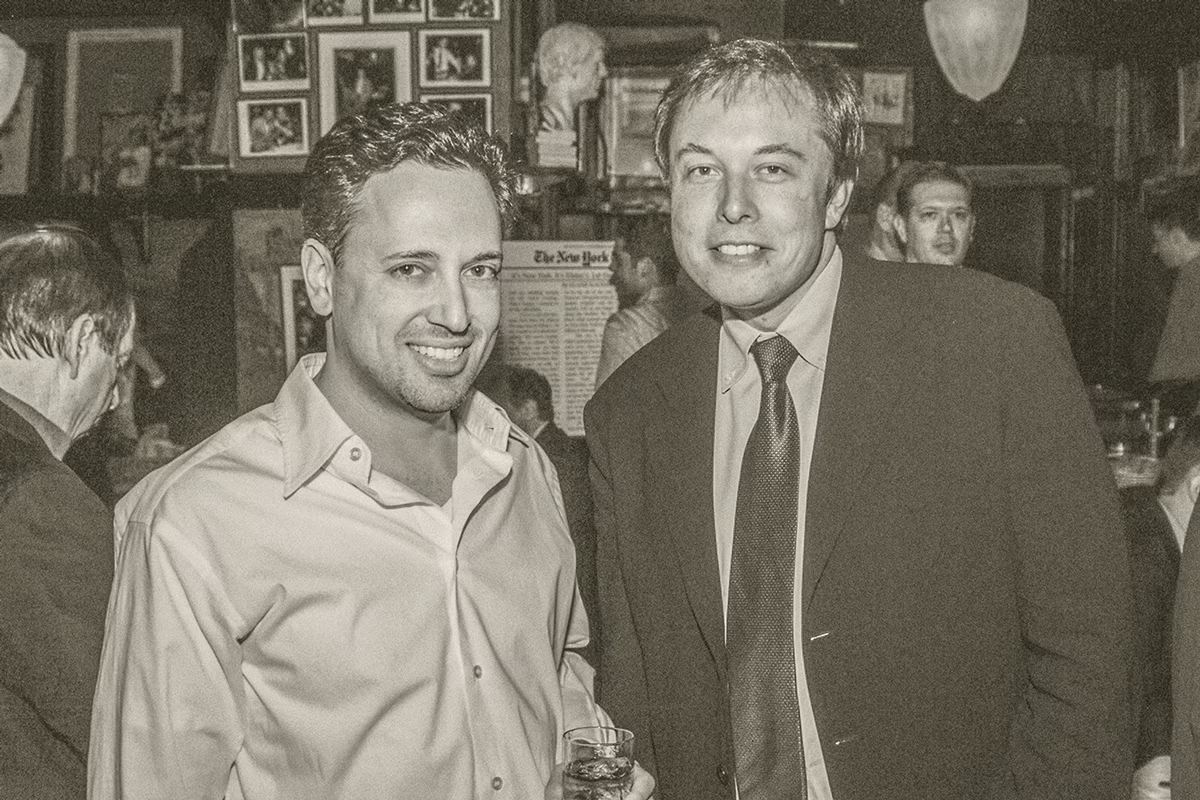
He conducted himself in the usual way of an aristocrat of the second Gilded Age: buying lavish properties, contributing to mainstream politicians (Mitt Romney in 2012, Hillary Clinton in 2016), and guarding his family’s privacy. He deplored the deterioration of urban life and funded the recall of San Francisco’s ultraprogressive district attorney, Chesa Boudin. Unlike Thiel, he didn’t publish writings on reactionary philosophers and the virtues of monopolistic capitalism.
The politics of the Valley was always a liberal sort of libertarianism: pro-choice, pro-immigration, idealistic, even utopian, arrogant about its mission of empowering individuals and connecting humanity, but indifferent to and ignorant of government, with an engineer’s contempt for the creaky workings of bureaucracy and the cluelessness of elected officials. Leave us alone to do our magic, which you can’t possibly understand, and everyone will benefit.
But about a decade ago, tech’s free ride ran into trouble. In 2013 Marc Andreessen, an inventor of the first popular web browser in the ’90s and now one of the Valley’s most successful venture capitalists, predicted to me a public backlash against technology companies over privacy rights, intellectual property, and monopoly power. With more foresight he would have included the addictive and corrosive effects of social media. Three years later, in 2016, Facebook enabled Russian meddling in an election that inflamed American divisions and sent Trump to the White House.
Trump and his populist followers made Big Tech a favorite target; so did progressives such as Senator Elizabeth Warren. Under bipartisan pressure, Silicon Valley had to search for ways to keep the government out of its business. Executives and investors spent fortunes on lobbying and campaign contributions. Mark Zuckerberg showed up in Washington to stand before Congress with his hand raised—eyes wide, as if stunned by the reality of representative government—and explain in tortured sentences why Facebook’s platforms weren’t driving America’s children to anxiety and depression while shredding the country’s civic ligature.
“Concern with tech monopoly was big in the first Trump administration,” Tim Wu, an antitrust expert and a professor at Columbia Law School who served in the White House under President Biden, told me. “This has been largely forgotten, but the first Trump administration brought the first cases against Facebook, which are under appeal, and against Google, which we won under Biden.” Biden’s Federal Trade Commission and the antitrust division of his Justice Department pushed anti-monopoly policies even harder. The tech giants “wanted to be able to get in and tell us what to do about everything,” Wu said.
Still, the confrontation between Washington and Silicon Valley under Biden was more rhetorical than substantive. His administration failed to push through any meaningful regulation of the industry, and its legislative achievements in infrastructure, semiconductor manufacturing, and clean energy directly benefited the technology sector. Yet during Biden’s presidency a highly visible element of Silicon Valley turned against the Democrats. It became known as the tech right.
Its most famous figure was Thiel, who had kept a lonely vigil for Trump in Silicon Valley since 2016. But by the early 2020s its most vocal spokesperson was Andreessen. For the tech right, technology is Promethean fire. The founders of the most successful companies in the Valley play a godlike role, for they alone can save America and “Western civilization” from Europe’s hyper-regulated stagnation and from communist and Islamist totalitarianism. Fred Turner, a Stanford professor who studies the culture of technology, told me that deep within Silicon Valley’s libertarianism lies “the idea of a community of saints, of special people, entrepreneurs, philosopher kings.”
In 2023 Andreessen published a litany of pseudo-Nietzschean credos called “The Techno-Optimist Manifesto.” On AI: “We believe Artificial Intelligence is our alchemy, our Philosopher’s Stone—we are literally making sand think.” The AI revolution is coming, just as electricity did; it will exalt mankind, and any attempt at regulation would be tantamount to mass slaughter: “We believe any deceleration of AI will cost lives. Deaths that were preventable by the AI that was prevented from existing is a form of murder.” Among the “Patron Saints” of this cult of the entrepreneur, Andreessen included John Galt, the hero of every libertarian teen who reads Ayn Rand’s novel Atlas Shrugged, and the 20th-century philosopher James Burnham, best known for predicting that the modern world would be run by an amoral class of “managers,” with the talented few ruling over a mass of semi-slaves. Elsewhere, Andreessen has said that oligarchy is inevitable.
The nearly hysterical voice of “The Techno-Optimist Manifesto” is that of a man who has freed himself from a deeply uncomfortable position. Andreessen was a longtime contributor to Democratic candidates. The political change of Silicon Valley figures like him was less a conversion to Trumpism than a deconversion from liberalism, caused by pressure from below and above. In 2025 Andreessen told The New York Times’ Ross Douthat that the new progressivism of the 2010s had “radicalized” young tech workers, turning them into spiteful and, once COVID hit, indolent rebels who intimidated their white, male, for-profit bosses into bowing to the Great Awokening. Andreessen was willing to pay high taxes and support liberal causes and candidates as long as he was regarded as a hero. But during the past decade, what he called “the Deal”—admiration and a free hand for Silicon Valley in exchange for building great companies, making the world better, and supporting Democrats—was broken, when first young people and then the Biden administration turned against the tech industry.
According to Andreessen, the administration wanted to kill the entire cryptocurrency sector by keeping the regulatory rules vague while threatening companies with devastating enforcement actions. He also described a meeting that he and his partner were given with senior officials at the Biden White House in May 2024 that, from the point of view of early-stage venture capitalists, was apocalyptic. Regarding AI, Andreessen claimed, the Biden people declared that the whole industry would be limited to a few heavily regulated large companies, with no place for start-ups: Because social media had turned out to be a disaster for democracy, Silicon Valley had to be nationalized or destroyed. Out in the West Wing parking lot, Andreessen and his partner decided to support Trump in that year’s election.
(I spoke with former Biden officials who disputed what Andreessen claimed he and his partner were told about AI; if anything, the officials said, those present had simply predicted how the capital-intensive technology would play out in the next few years. They pointed to several administration efforts on AI and start-ups that directly contradicted Andreessen’s nightmare account of Biden’s policies. “He needed a conversion story,” one former official told me.)
In 2020, during the pandemic lockdowns, Sacks and three other venture capitalists started All-In; the weekly podcast would offer market analysis, political argument, and tech-bro banter about poker and cars. It made them famous online, with Sacks (nickname: “The Rainman”) the smartest, most conservative, and least funny of the four. Shortly after January 6, when Facebook and Twitter banned the soon-to-be-former president and other MAGA figures, Sacks stopped talking about Trump as a threat to democracy. Instead, he denounced the “Big Tech oligarchs” who were threatening free speech in “the biggest power grab in history.”
Free speech—at least as it concerned right-wing political figures—was Sacks’s entry point into MAGA, and he never let it go. Anytime one of the “besties” on All-In mentioned January 6, Sacks countered with claims of censorship. His rhetoric became more polemical, a return to his anti-PC youth, but now in the spirit of Trump, not William F. Buckley, as if he was talking himself into a new political identity. At times his enemies were woke oligarchs, at times mid-level technocrats, at times entry-level radicals, but always “elites.” He criticized the elite’s forever wars and trade giveaways to China, and “the collusion between Big Tech and our security state.” He called himself a “populist” and identified with the two-thirds of Americans who are working-class. In 2022, on the Honestly With Bari Weiss podcast, he said, “I think that the next Republican who’s going to be successful has to take a page out of TR’s”—Teddy Roosevelt’s—“playbook here, which is: ‘We do not represent the interests of these oligarchs and these big, powerful companies. We represent the interests of the working man and woman to have the right to free speech, to make a living, to conduct payments. And it should not be up to tech oligarchs to decide who has those rights.’ ”
[From the March 2024 issue: Adrienne LaFrance on the rise of techno-authoritarianism]
If venture-capital populism seems like a stretch, Sacks resolved it this way: End mass immigration of the mentally average, and you’d lay to rest the heartland’s suspicion of Silicon Valley. The solution to inequality is a smaller, less intrusive government, combined with unbridled technological innovation, which would inevitably increase productivity and wages. (Sacks was unaware or unconcerned that decades of unregulated tech and deregulated finance had coincided with growing economic inequality.) “If the Biden administration had only been letting in people with 150 IQs, we wouldn’t have this debate” about immigration, Sacks said on All-In. “If they were just letting in the Elons and the Jensens”—referring to Musk and Jensen Huang, the CEO of the chipmaker Nvidia—“we wouldn’t be having the same conversation today.”
After the Russian invasion of Ukraine in 2022, Sacks voiced alarm about the dangers of American involvement in the conflict. Soon he adopted whole hog the “realist” line (which was also the Russian line) that NATO’s eastward expansion had provoked Vladimir Putin into a defensive war. No matter how often Putin claimed Ukraine as a historic part of imperial Russia, how many times he refused to negotiate seriously, how many provinces he annexed, how many Ukrainian civilians the Russian military killed and cities it destroyed, Sacks stuck by his theory. Eventually, it sank him into conspiratorial waters.
[Anne Applebaum: Putin’s newest annexation is dire for Russia too]
“This is basically a manufactured conflict that I think really started with Russiagate,” Sacks said in a 2024 speech, “where somehow this fantasy was created that somehow Putin was controlling our elections.” The American left, the “neocons,” and Ukrainian President Volodymyr Zelensky managed to fool the U.S. and Europe into risking what Sacks called “Woke War III.” “Somehow, this Russiagate hoax has metastasized into a new cold war with Russia.”
It’s worth asking how someone so committed to facts and logic could end up spouting such nonsense. If Sacks made investment decisions on this basis, he would go bankrupt. An obvious explanation is that a successful businessman might not know much about history and politics. But an intellectual deficiency can be compounded by a moral one. It’s striking that the ordeal of a fragile democracy fighting for its life while under assault by an aggressive empire leaves Sacks so cold that he ends up sympathizing with the perpetrator. If you neutralize any sentiment of right and wrong, Ukraine just looks like a risky bet.
In the 2024 Republican presidential primary, Sacks supported Ron DeSantis—not because Trump had disqualified himself, but because he “just gives his political enemies so much to work with.” A moral objection had become a practical one—so when Trump blew away the Republican field, the final step to complete support was easy. Two weeks after the fundraiser, Trump was invited onto All-In and raved about the splendor of Sacks’s house. Sacks returned the compliment. That July, he delivered a six-and-a-half-minute speech for Trump at the Republican National Convention. By August, he had downgraded January 6 to a long-past event that admittedly “wasn’t great” but had been hyped by Democrats into a “fake coup.”
Jeff Giesea, a fellow Stanford Review alum and entrepreneur who had been a Trump supporter in 2016 before turning against MAGA, gave me a sympathetic account of the calculus made by Sacks and the tech right. “The story Sacks told himself, I imagine, is that, regardless of Trump’s flaws, the benefits to society from pro-tech policies would be a great improvement over an administration that was mired in safetyism and identity politics,” he said.
Sacks had taken the measure of Trump and found a kindred spirit. After getting to know the ex-president at the fundraiser and on the podcast, he reported his findings: “All of his instincts are Let’s empower the private sector; let’s cut regulations; let’s make taxes reasonable; let’s get the smartest people in the country; let’s have peace deals; let’s have growth. ”
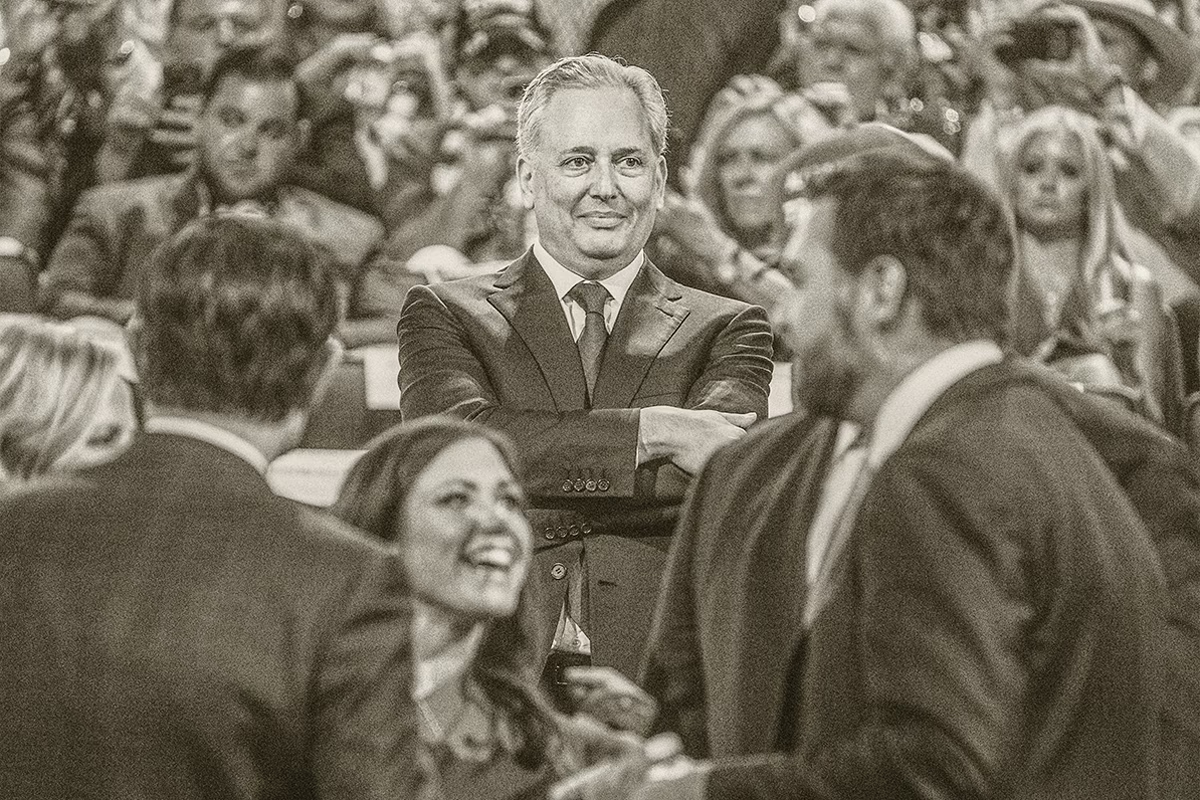
In December 2024 Sacks was named the White House special adviser for AI and crypto, with a venture capitalist from Andreessen’s firm installed as his deputy. Sacks’s status as a “special government employee” allowed him to stay on as a partner at his company Craft Ventures, while working no more than 130 days over the course of a year at his government job. He also continued as a co-host of his All-In podcast, analyzing technology, influencing market perceptions, making predictions—all while playing a central role in shaping public policy on AI and crypto.
Because special government employees are subject to most of the conflict-of-interest rules for regular government employees, the Office of Government Ethics (whose head had been fired at the start of Trump’s second term) required two waivers to allow Sacks to keep a foot in both the public and private sectors. They were written by the White House counsel, David Warrington, a Republican operative who had acted as Trump’s personal lawyer after his first term. A spokesperson for Sacks told The Atlantic, “Mr. Sacks and Craft Ventures had to refrain from investing in companies directly affected by his duties as a government adviser and furthermore had to seek approval from the White House Counsel Office for all potential investments.” In essence, the waivers argued that Sacks’s holdings were so large that keeping dozens of small investments in companies related to crypto and AI would pose no conflict of interest for him, because they made up such a tiny fraction of his overall portfolio. But the waivers give only percentages, and their language is so opaque that it’s impossible to know the actual value of these investments. “They try to finesse the issue by saying, ‘Oh, it’s a relatively small percentage of his portfolio, and he’s so rich, it couldn’t possibly affect him,’ ” Kathleen Clark, an ethics lawyer who teaches at Washington University’s law school, told me, adding that this stance beggars belief.
In November, the Times published a lengthy investigation of Sacks, finding that, despite large divestments, he continued to hold stakes in hundreds of companies that advertised themselves as AI-related, and that key policy decisions benefited both Sacks and his Silicon Valley associates. A chorus of them, including Andreessen, rushed to his defense. Sacks called the Times article a “hoax,” hired a defamation-law firm to write a threatening letter, and argued that he had cost himself and his company a lot of money—$200 million in crypto holdings alone—to work in government voluntarily without pay. Clark waved aside the question of whether there’s personal corruption on Sacks’s part. “I urge you to limit your use of the term conflict of interest,” she told me, “because it doesn’t begin to capture what’s going on.”
What’s going on is that Sacks joined the most corrupt administration in American history. Throughout his year in the White House, his work on tech policy brushed up against the spectacular grift of his boss at almost every turn. Giesea, the former Stanford Review colleague, who remains an admirer of Sacks, said, “He is an asset to the Trump administration on AI policy. But now he’s trapped in a corrupt clown show.” The pervasive rot makes it almost impossible to distinguish public policy from private venality. The Trump administration’s corruption requires a taxonomy of its own.
[George Packer: America’s zombie democracy]
At the most blatant level are the gifts the president accepts from abroad: the $130,000 gold bar and the gold Rolex desk clock from Swiss billionaires, followed by a lowering of U.S. tariffs on Switzerland; the $400 million jet from the Qatari royal family that might cost another half a billion or so to be outfitted as Air Force One, followed by a presidential visit (Trump’s first major foreign trip in his second term) to a country accused of sponsoring terrorism; the Trump-family memecoins sold to wealthy favor seekers. Clark called such brazen bribes “power corruption”: displays intended to show that Trump can get away with anything—“the equivalent of shooting somebody on Fifth Avenue.”
A slightly less glaring kind of corruption abuses government power for private gain: presidential pardons handed out to past and future benefactors; investment deals floated by Trump’s two favorite diplomats, his real-estate buddy Steve Witkoff and his son-in-law Jared Kushner, during the most sensitive peace talks in Russia and the Middle East; major investments in Trump-family crypto and real-estate businesses by foreign governments with extensive U.S. interests; stock trades and prediction bets likely based on insider access to official information, including about war.
Criminal anti-corruption statutes are still on the books. But these embarrassing shows of personal turpitude go uninvestigated and unpunished because the mechanisms for holding public officials accountable have been destroyed. When whistleblowers go unprotected, inspectors general are fired, incompetent loyalists replace nonpartisan civil servants, the Department of Justice is turned into the president’s own law firm and police force, and Congress abandons any oversight function, nothing is left to prevent the rot from spreading into every cell of government. (When Senator Warren wrote to Sacks asking for information on potential conflicts of interest in his role as a special government employee, the answer was silence.) The effect is to demoralize the public, to instill a sense of powerlessness. “We’re living in an era when the corruption is occurring on an unprecedented scale, orders of magnitude larger than anything we’ve seen in the history of this country,” Clark said. “And yet the more important story is what Trump has done to enable that corruption, which is dismantling the rule of law.”
Finally, there’s what Lawrence Lessig, of Harvard Law School, calls “institutional corruption,” which may be perfectly legal: the warping of public trust toward private ends, the replacement of the country’s priorities with those of a special-interest group. This brings us back to Sacks.
In his 2025 inaugural address, Trump declared America to be at the start of a “golden age.” His administration put crypto and AI at its center.
Cryptocurrency is a long-standing libertarian project—the dream of a privatized financial system. The founders of PayPal originally aspired to create a tool that gave people around the world access to finance, including in poor and corrupt countries without reliable banking institutions. But in practice, crypto’s anonymity and volatility have made it extremely prone to criminal activity and risky speculation. As a candidate in 2024, Trump, a former crypto skeptic and a latecomer to investing in it, won the industry’s lucrative backing on a promise to put the federal government to work on its behalf and turn the U.S. into “the crypto capital of the planet.” Back in office, he pardoned convicted crypto executives, neutered consumer protections, ended investigations by the Securities and Exchange Commission into crypto firms with ties to Trump’s businesses, and disbanded the Justice Department’s crypto-enforcement team. In May 2025, investors paid up to $400 million to buy $TRUMP memecoins in exchange for access to the president at a private crypto gala. Since 2024, Trump’s crypto wealth has grown by at least $7.5 billion.
[James Surowiecki: Crypto is a victim of its own success]
Sacks’s main item of business was to push through Congress a bill that would create a regulatory structure for cryptocurrency—something that the Biden administration hadn’t done, to the frustration of the industry and venture capitalists. The GENIUS Act required issuers of a type of crypto called stablecoin to back their digital currency on a one-to-one basis with assets such as dollars and short-term U.S. Treasury bills. According to Sacks and other supporters, the GENIUS Act would position the dollar as the default currency of the digital economy, while providing guardrails against fraud and other abuses. Critics argued that the guardrails were inadequate, and that crypto issued by private firms with government backing could undermine the entire financial system because of weak regulations and nonexistent enforcement actions. The law also does nothing to prevent government officials from profiting off crypto. When the GENIUS Act passed on a bipartisan vote in July, Silicon Valley and Sacks won the first big return on their investment in Trump.
If Sacks’s purpose with crypto was to bring it under a federal regulatory regime in order to make the industry more viable to buyers and valuable to investors, his goal with AI was to keep it unregulated, and to align administration policy with the industry’s wishes. His motto became “Let the private sector cook.”
At the start of his term, Trump revoked a Biden executive order that, among other measures, required AI labs to share the results of safety testing with the government. Though one company found that complying with the order required just one day of work for a single employee per year, Trump pronounced it onerous. Safetyism became a dirty word on the tech right, almost as contemptible as the phrase woke AI—an all-purpose indictment of Biden-era attempts to limit harm from AI to the public, especially children. Yet in the early weeks of the new administration, its policies reflected more continuity than rupture. Not only did Trump keep Biden’s restrictions on licensing the export of advanced AI technology to adversaries such as China; he even strengthened them.
Sacks’s influence increased when Elon Musk, his old friend and fellow PayPal mafioso, who was running the Department of Government Efficiency near the czar’s office in the Eisenhower Executive Office Building, walked away from his work of stripping the executive branch. “You see a more conciliatory approach to China emerging only after Musk has his falling-out with the White House,” Oren Cass, the founder of the conservative think tank American Compass, told me. “With Musk out of the picture, I think Sacks certainly became more prominent.” In April 2025, David Feith, a China hawk who was a senior director for technology and national security on the National Security Council, was fired in a larger purge after the right-wing influencer Laura Loomer warned Trump that Feith was disloyal. Soon after, the NSC’s whole technology directorate was eliminated, clearing the way for Sacks to become the loudest voice on tech policy. His goal was to keep AI free of regulation and let the private sector sell the most advanced American technology to the world—even to China.
On May 13, Trump scrapped a Biden rule, about to take effect, that would have restricted the global spread of advanced AI technology by dividing countries into three categories of trust, with China fully denied access. (A former White House official called it “the most ‘America First’ rule the Biden administration ever had.”) That same day the president traveled to the Middle East to consummate a deal, which Sacks had helped negotiate, to sell 500,000 AI chips to the United Arab Emirates. This astonishing figure alarmed national-security officials: Some of the chips were likely to end up in China, where strict export controls still applied, and the sale would make it easier for the Emiratis to acquire enough computing power to build their own AI capabilities.
The smell of corruption hung in the air before Air Force One took off for Abu Dhabi. At the beginning of May, one of Witkoff’s sons had announced that the Emirates’ AI-investment firm would put $2 billion into the crypto exchange Binance, using a stablecoin issued by World Liberty Financial, the crypto company founded by the Trump and Witkoff families. A co-founder of Binance, Changpeng Zhao, was pardoned by Trump after serving four months in a U.S. prison in 2024 for failing to comply with anti-money-laundering measures. In January of this year, The Wall Street Journal reported an even more blatant scandal: A few days before Trump’s inauguration, a powerful Emirati politician known as the “spy sheikh” (almost always photographed wearing sunglasses, even in the Oval Office) had bought a 49 percent share of World Liberty Financial. These deals made the UAE chip sale look like a giant payoff from the administration.
No one is allowed to be more corrupt than the president, but Sacks may well benefit from Emirati goodwill. The nearly $3 trillion UAE sovereign-wealth fund, of which more than half is controlled by the spy sheikh, offers an immense pot of money for venture capital. Although Sacks had no financial interest in the chip deal that he helped broker, it could put Craft Ventures in a sweet spot for a future round of funding. Is it unfair to point this out? Sacks’s position makes it naive not to. Remaining an investor while serving in an administration rife with graft and shaping policies that could significantly affect present and future deals blurs the line between public and private into indistinction. “It’s hard to disentangle his ideology from his personal interests,” the congressional aide who has followed Sacks closely said. “Maybe they’re one and the same: ‘Let the private sector cook,’ and it just so happens he benefits handsomely from that.” (Sacks’s spokesperson told The Atlantic that future investments “would not be a violation of government-ethics rules. Qualified people would not want to serve in government if it meant permanently giving up their careers.”)
On July 23, the White House released its “AI action plan” at an event in Washington co-hosted by the All-In podcast. Trump called out each of Sacks’s “besties” from the show, and they shared the stage with Vice President Vance and other administration leaders. (Susie Wiles, Trump’s chief of staff, had nixed the original idea for All-In to be the sole sponsor, perhaps out of a sense of propriety.) The 28-page plan, “Winning the Race,” called for rapid development of AI technology and construction of data centers so the U.S. can achieve global dominance. It was co-signed by Sacks, but its main author was Dean Ball, a technology researcher who served as a White House adviser for four months last year. Ball pointed out to me that the plan didn’t pose a choice between innovation and safety, nor did it take a position on changes in export controls: “What it does say is we should enforce the chip-export controls that we have more robustly than we currently do.”
But Sacks had already undermined this key aspect of the plan. A week before it was released, Jensen Huang, the CEO of Nvidia, the world’s leader in AI-chip production, had announced the resumption of the sale of Nvidia’s H20 chips to China, which the Trump administration had banned in April, before Sacks became the dominant official in tech policy. AI is an industry in which the U.S. has a significant advantage over its main rival. China is able to produce less than 3 percent of U.S. computing power—200,000 chips a year to America’s 12 million or so. Hardly anyone except Sacks was able to explain how the decision to lift the ban on selling chips to China fit with “winning the race” for global dominance, or with an “America First” administration.
[Read: Trump wasted no time derailing his own AI plan]
“I would define winning as the whole world consolidates around the American tech stack,” he said on All-In. “If we have 80 to 90 percent market share, that’s winning.” In other words, sell advanced American AI everywhere, including China, to make U.S. technologies and companies dominant. The counterargument, made to me by former Biden-administration officials as well as conservative critics of the Trump-Sacks policy, is that China will never allow itself to become dependent on U.S. technology. Instead, the People’s Republic will do what it’s done in other sectors: steal U.S. technology and innovate its own—the long-term “indigenization” strategy of Xi Jinping, and the reason the regime has prevented Chinese AI companies, which are hungry for American chips, from importing anywhere close to the numbers the Trump administration has made available for sale.
“Folks on the pro-export side have a story about how actually selling more of these advanced chips to China will addict them to our technology stack and slow their progress,” Oren Cass said of the Trump-Sacks policy. “I find it a ridiculously inadequate story that never holds up to 10 seconds of scrutiny.” Cass distinguished between an ideological view of U.S.-China competition (“two incompatible systems that can coexist but can’t be integrated in any meaningful way”) and the commercial view that has always been Trump’s, and seems to be Sacks’s. The key figure in moving American tech policy on China to the commercial view was Huang, who was eager to gain greater access to the Chinese market. Sacks now had the clout to accompany the CEO of the world’s richest firm into the Oval Office. “When Jensen comes to town, it elevates Sacks’s stature,” the congressional aide said.
I asked a former White House official with knowledge of the discussions if Sacks had achieved his goal of lifting the ban on selling chips to China simply by sitting down with Huang and a president with a well-known weakness for plutocrats. “Yes. That is exactly what happened,” the former official said. As for Sacks’s motive, “there is not a rational explanation. I think doing favors for Nvidia is the only real explanation, or else he believes Nvidia’s talking points that no one else buys.” (In a letter to The New York Times in November, Sacks’s lawyers wrote that the policies Sacks had advocated for benefited “all American chip companies” and that “Mr. Sacks has independently arrived at his views on chip policy by consulting and reading hundreds of experts in the space.”)
Even if Sacks is solely motivated by a sincere belief in free-market capitalism, his portfolio companies could now have privileged access to the world’s most coveted computer chips in a market where demand is stronger than supply. “This is why the person who’s regulating AI for the U.S. government shouldn’t also be running a venture-capital firm that has money all throughout the tech industry,” the former White House official said. “Of course he’s picking the winners that in some way benefit him.”
In December, Huang secured an even more valuable victory when the White House allowed Nvidia to begin selling to China one of its most advanced AI chips, the H200. This was too much for some conservative Republicans on Capitol Hill. Jim Banks, a MAGA-aligned senator from Indiana, had already introduced bipartisan legislation, called GAIN AI, that required Nvidia to put American customers, such as start-up companies and universities, ahead of Chinese companies for its limited supply of AI chips. Sacks, determined to prevent government from limiting tech’s commercial potential, began lobbying hard to keep GAIN AI out of the annual defense-appropriation bill. His efforts to get Republican senators to strip it from their version failed, but when the White House declared its opposition, House Republican leadership killed GAIN AI just before the final vote in December. “What ultimately happened is Jensen talked to the president about this, the dam broke, and Sacks got his way,” the congressional aide told me.
Sacks had less success when the administration tried to get Congress to pass a 10-year moratorium on state AI regulations. The measure lost in the Senate in July, 99–1, but its unpopularity didn’t deter Sacks from trying again. In December, Trump signed an executive order, written by Sacks, that banned states from passing laws to regulate AI. By then, state legislatures had introduced hundreds of bills—chiefly in blue states such as California and New York, but also in Florida, Utah, and Texas—and enacted dozens.
Sacks’s heavy-handed interventions in Congress on behalf of tech companies did not sit well with some of Trump’s MAGA allies. Stopping the spread of sexual material, protecting children from harmful chatbots, preserving individual privacy, heading off catastrophic threats such as bioterrorism, preventing large-scale unemployment—these things turn out to matter to Americans across the partisan divide. Polls consistently show that a majority fear AI will do more harm than good. Citizens of the world’s AI leader have a more negative view of the technology than those of almost any other country. Appearing on All-In in December, Tucker Carlson gently pointed out to Sacks and his co-hosts that Americans already feel powerless—“and all of a sudden you have a technology that promises to concentrate power still further in the hands of people other than them, and so they’re touchy about it.”
Oren Cass told me, “One of the challenges of the tech right is they are—what’s the opposite of adept ?” I offered clumsy. “They are very politically clumsy and don’t have a very good feel for the realities of the American electorate, how politics is conducted, what it takes to be successful.” Steve Bannon, a leader of the populist wing of the MAGA movement, recently told me that Sacks’s efforts on behalf of Silicon Valley are blowing up in his face. “Sacks is the best thing to ever happen to the populist revolt against the oligarchs. His unique blend of arrogance and incompetence has single-handedly delivered humiliating defeat to the AI supremacists.”
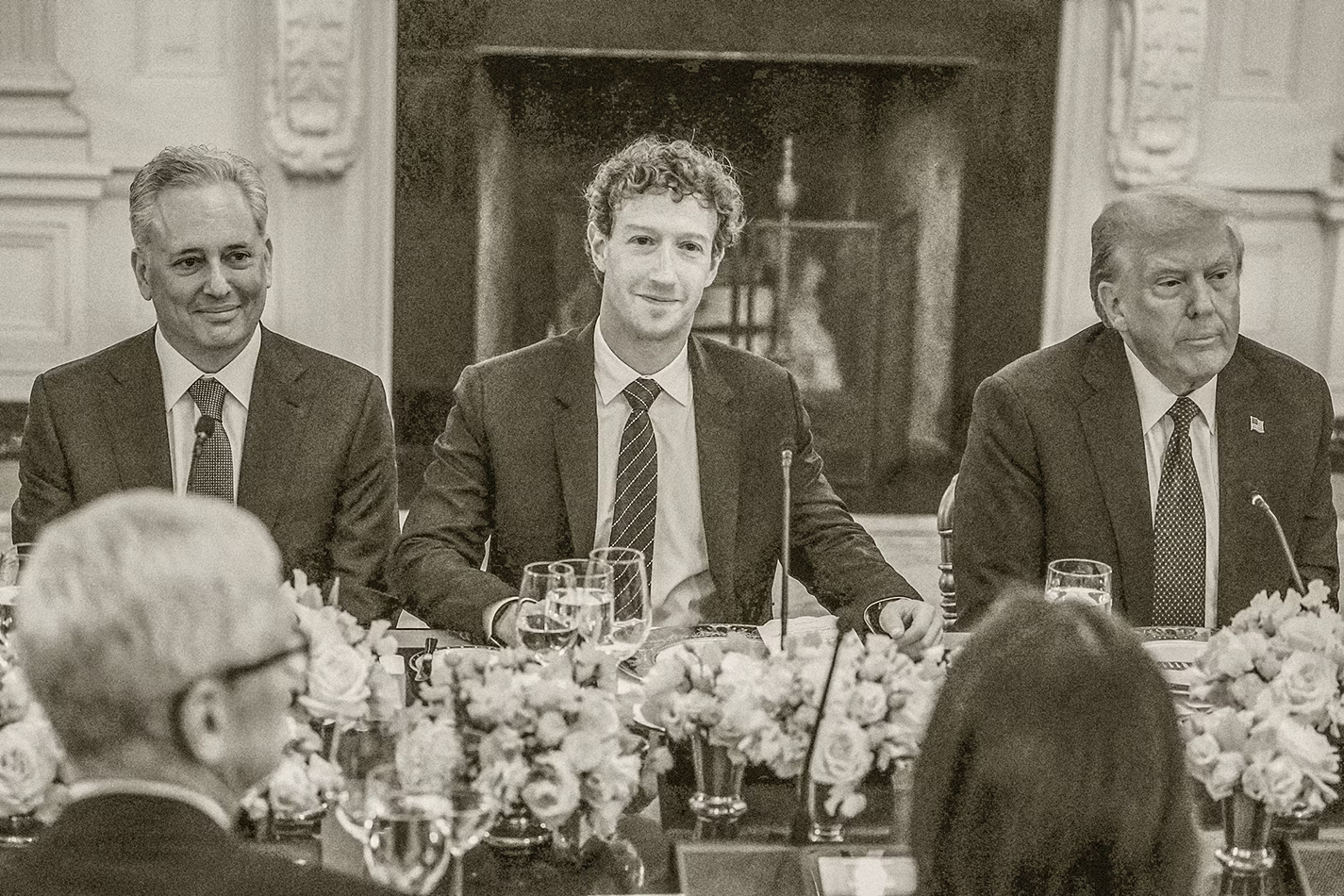
Meanwhile, AI’s capability is doubling about every four months. It is already changing work and life for millions of people, with the potential to transform fields such as medicine and war. Its inventors spend hundreds of billions of dollars to develop the technology even as they issue dire warnings of its dangers: It might kill us, but we have to make it as powerful as possible as fast as possible. Sacks dismisses or minimizes the potential for harm. In public comments he has claimed that AI isn’t addictive like social media, that productivity gains will more than make up for lost jobs, and that the number of teenage suicides caused by chatbots is small. Because China doesn’t care about things like copyright protection, compensated journalism, and restrictions on export licenses, we can’t afford to either. He accuses skeptics of belonging to the cult of effective altruists—“doomers,” funded by a few anti-AI Big Tech billionaires, who peddle lies to invite global control of the technology for their own financial gain.
One of the doomers, Nate Soares, a co-author of If Anyone Builds It, Everyone Dies, told me: “The lab leaders say this is horribly dangerous, the employees say this is horribly dangerous, the eminent scientists and researchers who developed AI decades ago say this is horribly dangerous. The only people who say ‘Don’t worry’ are the venture capitalists. They’re the ones who stand to profit from it but aren’t close enough to understand it.”
Unlike Andreessen, Sacks doesn’t equate regulating AI with mass murder. But for every concern, he has the same answer: AI is coming, just like the tide. If America doesn’t win the race, China will.
Once in government, Sacks learned to adopt his boss’s language and defend the indefensible. He derided “fake news” and called climate change a “hoax,” January 6 prosecutions “lawfare,” the notion of White House corruption “nonsense,” and the killing of two protesters by federal immigration agents in Minneapolis a consequence of “antifa-style operations” intent on thwarting the president’s deportation of “criminal aliens.” He liked Trump’s idea of seizing Greenland and predicted that the war in Iran, which he blamed on “that whole neocon establishment,” would probably be short and decisive because the markets wanted it over and Trump’s political instincts were “impeccable.” But on the threats of censorship, politicized justice, state surveillance, and monopoly power, which had once animated his outrage, and which now came from the Trump administration, he had nothing to say. Sacks had become what he always despised—political.
[From the July 2025 issue: The talented Mr. Vance]
In March, he left his position as AI-and-crypto czar, saying that he had completed his 130 days of service, and returned full-time to Craft Ventures. In December he had moved from San Francisco to Austin, just in time to escape a proposed tax on billionaires that may appear before California voters this November.
Silicon Valley will still have a valuable line to the White House. When Sacks stepped down, he was named co-chair of the President’s Council of Advisors on Science and Technology. Its members include Andreessen, Zuckerberg, Huang, Sergey Brin, Larry Ellison, Michael Dell, a co-founder of a cryptocurrency exchange, the CEO of a semiconductor manufacturer, and a billionaire investor who co-hosts All-In with Sacks. (Among the 15 there is one academic scientist.) This lineup, almost a parody of crony capitalism, signals the final union of America’s interests with those of its wealthiest citizens—tech power fused with state power. The private sector is cooking in Washington.
In his year there, Sacks achieved his two central goals: putting the government’s seal of approval on crypto and keeping its hands off artificial intelligence. He was also a founding member of an exclusive MAGA-aligned club in Georgetown, with a fee of $500,000, called the Executive Branch, and he midwifed the creation of an AI-industry lobby, Innovation Council, that plans to spend at least $100 million in support of the Trump administration’s technology policy in this year’s midterm elections.
In winning his policy battles, though, Sacks might have lost the war. What Tim Wu calls “the turn away from populism to corruption in tech policy” has alienated important parts of the MAGA coalition from Trump and his rich backers. Steve Bannon says that he and his anti–Big Tech allies are going to make the Innovation Council “the moral equivalent of AIPAC: You take that money and you’re dead.” At some point, an unlikely left-right alliance could unite against the tech oligarchs. “Donald Trump and his administration are using the presidency to make themselves and their billionaire friends richer,” Senator Warren told me, listing Sacks’s policy achievements in crypto and AI. “We are at an inflection point where very powerful AI systems threaten to displace jobs and transform our economy—and we will be living with the consequences for years if Sacks gets his way.”
AI could well be the most important issue in the 2028 presidential election. Sacks has moved Trump into the camp of the Silicon Valley saints, selling a world few people actually want to live in, where the state is the handmaiden of industry, wealth accumulates to insider elites tainted by grift, and ordinary people find that they’re losing the last power they have left, over their own minds.
Every so often, the hosts of All-In remember that staggering quantities of money are pooling upward in America, while discontent roils down below. Suddenly sounding earnest, almost chastened, one of them will call on the group to “fix this inequality gap,” end “ostentatious displays of wealth,” do more in the mode of Carnegie and Rockefeller to benefit the public, maybe even support a wealth tax to stave off the coming class war. But Sacks will have none of it. He alone remains committed to the principle of self-interest. He still believes that capitalism means never having to say you’re sorry.
This article appears in the June 2026 print edition with the headline “The Venture-Capital Populist.” When you buy a book using a link on this page, we receive a commission. Thank you for supporting The Atlantic.
The post The Venture-Capital Populist appeared first on The Atlantic.