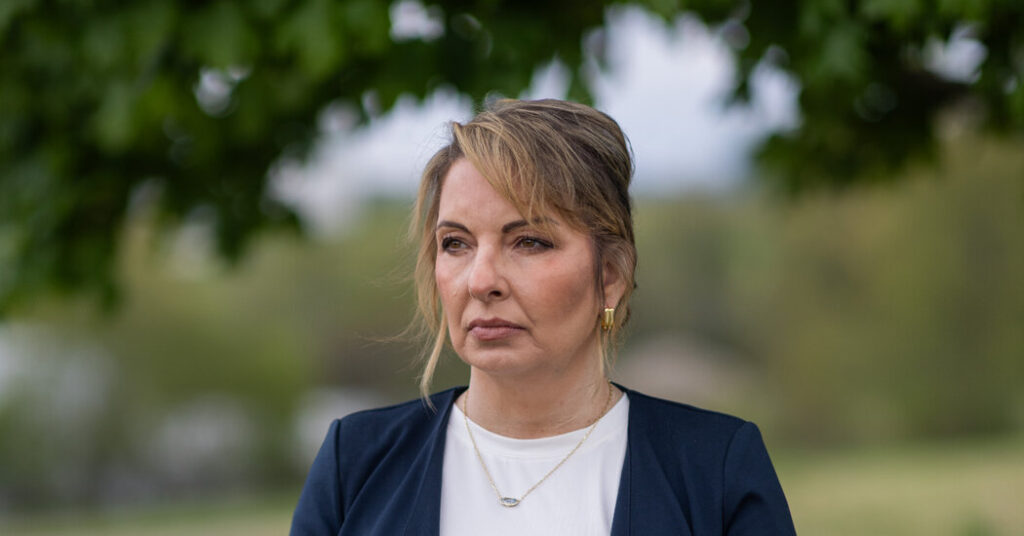
Helen Comperatore has heard the conspiracy theories about the assassination attempt on Donald J. Trump in Butler, Pa., that killed her husband.
She has watched them migrate from the political left to the political right, elements in both holding that her husband, Corey Comperatore, was a human sacrifice to lend credibility to a plot to help elect Mr. Trump.
Over the last week she watched as those conspiracies surged again following the assassination attempt at the White House correspondents’ dinner. And she wants the world to know that they are painful.
“Especially when they say it was staged,” she said in a telephone interview. “Like any of that’s staged. I mean, how? Why would you think that the president would stage taking a bullet? I mean, that’s insane.”
But as her grief mixes into the larger swirl of social media, hardened partisanship and distrust in government institutions, Mrs. Comperatore, a devoted supporter of President Trump, still harbors a baseless conspiracy theory of her own: she believes, even though no evidence has shown it, that President Joseph R. Biden, Jr. was somehow behind the 20-year-old gunman in Butler.
“I do not believe that this kid just got out of bed that day and decided to come over there and kill the president,” she said. “I believe that he was involved with someone greater than him, that worked with him and probably offered him money to do this, and I would like to know what that entailed.”
Multiple reports, done by Republican allies of the president and by an independent review commission, have found no evidence to support that or any of the hothouse conspiracy theories that flourished on social media immediately after the shootings in Butler and at the dinner in Washington. Indeed, investigators said the shooter, Thomas Crooks, had researched how to kill both Mr. Trump and Mr. Biden. (A spokesman for Mr. Biden declined to comment on her allegations.)
The reports on Butler all concluded that the shooting was the result of what Senator Rand Paul, a Kentucky Republican who led one of the investigations, called “a complete breakdown of security.” It found that the Secret Service failed to coordinate with local law enforcement officials to secure the site of the rally, or to communicate warnings from agents who raised concerns about the shooter to Mr. Trump’s security detail, which could have prevented him from taking the stage.
The shooter at the correspondents’ dinner took singular responsibility for the assassination attempt in a sprawling email he sent to family members about 10 minutes before he bolted past security at the event at a Washington hotel.
“I don’t see anyone else picking up the slack,” he wrote, according to the writings released by law enforcement.
In a postscript, he criticized the failings of those assigned to protect the president: “No damn security. Not in transport. Not in the hotel. Not in the event.”
But conspiracy theories resist facts and evidence, as a long history of scholarship has found. They tend to flourish in times of instability. Now, the rise of social media and artificial intelligence encourages the rapid spread of rumors and misinformation.
Elise Wang, a historian at California State University, Fullerton, said conspiracy theories function more like saint or miracle tales.
“They’re sort of a demonstration of faith,” she said. “If there’s something I believe is important to me and is part of my loyalty or faith to something, someone coming along and saying, ‘The bullet trajectory didn’t go that way,’ it feels not just beside the point, it feels offensive, it feels like an attack.”
Mrs. Comperatore feels the attacks acutely.
“I’m the one who walked out of there that day without her husband,” she said.
“When your husband’s killed like that, when you’re tied up with the government and the president’s involved, you have no idea,” she added. “Your mind goes crazy.”
Her husband, a firefighter, “was my soul mate,” she said. “We have been together since we have been teenagers, I knew him my whole life. What else do you do when you’re alone — you want to find out what happened to your husband.”
The Comperatores entered the rally on that sunny day in Butler with a deep faith in Mr. Trump, and antipathy toward Mr. Biden. Mrs. Comperatore said she was suspicious even before the shooting, thinking that there were not enough police officers around.
Afterward, she heard that Mr. Biden had said it was “time to put Trump in a bull’s-eye.”
(Mr. Biden made the remark in a call with donors, arguing that they needed to stop talking about his faltering debate performance and redirect their focus to beating Mr. Trump, but he admitted later that it had been “a mistake” given the volatile political climate.)
“That’s why I didn’t take Biden’s call,” Mrs. Comperatore said. “I thought he set something up.”
Mr. Trump has held Mrs. Comperatore close, inviting her to his inauguration and the State of the Union. She describes it as “very sad” how some of his most ardent supporters like Marjorie Taylor Greene have turned on him and embraced conspiracy theories spun out of Butler.
Why, conspiracy theorists ask, did the Secret Service allow Mr. Trump to stand for the iconic photo of him holding his fist aloft? Why did not more heads roll at the Secret Service? Why was the investigation of Mr. Crooks so quiet?
Mrs. Comperatore sees in those questions a form of resistance to Mr. Trump.
“He told everybody he was going to come in and he was going to shake things up and he was going to do it swiftly and that’s what he’s doing,” she said. “You’ve got to trust him, it always works out for him.”
She doesn’t spend much time thinking about the theories — from the left and the right — that her husband was collateral damage. “I think he was just in the wrong place at the wrong time,” she said.
She asked the proponents of those theories to watch the video that captured the moments her husband fell. “Just look at my face,” she said. “I’m not an actress, I never was. I’m a small town country girl.”
“That scream you hear the entire time,” she added, “that was my daughter.”
She, too, says she wants more answers. “I want to know what happened. My whole family wants to know what happened,” she said. Even if the other conspiracy theories are proven true, “Then I’ll know. I would like to know regardless.”
At the same time, she said, no investigation will give her the answers she wants. She doubts any investigation will put the conspiracy theories about Butler to rest, just as other investigations have failed to silence a long history of American conspiracy theories.
“At the end of the day my husband’s gone,” she said. “The pain is there and how he died was disgusting, and my kids and I should never have had to see that.”
“We went from having a beautiful family day together to leaving there,” she said, her voice breaking. “It was the worst day of our lives and we’ll never forget it.”
She is trying to move on, and focus on an upcoming fund-raiser for the foundation she is starting in her husband’s name. A grandson, her first, is due on Mother’s Day.
“I just want to enjoy my grandson and enjoy my daughter and my life,” she said. “And some peace for a while.”
Kate Zernike is a national reporter at The Times.
The post The Widow of the Firefighter Slain by a Would-Be Assassin Speaks Out appeared first on New York Times.