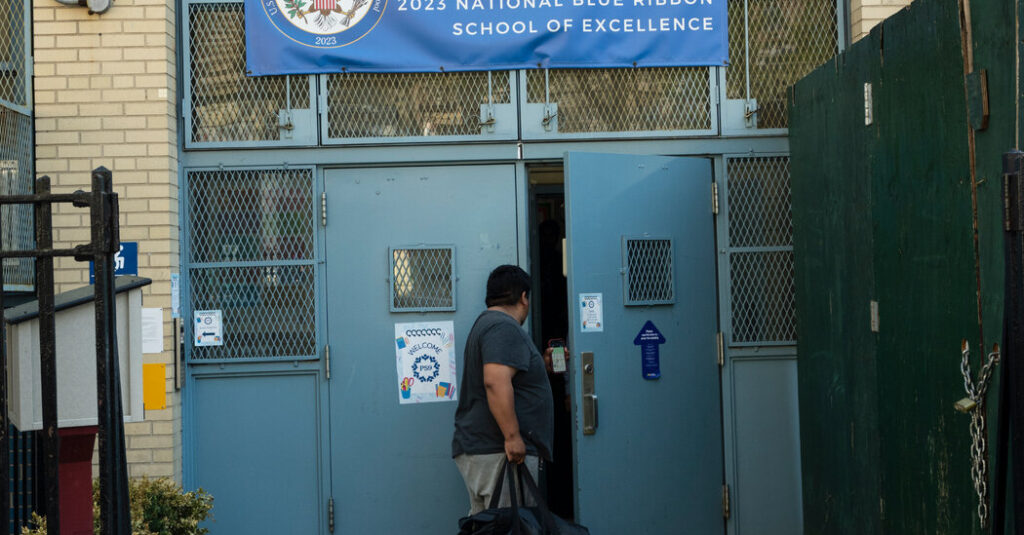
For 17 years, the schools on the Upper West Side of Manhattan have coexisted in harmony. But when the families of their students gathered on a recent night in their shared auditorium, there was nothing neighborly about it.
On one side was Public School 9, a coveted but overcrowded elementary school where parents raise $2 million annually to pay for extra teachers in every classroom. On the other was Center School, a beloved middle school with ingrained traditions like allowing its students to eat lunch off campus. The topic that night was their proposed breakup.
P.S. 9 wanted to take over the entire building, kicking out Center School, so that it could expand, reduce class sizes and, perhaps, attract more families from the neighborhood. Center School would move to a building about 20 blocks south that it would occupy alongside a chronically low-performing school, Riverside School for Makers and Artists, whose middle school is losing students and would be eliminated. Center School families agreed that it should move — but not to Riverside, which they say lacks everything it needs.
Across the country in recent years, a similar landscape of schools — some hollowing out, others teeming with students — has emerged as public school systems confront a yearslong, sustained decline in enrollment. The exodus accelerated during the Covid-19 pandemic, as parents considered other options for their children, and has started to strain budgets and force tough decisions.
Since the pandemic, more than 123,000 students have departed New York City public schools, while nearly 1.3 million have left public schools nationwide. From California to Texas to Maine, school leaders facing half-empty schools and stark forecasts of continued enrollment declines have few options, including closing or merging schools.
But those are deeply unpopular, politically radioactive and tear apart neighborhoods. That was clear that night on the Upper West Side.
“If you don’t want families to go to charter schools, if you don’t want families to go to private schools, then stop closing schools,” said one of the first speakers, Dawn Goddard, a mother of a sixth grader at Center School.
A fifth grader at Center School said she was being punished to help a “larger, wealthier school.” If P.S. 9 really needed space, a sixth-grade boy said, it should start by eliminating its science lab. And a Center School mother wondered why P.S. 9 parents hadn’t expressed concern for the Riverside students, many of whom are recent asylum seekers, including one who, the mother noted, had witnessed the decapitation of his parents.
Seated in the first rows, parents and teachers from P.S. 9 shook their heads in disgust. A mother of a girl with special needs took the microphone and spoke about the shame her daughter feels because her therapy sessions have to be held in a room with other students because of space constraints.
Gale Brewer, a City Council member who represents the area, had tried to broker a deal to appease all sides. “They’re very, very nasty to each other,” she said. “I don’t know what to do.”
This has been the atmosphere during the past four months after New York City’s Education Department announced a plan to break up those schools and close or downsize others before the next school year. Opponents said that the proposals had been rushed.
Versions of this feud on the Upper West Side have been playing out across the country. Parents have protested proposed closures, shouted at public meetings and, on rare occasion, been escorted away by the police, including recently in Houston just before its school board approved the shuttering of 12 schools.
Facing overwhelming opposition, school leaders in some places, such as Philadelphia, have scaled back their closure plans, revealing the difficulty in trying to address declining enrollment.
“Closing a school is an incredibly sharp pain point for parents and communities,” said Thomas S. Dee, a professor of education at Stanford University, who has been tracking school closures nationwide since the pandemic. “Local schools are often a focal point for neighborhood identity.”
On the Upper West Side, where families carefully study school attendance zones before buying or renting and sometimes pay more to live near higher-achieving schools, Education Department leaders insisted in town hall-style meetings that they would not back down from the proposal. It could not be negotiated, there was no Plan B.
But two days before a panel of education advisers was expected to approve it, New York’s new schools chancellor called it off, an inauspicious start to what could be a wave of closures and mergers in the coming years as enrollment declines.
The chancellor, Kamar Samuels, said the proposal was too much change too quickly into a new administration, even though Mr. Samuels had crafted it himself in his previous job overseeing Upper West Side schools.
But the deal was not dead. He said it would be revised by local school leaders in consultation with parents.
While the clash pitted families against one another and strained friendships, it also cast a harsh light on the differences and inequities among schools, even those just blocks apart, and also brought up fraught questions about race and class. A battle a decade ago on the Upper West Side over school attendance boundaries centered on the same issues.
Across the country, school closures have disproportionately affected Black and Hispanic students, and it would have been no different for the schools marked for shuttering or downsizing on the Upper West Side.
At one of them, Community Action School, nearly every student is Black or Hispanic. During one of the first meetings about the closures, an eighth-grade girl from the school pleaded for it to be saved, describing how it had been a refuge after a tumultuous experience earlier in middle school.
While she spoke, a mother, who was watching remotely and speaking on a hot mic, said, “They’re too dumb to know they’re in a bad school.” (Afterward, the woman said that her comment had been taken out of context.) Mr. Samuels later announced that Community Action School would stay open.
Of all the changes Mr. Samuels had pursued, one school would have come out ahead of the rest: P.S. 9, one of the most-sought after in the city.
Most of its students are white, and it has resources — a science lab, a computer room, a library and two art rooms — that are a rarity among New York elementary schools. Among the city’s nearly 1,600 schools, only five raised more money than P.S. 9’s parent organization last year.
The Education Department believes that P.S. 9 could lure families back into the public schools, which remain popular in neighborhoods that are home to many middle-class and upper-middle-class families.
This school year, more than 800 students applied for the school’s kindergarten class, which had just 100 seats. With an expansion, P.S. 9 could accept more of those students, school leaders said, and also lower its class sizes to comply with a new state cap.
More than 40 years ago, education leaders in New York saw the same potential in Center School during another period when schools were losing students. A group of educators aimed to create a school unlike any other in the city — and it remains that way today.
It has four grades, unlike the three in most middle schools. The roughly 250 students are grouped in classes that span every grade. Collaboration and fun are prioritized. Students play together during recess, eat lunch together — often off-campus at pizza shops and empanada spots — and direct, perform and produce the school’s highly anticipated variety shows.
“Families who might otherwise opt for charter, private, suburban middle schools see Center as a rare gem,” said Michael Fram, a high school principal whose child attends the school and who attended a meeting in January.
Relocating Center School to Riverside would kill Center, parents and students said. Riverside does not have a dedicated auditorium, its play area is on a rooftop and the neighborhood has fewer restaurants.
That night in the auditorium, a mother, Tiffany Rodriguez-Noel, who has children at Riverside, said it had been overlooked in the clash among the other schools. It needed more resources, which were promised years ago, she said.
In the school boundary fight a decade ago, much of it centered on the creation of Riverside. Back then, it was known as Public School 191, and almost every student who attended it lived in the Amsterdam Houses, a public housing complex near Lincoln Center.
It was renamed and relocated, placed on the ground floor of a luxury high-rise in a wealthier neighborhood, as part of an effort by the Education Department to give it a new start. It would have a diverse student population, school leaders said, and just 20 percent of its students would come from low-income families. Today, that number is 86 percent.
“It feels a lot like our land is being stolen to cover up being neglected, ignored and robbed of an adequate education,” Ms. Rodriguez-Noel, said.
Kitty Bennett and Georgia Gee contributed research.
Matthew Haag is a Times education reporter focusing on New York City schools.
The post The New Schoolyard Fight: Shrinking Enrollments and Too Many Classrooms appeared first on New York Times.