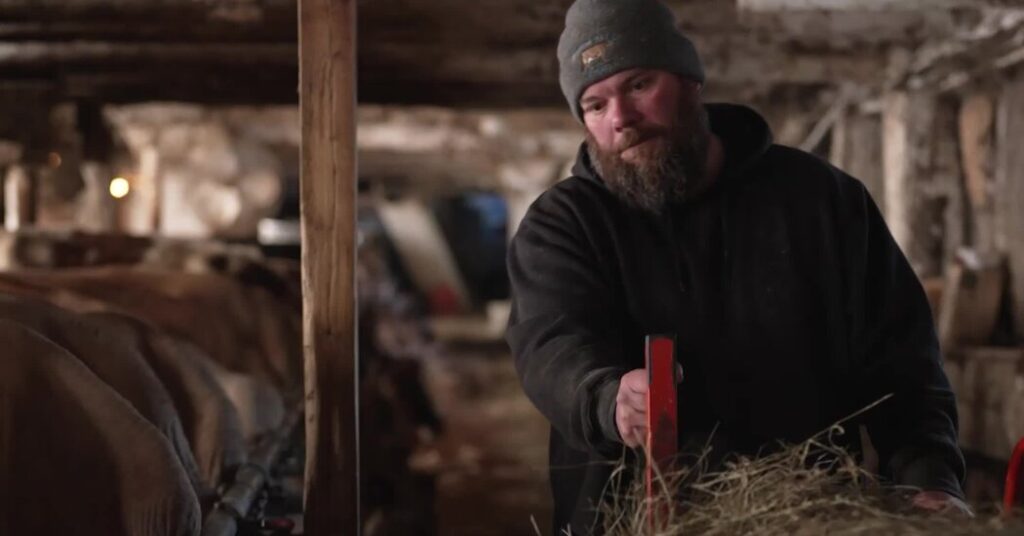
Brad Watson, 41, awoke without an alarm at 5:30 a.m., strapped on his headlamp and headed to the barn. Cold air leaked through a small gap in the boards, and he stuffed a paper bag into the hole to block the wind. He knew every detail of the barn in the morning: hay shifting beneath his boots, heat rising off the cows, the way the milking equipment froze against his hands. He walked through the stalls to greet each cow by name and then stopped.
It was Meg, a purebred cow, one of his best. She had flipped over her stall in the night and twisted in her chain, strangling to death. He knelt to touch her head and then kept walking toward the milking parlor. More than 90 other cows still needed to be milked, twice a day, every day, and that work never stopped for a weekend, or a vacation, or a dead cow, or any other crisis during a winter in which his family dairy business was beginning to unravel.
He guided the cows into the parlor one at a time, patting their flanks to help them stay calm. “Come on, girls. Settle down,” he said. He hooked each one to a machine and watched the milk start to flow as he ran through the numbers again in his head. His milk check came every other week, and it never covered his bills. Feed, fuel and fertilizer had nearly doubled in recent months. Lately, he was losing several hundred dollars each day, and without Meg the math would be worse.
Brad attached the next cow to the machine and texted his father, Brian Watson, 62.
“I can’t keep going like this,” Brad told him. “I could make more by picking cans up off the road. I’m done.”
“Don’t think you failed,” Brian responded. “You’re the last Watson milking.”
The Watsons had been dairy farming since before the Civil War — one of dozens of Watson farms that had spread across northern Pennsylvania over the generations, and then, like dairy farms everywhere, gradually disappeared. The number of dairy farms in the United States had fallen to fewer than 25,000 from a peak of nearly 700,000 in the 1970s. Milk prices had barely risen in half a century, held down by overproduction and a handful of large corporations that dominated the dairy market. The costs of running a family farm had skyrocketed by as much as 500 percent.
Brad had supported Donald Trump in 2024 in part because Trump promised to change all that by becoming “the most pro-farmer president you’ve ever had.” Instead, new tariffs had cut into Brad’s potential export market and the emerging war in Iran had sent gas and fertilizer prices surging by as much as 70 percent. He was losing thousands of dollars each month and falling behind on his feed bill, until he made the call he’d been dreading his whole career. He dialed up an auction house to arrange the Watson family’s final dairy sale last month.
“Complete Jersey herd dispersal,” one ad read. “Farm is going dry. Every cow must go.”
Brad had a few weeks to prepare for the auction, which meant 16-hour days of milking, sorting cows and cleaning out the barn. He had let go his only employee months earlier, when he first started to worry about bouncing checks. That meant it was just Watsons working inside the barn: his father, Brian, who helped run the farm and had been milking for almost 50 years; his youngest child, Ellie, 12, who fed the baby calves; and his eldest, Hailey, 18, who insisted on naming the cows even though a vet had warned her that it was better not to get attached. Now they had Gouda, Pasta, Grape Juice, Toots, Perfection, Tortilla and Repeat, who always tried to kick.
But it was Brad’s middle child who seemed most attached to the rhythms of the barn. Boyd, 14, left tracks in the mud with his size-15 boots as he raised his own herd of sheep and showed calves in youth farming competitions. He’d always treated the farm like his own, and one morning a few days before the sale he helped Brad milk for a few hours until they lost track of time.
“Shouldn’t you be leaving for school?” Brad said.
“I’ve got a cold,” Boyd said. “I’m staying home sick.”
He cleaned the milking parlor, hauled hundreds of pounds of feed and worked in the barn through lunch. Watching him, Brad sometimes thought about his own childhood, following Brian to the barn even when he was too small to do anything but watch. He’d left the farm after high school for a good-paying factory job and then counted down every 12-hour shift until he could return to the barn. Now it had been more than four years since his last day off from milking cows and almost a decade since he took a vacation, but farming was the only thing he had ever wanted to do.
“What’s going to happen to the barn?” Boyd asked him.
“I don’t know yet, but we’ll be better off,” Brad said.
“It’s weird. I can’t picture it empty.”
“Me neither,” Brad said.
Their farm was called Butter Ridge, 326 acres of pastoral valleys and rolling hillsides just south of the New York State border. From his house at the top of the ridge, Brad’s father, Brian, could turn in every direction and see land that his family had once farmed. His grandfather Ivan Watson had run a large dairy operation just to the west, near the Susquehanna River. Ivan’s nine children had all gone on to become dairy farmers, setting up their own herds within a few miles. Brian’s father had milked Jersey cows. So had all of Brian’s uncles, his aunts, his cousins and two of his siblings. Only one brother had gone his own way and rebelled against family tradition, by choosing to milk Holstein cows instead.
Now it was the evening before the auction, and Brian stood on his porch and looked out at farms that were dry, or bankrupt, or leased out to hunting clubs, or standing empty with the roofs falling in. Down in the valley, the lights of his son’s barn were on. Brad was already there herding cows and hauling feed on a tractor. Brian pulled on his coat.
“I’m headed back down,” he said, as he waved to his wife and walked out to his truck.
He’d been working in the same barn for 45 years, starting out with a small herd of a few dozen cows right after high school and milking five hours each morning and four more every night. His cows had won acclaim for their milk quality with a high percentage of butterfat, but each year he kept losing more money. The farm had survived thanks to some monthly income from a cellphone tower and the discovery of natural gas under his land. He’d drilled eight wells and invested the profits back into the farm, spending more than $100,000 to restore equipment, purchase cows, pay insurance premiums and install a new roof on the barn before passing it down to Brad as the legal owner in 2018.
Lately, the gas wells were in decline and dairy bills were rising each month as the cows cost more to feed than they earned with their milk. Instead of stepping back into retirement as he’d hoped, Brian was driving to the barn before sunrise every morning to help Brad. They had gone together to talk to a banker, who looked over the numbers and told them: “This is a hobby, not a business. How long do you want to pay for the privilege of milking cows?”
Brian pulled up to the barn, motioned to Brad over the roar of the feeding cart and headed straight into the milking parlor. They’d been working together in the barn for long enough that they could run the whole operation on hand gestures. They shared the same muscled build, the same calluses on their hands, the same firm tone with the cows. One of their few differences lately was politics. Brad had believed that Trump might help them, and he appreciated the frustration in Trump’s speeches about America’s decline. Brian was more cynical. He’d seen generations of politicians riding tractors and pandering to rural America as more farmers went under.
He hooked the milking machine up to the first cow, and Brad came into the parlor with a Keystone Light.
“It’s going to be strange tomorrow night when there’s nothing to milk,” he said. “I won’t know what to do with myself.”
“Might actually get to sit down for a minute,” Brian said. “See the kids. Watch a ballgame.”
“We were probably fooling ourselves these last few years, but I’m glad we got to do it,” Brad said. He stood there for another moment and then tapped his fist against the door. “All right,” he said. “I’ll start loading them in.”
Brian talked to the cows as he hooked them to the machine one at a time. Each was a product of decades of meticulous breeding. He knew every relative in their family line and whether they milked four gallons a day or closer to five. In came Karma, who mooed and bullied the other cows, and Crow, who stopped and stared at him, wanting to be pet. He put on the country radio station and milked each cow for about six minutes, until finally there was only one left, S’mores, who shuffled her feet and stared at him with anxious eyes.
“Careful, girl,” he said. “Nothing scary. It’s just me. You know the routine.”
She was a 2-year-old cow, the daughter of Sassy and the granddaughter of Sally, whom Brian had bought a decade earlier at an auction in New York when he still had dreams of growing the herd and turning a profit. A few nights earlier, S’mores had given birth to her first calf, which froze to death in the field. She had licked the calf clean trying to revive it and then come back to the barn, too agitated to return to her stall. Brian had put her in a pen where she was safe to roam, but she was still skittish and wild.
Brian touched her forehead and wondered where she might end up in the next few days. He thought she could still become a good cow in the right situation, if a farmer had enough space and patience. She jerked her head and watched as he hooked her to the machine.
“Easy now,” he said.
The auctioneer, Adam Fraley, was waiting for them at the barn early the next morning, five hours before the sale. He had already numbered each one of their cows, printed auction catalogs and erected a tent outside the barn. In the last decade, he’d helped run dispersal auctions for Brian’s brother, his cousin and his uncle, and now Fraley led Brian and Brad through the barn to evaluate their herd one last time. Fraley nudged each cow to its feet and made final notes in his catalog.
“One-fourteen is fresh,” he said. “Eleven needs to go dry. What’s the breeding update on 61?”
“Are you talking about Ruby or Melon?” Brian asked.
“Sixty-one.”
“You mean Ruby? You’re losing me.”
“Sixty-one.”
“Name! I need a name!” Brian said. He took a breath and held up his hand. “Sorry,” he said. “I didn’t mean to snap at you.”
“I get it,” Fraley said. “I know it’s a hard day. You’re doing great. Believe me, I’ve seen the worst of the worst.”
He had auctioned more than 50,000 cows as he traveled across the country during the dairy sell-off of the past decade. Some were corporate herds of 1,000 or show cattle that brought up to a million dollars, but often Fraley had been the last visitor at family barns like the Watsons’, where he auctioned cows, machinery and sometimes even the property itself for a 10 percent cut. The average Pennsylvania family dairy farm was earning about $20 for every 100 pounds of milk — and that same amount now cost more than $30 to produce. He’d seen farmers who tried to hang on by neglecting their equipment, underfeeding their cows, extending their hours and borrowing tens of thousands they could never repay.
His career had unfolded against a steady backdrop of bankruptcies, accidents and tragedies: the New York farmer who shot all 51 of his dairy cows and then turned the shotgun on himself; an Amish father who suffocated with his two sons after becoming trapped in their grain silo. In 2018, a Wisconsin farmer had sold his cows at auction, taken a part-time job at a grocery store and then killed himself with a note in his pocket. “I’m a dairy farmer,” it read. “I want my old life back, but I can’t get it anymore. Everything I do fails.”
Farm bankruptcies across the country had risen 55 percent in 2024, 46 percent in 2025, and another 70 percent so far in 2026 as nearly a third of the world’s fertilizer exports were impacted by conflicts in the Strait of Hormuz. Lately, Fraley had begun counseling farmers on how to emotionally endure the aftermath of an auction, suggesting potential hobbies or strategies for debt consolidation.
“Tomorrow’s going to be the hardest day when you see the barn empty,” he told Brian. “It’ll feel like a death, but just think of all that freedom. Go out for breakfast. See the world. There’s life after cows.”
“A part of me will be relieved,” Brian said. “My whole life, people have kept telling me it’ll get better. The truth is it never does.”
They were in better shape than most dairy farmers because of the cellphone tower and the natural gas money. They could sell the herd, pay off their feed bill and maybe even end up with a little extra money. Brian thought he might take a vacation to Myrtle Beach with his wife. Brad was talking about getting a job in the natural gas business. It was 14-year-old Boyd who seemed the most uncertain about a future without farming, so he’d asked Brian about growing the goat herd or investing in beef cattle.
Boyd came into the barn a few hours before the auction and followed Fraley as he cleaned the mud off cows, polished equipment and started tagging the calves for sale.
“Not that one,” Boyd said.
“No?” Fraley said.
“She’s not for sale,” Boyd said. He explained that his father and grandfather had allowed him to keep one calf — not to milk, but to show in competitions and raise as his own.
“That’s Parachute,” he said. “She was just born in March.”
“OK,” Fraley said, marking up his catalog. “Parachute stays.”
The first trucks started to arrive an hour before the auction, kicking up a trail of dust that clouded the dirt road and coated the barn. Next came groups of Amish and Mennonite families in horse-drawn buggies, small homesteaders from the suburbs of Elmira, out-of-state cattle dealers hauling livestock trailers and beef buyers looking for cheap cows to slaughter. By the time Fraley leaned into the microphone and called everyone over to the auction tent, more than 50 people were milling through the Watsons’ barn, touching their equipment, inspecting their milk parlor, judging their cows.
“What am I supposed to be doing right now?” Brad asked Fraley, as the crowd started to gather under the auction tent. “I’m a little lost. I feel like I’m in the way.”
Fraley pointed to a set of chairs near the front of the tent that were set aside for the Watson family. Brad nodded and sat down in the audience next to his father as Fraley started to auction their equipment. He sold off the hutches where Brad and his children tended to their calves and the new feed cart they’d bought last year.
“OK, now we’ll start with the cows,” Fraley announced. “Listen guys, these are some great dairy cows. If you treat them good, they’ll give you everything they’ve got. It’s your lucky day. Let’s get them sold and loaded up.”
The first cows came parading into the auction ring, and Brad stood up and started to pace behind the tent as people began to bid. Fifteen hundred for Tortilla. Sixteen hundred for Jello. He waited for a break and found Fraley behind the stage.
“I can’t just sit here and watch,” Brad said. “Give me something to do.”
“It’s your barn,” Fraley said.
“Yeah, but it’s not my circus,” he said. “Put me to work. Give me a job.”
Fraley squeezed his shoulder and headed back toward the auction stand. Brad stood in place for a moment and then walked toward his milking parlor. Even if the cows weren’t his anymore, they still needed to be milked before they could be loaded into trailers and transported to new homes. He hosed down the parlor and started attaching cows to the machine as the repetitive chanting of the auction continued behind him.
“Lookie here. Lookie here,” Fraley said. “Talk about a good one, boys. This cow will milk!”
“Next, we’ve got a no-brainer. She’ll pay the bills. Due in June. Due in June.”
Brad turned up his music as each cow rotated from the sales tent into the parlor. Buttercup and Sophia had been sold to a neighbor’s farm a few miles up the road. Queeny was going to Massachusetts. Repeat and S’mores were headed to New York. Brad put his hand on every cow and milked them out for six minutes each. He counted down the time and glanced at the dry-erase board on the wall, where family members sometimes left messages or jokes for one another. “I told a cow joke,” someone had written, “but it was a total udder failure.”
“Going once. Going twice. Good cow. Great cow,” Fraley was saying.
“Come on, boys! This is your chance! Cheap, cheap, cheap, cheap, cheap milk!”
Brad worked by muscle memory, detaching and reattaching the machine, focusing on the work and trying not to think about the sales numbers, or the feed bill, or the sound outside of clanking trailers and trucks turning back onto the road.
He milked until the last cow left the parlor, and then he took his time hosing down the machines before he walked into the barn. The auction was over and the stalls were empty. But there was Boyd, leading Parachute into a pen.
Erin Schaff contributed reporting.
Eli Saslow writes in-depth stories about the impact of major national issues on people’s lives.
The post The Last Days of Butter Ridge appeared first on New York Times.