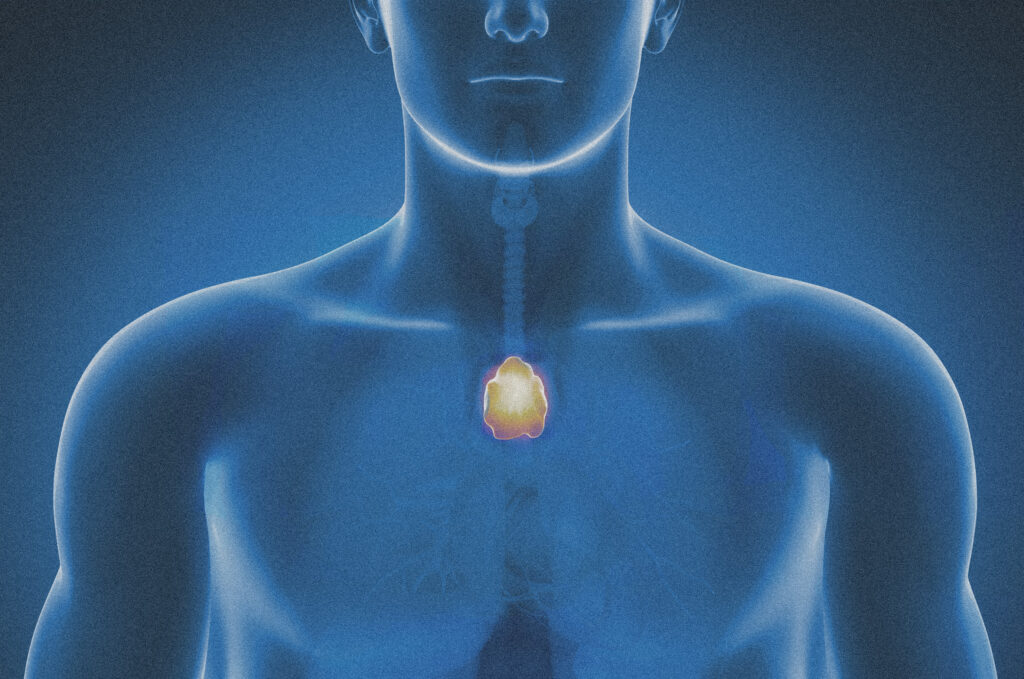
For decades, a mysterious, two-lobed organ nestled behind the breastbone has been overlooked by most physicians, thought to be a largely useless lump for most of human life: the thymus.
The ancient Greeks posited this knob of tissue might be the seat of the soul. In the early 1960s, a Nobel laureate dismissed it as a mere graveyard for cells, “an evolutionary accident of no very great significance.” Today, scientists know the thymus plays an essential role in setting up a functioning immune system in childhood, but then starts to rapidly shrink into obsolescence in puberty.
Now, a raft of research is recasting the thymus from a bit player to a potent regulator of aging and immune health across the lifespan.
Studies highlight the crucial role it might play in longevity, as well as protecting against cancer, autoimmune disease and cardiovascular risk. The work has ignited interest in finding ways to rejuvenate the thymus, slow its decay and better understand its function.
“It was completely assumed the thymus would become irrelevant,” said Hugo Aerts, director of the Artificial Intelligence in Medicine Program at Mass General Brigham. In studies published in Nature, Aerts and colleagues found that people with a healthier thymus were less likely to develop lung cancer or to die of heart disease — or any cause. They also responded better to cancer immunotherapy treatments.
Key questions remain: Is the thymus the driver of these improved health outcomes or an indirect barometer of better overall health? Why does its decline vary between different people, and can that be slowed or stopped? And, perhaps most fundamentally, why did it take so long to reconsider the thymus?
An accidental landmark study
The study that cast a new spotlight on the thymus started by serendipity.
Kameron Kooshesh, a medical student in David Scadden’s lab at Massachusetts General Hospital and the Harvard Stem Cell Institute, was interested in understanding the role of the thymus in a narrow population — adults who received bone marrow transplants. As those patients rebuild their immune defenses, researchers knew the thymus plays a role just as it does in childhood.
Then, covid shut everything down. The team shifted to an experiment that could be conducted remotely, broadening the research question: What did the medical records of adults who had their thymus surgically removed suggest about their overall health?
The findings stunned the team. In the five years after surgeons removed their thymus, people were more than twice as likely to die of any cause than a similar set of people who had undergone heart or chest surgery but still had one. Those without thymuses were twice as likely to develop cancer. When researchers limited the analysis to people who didn’t have immune-related issues before surgery, those lacking a thymus were more prone to autoimmune disease.
“I frankly was thinking it was more of a way to keep my student active during covid and didn’t think it would show much,” Scadden said. “We were all just struck. This has a big impact, not just in the things we were worried about … but also all-cause mortality.”
The results were published in 2023 in the New England Journal of Medicine, along with a perspective piece that called it “pioneering research.”
A childhood organ
In the annals of human anatomy, the thymus was relatively unexplored territory for much of medical history. Physicians often describe it as the last major organ to have its function discovered. It can be removed in a procedure called a “thymectomy,” which can be done for a variety of reasons, including to get better access to the heart. As far as anyone knew, those people did fine.
“These are very subtle signals. This is not like we take the heart out [and] the patient dies,” Aerts said.
It wasn’t until the 1960s that researchers began to piece together the crucial role the thymus plays during childhood.
The thymus educates immune cells called T cells (the “T” is for thymus), about how to defend against viruses and other pathogens and how to avoid attacking healthy tissue. Children born without it suffer severe immune problems and die without a transplant.
T cells “come out of the bone marrow, home into this organ, and at first, they have this school — I call it the kindergarten or preschool. The cells get to proliferate and expand extensively,” said Andri Lemarquis, a physician and scientist focused on restoring the thymus at City of Hope, a cancer research and treatment center. “Then they come to college and they get deleted. We don’t want any of them to attack our own body.”
The thymus is a key reason that our immune systems do not go haywire and attack our own cells, what immunologists call “self-tolerance.”
But in people’s teens, it begins to dissolve into fatty tissue. Many doctors considered it a largely vestigial organ for the bulk of human life.
Reconsidering and regenerating the thymus
The new spotlight on the thymus connects it to a wide range of health outcomes.
Aerts’s team came at the problem by using AI to find patterns in large, long-term databases used to track cardiovascular disease and cancer. As part of their health workup, thousands of people had been given CT scans that revealed their thymus. His team used AI to develop an overall thymic health score, and then searched for patterns in the health records following those people over years.
They found that a healthy thymus predicted good health over a broad set of criteria. In one set of data, people with a higher thymic health score were less likely to die of any cause over the next 12 years. They were less likely to develop lung cancer or die of heart disease.
Intriguingly, they also found that people with healthier thymuses were more likely to respond to cancer immunotherapy drugs, which trigger the immune system to fight cancer, but don’t work for many patients.
The new research can’t say the thymus is the cause of the better health outcomes, but it generates new leads to be explored.
For some, the new interest is long overdue.
“Finally, people realize the thymus is an important organ!” said Paola Bonfanti, a cell biologist at the Francis Crick Institute and a professor at the University College London who has been fascinated by a thymus paradox: It has an extraordinary ability to regenerate, but it is also one of the fastest-aging organs.
“It contains stem cells that are equal to the ones of our skin, and we make new skin every three weeks,” Bonfanti said.
Bonfanti is working to build a human thymus in the lab. In the long term, she hopes it might be possible to engineer a thymus from an organ donor, to help people who receive transplants tolerate their new organ without taking harsh anti-rejection drugs. Those protect the new organ from being attacked by the immune system but come with many side effects.
She’s also interested in probing whether there are ways to slow down the thymus’s natural deterioration. That work could have many applications in autoimmune diseases, improving people’s responses to vaccinations as they age or improving how people respond to cancer immunotherapies.
The post The body’s most mysterious organ may play a key role in longevity and cancer appeared first on Washington Post.