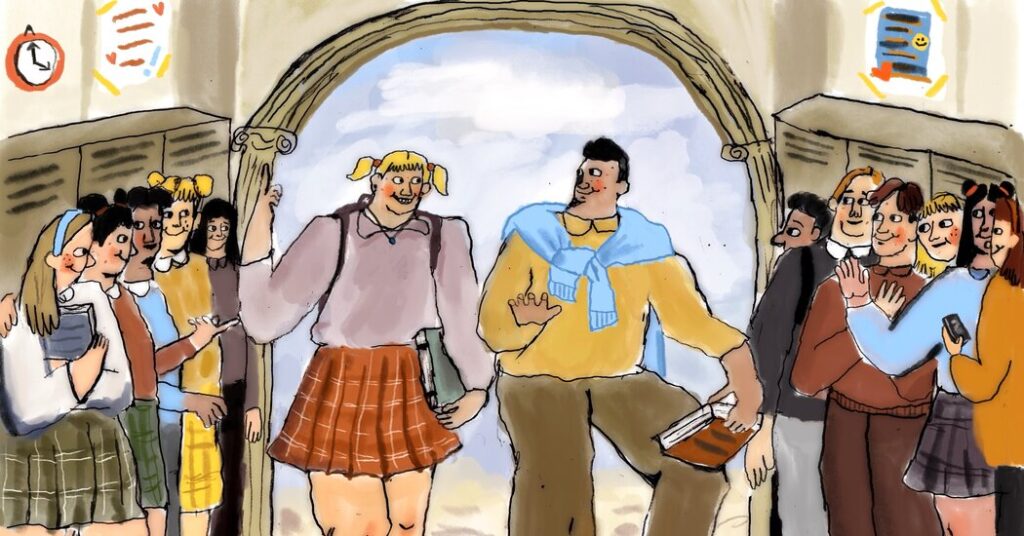
This spring, I sat in the back of a ninth-grade class at Eagle Ridge Academy, a classical charter school in the suburbs of Minneapolis. The students were talking about the part of Virgil’s “Aeneid” in which Aeneas tells Queen Dido of Carthage the story of the Trojan War and the travails that had brought him to her shore. Their teacher, Jeremiah Lemon, asked if Aeneas was telling the truth or shaping the tale to his own advantage, as Odysseus had done in “The Odyssey.”
“I think he’s telling the truth,” said one student. “Odysseus was trying to make himself look good, but Aeneas is telling Dido all the dirty details.”
“I agree,” said another. “I think he wants to show Dido that he can persevere, that he can go through hardship and still come out of it.”
That second comment was a reference to Eagle Ridge’s moral code: Citizenship, integrity, perseverance, honor, excellence and respect. Those virtues are meant to infuse the school’s daily life. Almost everyone in Mr. Lemon’s class wanted to talk, but no one interrupted. There was no showboating. The students had arranged their desks in a big square to facilitate this Socratic seminar. At one point, a girl looked at a student who hadn’t spoken and said, “What do you think about this question?” And the student answered.
Having recently spent a year in public school classrooms for a book on civic education, I can tell you that the average ninth-grader does not sound remotely as serious, or as respectful, as the kids in Mr. Lemon’s class. Eagle Ridge is one of a growing body of classical schools whose traditional ethos includes both a curriculum based on the great books of the Western canon and a culture founded on the idea of virtue. That includes old-fashioned rules of comportment. Students at Eagle Ridge wear uniforms; younger students are expected to stand when speaking. The elementary school children enter and exit class in an orderly single file. I heard a kindergarten teacher, Paige Schneider, praise her kids for their perfect performance in the previous day’s bathroom break. “Raise your hand,” she said, “if you’re ready to commit to that again.” They were.
The idea that public schools should be used to impart virtue raises many hackles — not because we reject virtuous behavior, but because conservatives so often use “virtue” to enforce compliance with social codes. I share that unease: I’m a child of the 1960s who went to progressive schools where our chief extracurricular activity was protesting the Vietnam War.
But as the United States conducts a terrifying experiment in just how poisonously angry, distrustful and self-aggrandizing a democratic polity can become without destroying itself, we have to ask whether public schools should continue to regard the moral development of children as a purely private matter.
I was struck during my year in the schools by the growing wish for explicit moral instruction. Classical schools, both public and private, are growing rapidly across the country — of the 895 operating today, about one-third opened between 2020 and 2024, according to the Heritage Foundation. You can also see that hunger for a more moral education in the curriculums of some conventional schools. More than 90,000 middle and high school teachers now use materials from the Bill of Rights Institute, a nonpartisan nonprofit that lists nine civic virtues that, it claims, “promote self-government” and advance “the spirit of a common purpose.”
Perhaps our civic breakdown has made the case for moral clarity.
America’s founders, who disagreed on so much, never questioned the idea that a republic depended on the virtue of its citizens. They believed that the Roman Republic fell because the people became corrupt and that civic virtue had decayed in England under George III. They advocated widespread, even universal, systems of public schooling in order to reinforce the classical (not Christian) virtues of wisdom, justice, courage and temperance. Our first great school reformer, Horace Mann — an heir of the Puritan rather than the Enlightenment tradition — believed only the “common school” could make ordinary citizens worthy of self-government.
Perhaps inevitably, then, American public education in the 19th century often consisted of very little besides moral precept. The “McGuffey Reader” taught children to read with didactic fables and allegories about barnyard animals; older students studied patriotic authors like John Greenleaf Whittier and Henry Wadsworth Longfellow. By the end of the century, virtually all states had passed laws prohibiting sectarian instruction in the public schools, but even then a typical statute admonished teachers to instruct pupils in “the principles of morality, truth, justice, temperance, humanity and patriotism.”
This moralistic, often heavy-handed pedagogy began to give way about a century ago. A new breed of progressive thinkers led by the philosopher John Dewey viewed education not as a means to shape children according to society’s precepts but rather to empower them to become fully independent.
Yet in practice, what often filled the space once occupied by morality was not Dewey’s high ideals but a lowest-common-denominator relativism. Virtue language, as James Davison Hunter wrote in the grimly titled “The Death of Character,” gave way to talk of “values,” which is to say, personal preferences. In our modern therapeutic vocabulary, “temperance” and “justice” gave way to “self-esteem.” If the schools of a century ago imposed too much guidance, the schools of today offer too little.
Classical education is most popular in red parts of the country, where a traditional education appeals to parents who might otherwise home-school their child or choose a private religious academy. But the deep-blue Minneapolis metro area has seven or eight classical schools (depending on what counts.) And Eagle Ridge’s politics, at least that I could see, seemed very Minnesota: On the walls, there were an awful lot of posters about “sustainability.” For their medieval history class, the 10th-graders had produced modern versions of Luther’s 95 theses. Several demanded a reduction in pollution and the use of fossil fuels.
Classical schools are traditional, but they are not intrinsically conservative. The classical schoolteachers I’ve spoken to describe their own concerns as “prepolitical,” arising not from current affairs but from the pursuit of enduring principles — truth, beauty and goodness. The Renaissance scholar James Hankins has described classical schools as the modern version of the liberal education considered suitable to an Italian courtier. (That might be a useful branding device as classical schools spread into liberal America.)
Only 8 percent of Eagle Ridge’s 1,550 students come from the prosperous, largely white and progressive Minnetonka school district. Two-thirds are nonwhite, mostly East African and South Asian; 40 percent are poor enough to qualify for a federally subsidized lunch. Perhaps it’s not very surprising that the bluest residents of this very blue neighborhood don’t seem to want to send their children to a school where the kids stand up to speak and walk single file through the halls, and that immigrants from all over the region, attracted not only to Eagle Ridge’s traditional values but also to its very impressive test scores, do.
I wondered how a moderately ironic adolescent would feel about the rules, the uniforms, the moral admonitions on the walls. The one Eagle Ridge program that might provoke a serious eye roll assigned middle schoolers to teams, with their own chants, gestures, mythological back stories and classical philosophers. Students won or lost points by engaging in, or falling short of, virtuous behavior. The administration had dreamed this up in order to counter unruly behavior that had led to multiple suspensions. Apparently 12-year-olds at Eagle Ridge are still 12-year-olds. Otherwise, the school ethos seemed more a matter of internalized behavior than explicit instruction.
What Eagle Ridge’s moral code seemed to be promoting above all was civil discourse and mutual respect. Julie Friedman, a sixth-grade science teacher, told me that at the school in New Jersey where she had previously taught, “the kids just didn’t seem to know how to disagree with each other.” At Eagle Ridge, they are taught to preface their remarks with, “I agree with you” or “I disagree with you.” Apparently they do disagree. Mr. Lemon told me that he listened to two girls whose parents were pro- and anti-Trump have a fierce political argument — then stand up and take each other’s hands.
Every school says it encourages civil discourse and mutual respect. But that can be the precondition for something greater. At Eagle Ridge, the habit of thinking in serious moral terms enabled the kind of conversation I heard in Mr. Lemon’s class. After talking about whether Aeneas was lying to Dido, Mr. Lemon asked whether the hero could freely choose to remain with Dido if he already knew that his fate was to found Rome. The kids concluded that fate probably precluded choice. Mr. Lemon then turned the question in a more personal direction: “What matters more, the fate or the journey to get to that fate?”
“Every single person is fated to die,” a student said. “But everyone has to make their own journey.” Another drew on his prior reading: “If you just knew Oedipus’s fate, you would think he was a terrible person. But once you understand the journey he took” — what both his father and mother had done — “you’d be more sympathetic.” They did not come up with an answer; after all, they were thinking about questions that had no definitive answer. And they were 14 and 15 years old.
Classical schools, and liberal education, may not be to your taste. But here’s a question to ask yourself: Would you feel better, or worse, if you knew that every future American citizen would receive an education like the one they get at Eagle Ridge?
James Traub reported from Minneapolis. He is the author of “The Cradle of Citizenship: How Schools Can Help Save Our Democracy” and writes the newsletter “A Democracy, If You Can Keep It.”
The Times is committed to publishing a diversity of letters to the editor. We’d like to hear what you think about this or any of our articles. Here are some tips. And here’s our email: [email protected].
Follow the New York Times Opinion section on Facebook, Instagram, TikTok, Bluesky, WhatsApp and Threads.
The post Strict Uniforms. Ancient Philosophy. Can a Public School Cure Our Toxic Politics? appeared first on New York Times.