When I look at photographs of Lauren Sánchez Bezos I see someone who loves fashion, although not at all in the way I do. My affection for it is rooted in respect for its beauty and creativity and in a fair amount of skepticism because of its stumbling acceptance of its social responsibilities. Her version of fashion exudes personal indulgence and broad disregard.
A plutocrat by marriage, she represents the industry’s ultimate customer, with its ever-rising prices and shrinking sales. Fashion is pricing all but the most astoundingly wealthy out of the market.
In the just-opened film “The Devil Wears Prada 2” Justin Theroux plays a dastardly acquisitive tech titan named Benji Barnes, with clear echoes of her husband, the billionaire Amazon founder Jeff Bezos. The Barnes character happens to have a girlfriend who might remind you of Mrs. Sánchez Bezos. Their thirst for clout helps drive the film’s plot.
On Monday, Mr. Bezos’ real-life hundreds of billions of dollars will propel Mrs. Sánchez Bezos up the grand Fifth Avenue staircase of the Metropolitan Museum of Art, past a gantlet of photographers and into the Costume Institute Benefit, better known as the Met Gala, over which she and he will preside as honorary co-chairs. The institute’s exhibition this year, “Costume Art,” is made possible by the Bezos largess. But the couple is so broadly unpopular in the fashion world and beyond that there were calls for a boycott of the gala.
Beyoncé is also supposed to be there, serving as an official co-chair, along with Nicole Kidman, Venus Williams and Condé Nast’s chief content officer, Anna Wintour. But Mrs. Sánchez Bezos is the star of the Met Gala because she represents what fashion, buffeted by social and technological change, has surrendered to: economic inequality in human form, with pink, glossy lips, cinched up in a couture corset.
Taste is one more part of the culture for ruthless tech titans to attempt to optimize for their benefit. With Ms. Wintour’s determined gatekeeping and the Costume Institute’s intellectual concerns about human creativity, the Met Gala is the perfect laundromat for soulless tech money.
Both “The Devil Wears Prada” and its sequel stage fictional versions of the Met Gala for the cameras and star Meryl Streep as Miranda Priestly, a fictional version of Ms. Wintour. The first film captured the fabulousness of the fashion world. It also worked to give viewers the sense that its haughty, judgmental inhabitants were hard at work helping to make small lives feel bigger by the decisions they made huddled in a room going through “a pile of stuff.”
I think about how the sharp-tongued Miranda might view Mrs. Sánchez Bezos: A corset? In an evening gown? Groundbreaking. The sequel depicts Miranda with her power and influence slipping. She’s confronting the same tidal wave of financial challenges that the real-life fashion ecosystem is navigating.
Onscreen, the upheaval comes by way of data-driven technology, an awkward tycoon with no sense of style and the fashion-loving woman he aims to please. As Stanley Tucci’s character, Nigel, says, he’s reduced to creating “content that people scroll past as they pee.” In real life, fashion magazines — and publications in general — are in trouble, and they’re hoping the right billionaire will bail them out. (The Bezoses have been rumored to be considering buying Condé Nast, Vogue’s parent company; when asked about it, Mrs. Sánchez Bezos told the writer Amy Chozick in The Times, “I wish!” and then, “No.”)
With her donations, scholarships and grants, Mrs. Sánchez Bezos offers the industry some support beyond her expensive shopping habit. The Bezos Earth Fund awarded $34 million in grants to institutions developing environmentally neutral fabrics, and she directed $6.25 million from the Earth Fund to the Council of Fashion Designers of America to support innovation and education in sustainability. The industry readily grabs on. Some people are betting that she’s the right billionaire.
According to Ms. Chozick’s recent profile of her, Mrs. Sánchez Bezos just wants to be happy. And whenever she steps in front of cameras, dressed in a remarkable array of finery, she looks delighted. In an era of extreme economic inequality and financial instability, when California is looking to institute a billionaire tax and a tax on second homes in New York City is under consideration, Mrs. Sánchez Bezos moves about with ostentatious pleasure. She counts her 10-figure blessings, and wears her windfall on her back for all to see.
Her taste veers outside a palette of beige and gray cashmere — the approved sensibility of well-mannered, quiet money. She is willing to flash a wide smile or offer a pouty stare for the cameras rather than stare them down with an expression of bashful reserve or detached ennui, which is what serious women are supposed to do. She does not have the body of a 6-foot-tall 12-year-old boy, which is how high fashion still insists on defining an elegant female physique.
She defies these expectations — something that could be lauded. But she simply embraces a different cliché, an extreme version of femininity that’s defined by a snatched waist and a cantilevered bosom.
She laments how little the public really knows about her. But provided the opportunity to tell her critics more, she refrains.
“I am not talking politics,” she told The Times. “No, no, no, no, no. No way.”
It’s reasonable to believe that since she sat in a place of honor behind President Trump during his inauguration, she might have a few thoughts about the current administration. Mrs. Sánchez Bezos, who once worked in broadcast news, acknowledged the importance of journalism but offered no thoughts on her husband’s drastic staff cuts at The Washington Post, which he owns (and where I used to work).
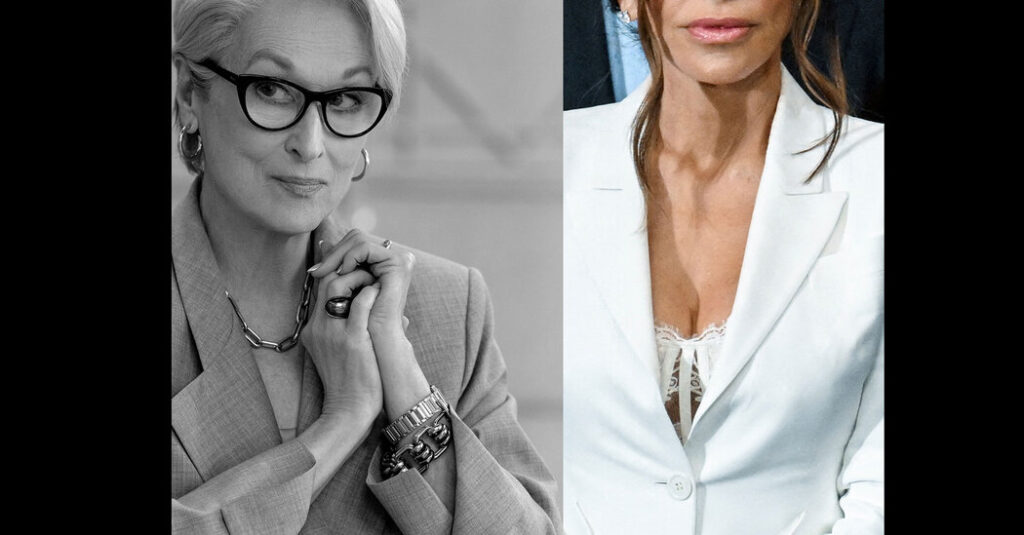
But she is willing to express her exasperation that the white lace bra readily visible under the Alexander McQueen suit she wore to Mr. Trump’s swearing-in caused an online kerfuffle. She defines the problem as a scandal about lace, not her disregard for the dignity of an official function.
To draw the cameras, it helps that she has hired one of the best stylists money can buy, Law Roach, and collected an impressive array of very expensive stuff. She’s done so from a feast of options. Costume not as art, but as merchandise. Perhaps she even scrolled past some of it while she was indisposed. As Miranda deftly shivved a would-be white knight, “You’re not a visionary; you’re a vendor.”
Mrs. Sánchez Bezos’ clothes don’t demand that the public pay attention to her story. Or even the stories of the designers she wears. Or really, even fashion.
She has assembled a tote board of Bezos wealth. And if it tells any story at all, it’s his.
Robin Givhan is a Pulitzer Prize-winning fashion critic and a former senior critic at large for The Washington Post.
Source photographs by Macall Polay/20th Century Studios, via Associated Press, and pool photo by Kenny Holston.
The Times is committed to publishing a diversity of letters to the editor. We’d like to hear what you think about this or any of our articles. Here are some tips. And here’s our email: [email protected].
Follow the New York Times Opinion section on Facebook, Instagram, TikTok, Bluesky, WhatsApp and Threads.
The post Lauren Sánchez Bezos and the Fashion End Times of ‘The Devil Wears Prada 2’ appeared first on New York Times.