Spencer Deery is running for re-election to the Indiana Senate with endorsements that most any conservative Republican would covet: the National Rifle Association, Indiana Right to Life, Indiana Farm Bureau.
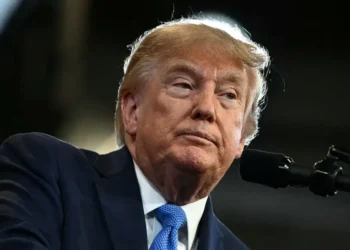
President Trump, however, wants him to lose.
In Mr. Trump’s view, Senator Deery is “an incompetent and ineffective RINO incumbent” and “America Last politician” who “has become a favorite politician of the Far Left.” The president has urged Republican voters to support Mr. Deery’s opponent, Paula Copenhaver, in the primary on Tuesday.
Mr. Deery garnered the president’s scorn in December by helping to vote down a plan to redraw Indiana’s congressional districts outside the usual once-a-decade cycle. Mr. Trump lobbied for months for the new map, which would have positioned Republicans to flip two U.S. House seats in the midterm election, but he failed to convince enough lawmakers in the Republican-led State Senate to go along with the plan. The highly public defeat in Indiana was a rare instance of Republican officials going against the president’s wishes, and a counterpoint to a redistricting blitz that has played out in other states.
In the months that followed, Mr. Trump made good on his promise to try to unseat the Republicans who had defied him with a series of social media endorsements and White House meetings, an unusual level of presidential involvement for local legislative races in a solidly Republican state.
That has turned Mr. Deery’s race, along with those of six other Republicans facing Trump-backed challengers, into a test of the president’s ability to bend the party to his will and exact political revenge.
“It’s an important election nationally because they’re trying to demonstrate a proof of concept that if the states do not line up with their view, that there can be political consequences,” said Mr. Deery, a first-term senator who reported receiving death threats after coming out against redrawing the maps last year. “No matter your politics, no matter your state, that should be concerning to you.”
The race between Mr. Deery, who has worked in higher education, and Ms. Copenhaver, a Covington City Council member and the chair of the Fountain County Republicans, has attracted unusual levels of spending, attention and Republican-on-Republican vitriol.
Around this district, which runs from the college town of West Lafayette into the countryside, Republican voters described frustration with the tone of the campaign, offering mixed opinions of the two candidates and differing appraisals of Mr. Trump’s second term. Most were aware that Ms. Copenhaver has the president’s support. But across ideological lines, many voters said Mr. Trump’s endorsement would not be the deciding factor for them.
“That’s just one piece of the puzzle,” said Angela Yost, who works as a school speech therapist and who said last month that she was undecided in the primary.
Ms. Yost, who has voted for Mr. Trump, said she agreed with the president on redistricting and was disappointed that Mr. Deery had voted against a new map. But she also praised Mr. Deery for meeting with her school’s Young Republicans club, which she sponsors, and for engaging with her students’ questions.
John W. Wilson, a real estate agent, said Ms. Copenhaver won him over after a long discussion on his front porch. Mr. Wilson said he had supported the president and wanted Indiana to redraw its congressional map, but that Mr. Trump’s endorsement “had absolutely nothing to do with my support of her.”
Tom Covington, a hospice chaplain, requested a Deery yard sign precisely because of the senator’s vote against redistricting. Though Mr. Covington described himself as a longtime Republican, he did not vote for Mr. Trump and said he was worried about an erosion of norms and institutions.
“I assumed Republicans here just did whatever the Trump administration wanted,” Mr. Covington said. “And I was so pleasantly shocked that they were saying no. And then really pleasantly surprised that my senator was one of the leading voices of principle about it.”
Indiana’s two Democratic-held congressional seats were expected to be easy pickings last year when Mr. Trump set out to reshape the U.S. House map to support Republicans.
But unlike Republican legislators in Missouri, North Carolina and Texas who rushed to do Mr. Trump’s bidding and pass new boundaries, Indiana lawmakers were skeptical of redistricting. Months before a vote, Mr. Deery released a statement announcing his opposition, saying that there was “no constitutional principle more basic than popular sovereignty and the idea that voters choose their leaders and shape their own destiny.”
That opposition remained even after Democrats elsewhere moved to remap some states that they control, and as a presidential charm offensive on the issue morphed into threats of primary challengers. When a Trump-backed map arrived on the floor of the Indiana Senate late last year, a slim majority of Republicans joined every Democratic senator in voting it down, revealing limits of the president’s power over his own party.
Mr. Trump and his allies did not concede the political war. All but one anti-redistricting Republican senator on Indiana ballots this year has a Trump-backed challenger. Outside groups aligned with Mr. Trump, including Club for Growth Action and Turning Point Action, have poured money into the races. And Trump-aligned Indiana officials, including Gov. Mike Braun and Lt. Gov. Micah Beckwith, have lined up behind many of the challengers.
The primaries, like the redistricting debate, are also testing competing Republican views of whether Democrats are an opposition party to work with or a threat to contain. Mr. Beckwith described “a progressive, Marxist wave” that was “taking over our nation one state at a time.” Indiana, he said, needed to do all it could to fight back.
“Some of these incumbents just have stuck their head in the sand, and they have said, We’re just Indiana: We just isolate ourselves from the rest of the nation and we’ll be fine,” said Mr. Beckwith, who supported redistricting. “And I think what President Trump is hitting on is like, No, you won’t be fine.”
The incumbents, many of them longtime officeholders whose careers started in a far different political era, have cast themselves on the campaign trail as steady hands with solidly Republican voting records. They have attracted support from members of their party’s establishment wing, a mix of moderates and conservatives who are more apt to cite former Gov. Mitch Daniels or former Vice President Mike Pence as a political inspiration than Mr. Trump.
In Mr. Deery’s district, where Purdue students are wrapping up the academic year and farmers are planting corn and soybeans, the winner of the Republican primary will be heavily favored in the general election.
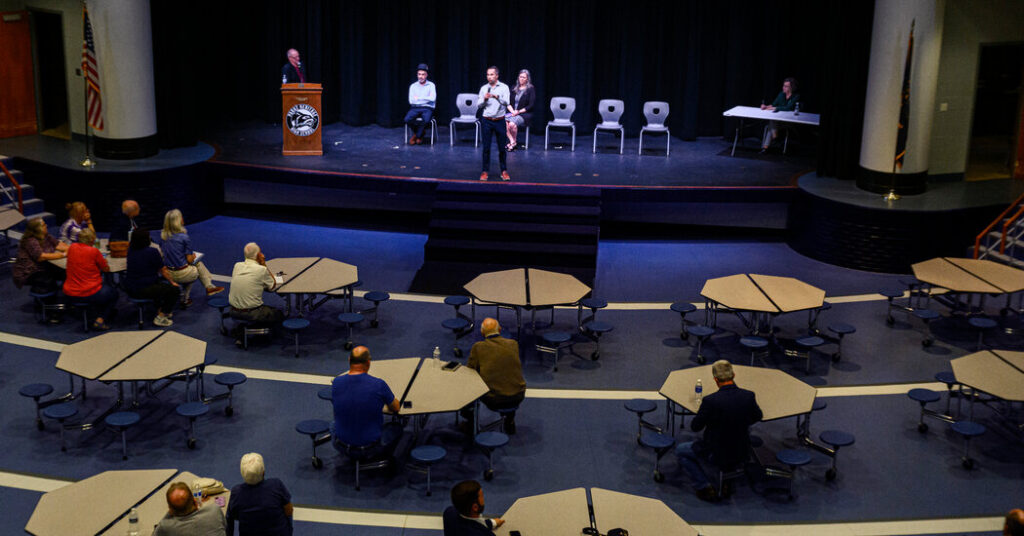
At a recent candidate forum in Rockville, a town of 2,500 people about 60 miles west of Indianapolis, the word “redistricting” never came up. The moderator asked instead about Medicaid, food safety net programs and whether certain noncitizens should be allowed to purchase land in Indiana.
Still, the remapping debate and the president loomed over the conversation.
Mr. Deery described how his home had been swatted and how he had received death threats after he voiced opposition to a new map. He lamented what he saw as “outside forces coming into a state trying to manipulate” the election. Ms. Copenhaver, who declined to be interviewed for this article, noted in a closing argument that “I have been endorsed by our president, Donald Trump.”
As the few-dozen spectators filed out of the high school auditorium, Jacob King said he appreciated Ms. Copenhaver’s rural roots and thought she had made some good points.
“But honestly, if I had to say one thing was against her, it’s probably all the Trump support,” said Mr. King, a farmer who voted for Mr. Trump in the last three elections and who is running as a Republican for a seat on the Parke County Council.
Mr. King said the market for his crops had been scrambled, the price of fertilizer had shot up and the president was “trying to be too much of a bully.” He left the forum holding a Spencer Deery yard sign.
Mitch Smith is a Chicago-based national correspondent for The Times, covering the Midwest and Great Plains.
The post Indiana Republicans Defied Trump. Will Voters Punish Them for It? appeared first on New York Times.