BATON ROUGE — Press Robinson had to show he could read, before he was allowed to become the first member of his family to vote in the 1950s. In the 1970s, he filed a trailblazing lawsuit that cleared the way for him to be the first Black person elected to the city’s school board.
It was a trajectory the son of a poor sharecropper in the Jim Crow South never envisioned was possible.
His hard work and drive was not enough. Robinson also credited his progress and that of millions of other Black people to the Voting Rights Act. The law, signed in 1965, outlawed discriminatory practices in elections like the literacy test Robinson encountered and the gerrymanders that kept him off the school board.
Having lived the rise in Black political power across the South enabled by the VRA, Robinson worries he is now a witness to its dramatic demise after the Supreme Court sharply limited the last vestige of the landmark law often called the crown jewel of the civil rights movement. The ruling could put hundreds of minority officeholders at risk of losing their seats, and diminish opportunity for the next generation of leaders.
At 88, Robinson was on the losing side of the case, likely one of the final acts in a life of activism.
“That law passed in 1965 was the bedrock of improvement of life in America for people of color,” Robinson said. “This is a Louisiana case, but the result is not going to be limited to Louisiana. It’s going to set the stage for redistricting in the entire country.”
The justices struck down a second Black-majority congressional district in Louisiana, ruling it was an unconstitutional racial gerrymander. In the process, they made it much harder for Black people and other groups to win lawsuits seeking majority-minority districts that bolster their voting power.
Section 2 of the VRA has been one of the main tools of minority political empowerment, particularly in the South. The decision clears the way for Republican-controlled states to redraw districts at the local, state and federal level mostly held currently by Black and Latino Democrats.
Justice Samuel A. Alito Jr., who wrote the majority opinion, reasoned that gains in minority voting and racial equality meant it was time to retool Section 2. The decision was applauded by President Donald Trump and many Republicans who have long argued considering race in drawing electoral maps violates the Constitution.
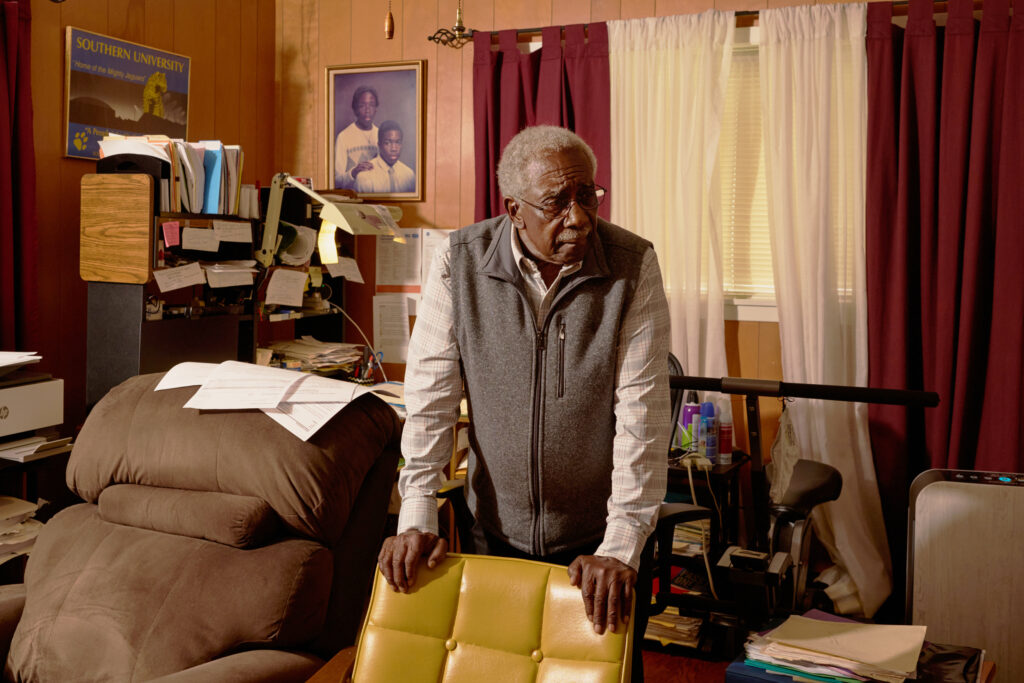
But sitting at his dining room table surrounded by mementos of a life in politics and community organizing on a recent day, Robinson said he felt like 60 years of work was unraveling. Discrimination is not gone, he said, and people like him need a path to county boards, statehouses and Congress to help shape policy for all of America.
He recalled how Black schoolchildren in Baton Rouge were once only given worn books cast off by their White peers, their inside covers crowded with names. That only changed when the VRA paved the way for voices like his to be heard.
Carving up districts
The Supreme Court ruling has touched off a furious scramble by GOP-controlled states to try to redraw majority-minority districts ahead of November’s pivotal midterm elections. Louisiana Gov. Jeff Landry (R) moved to suspend congressional primaries just hours after the decision and officials in Tennessee, Alabama and other states are eyeing similar tactics.
“The best way to stop discrimination on the basis of race is to stop discriminating on the basis of race,” Landry wrote on X.
Officials in blue states countered by announcing they were exploring ways to eke out more Democratic seats in Congress.
The ultimate outcome of the tit-for-tat moves remains unclear, but it has injected more chaos in an election year already roiled by a national redistricting war. The one thing that is almost certain: Black representation in Congress will drop.
With Louisiana’s history of slavery and Jim Crow, Black people have long been locked out of competing for political office despite the state having one of the nation’s largest populations of Black Americans by percentage.
No Black person has been elected to statewide office since Reconstruction and many who have won seats on state commissions and in the legislature are running in “opportunity districts” that Section 2 mandated be created in certain circumstances so minorities could have a shot at winning.
Davante Lewis, who is Black and the state’s first openly gay elected official, said his opportunity district on the state utilities commission illustrates what’s at stake for Black communities.
The Democrat represents an area known as “Cancer Alley,” an industrial stretch along the lower Mississippi that is home to hundreds of oil and chemical refineries. It has some of the nation’s highest cancer concentrations, including one spot where rates are seven times the national average, according to the Environmental Protection Agency.
There is a large Black population, which research shows is disproportionately impacted by cancer. Many in that community live in poorer neighborhoods next to refineries.
Lewis has made greening the state’s power portfolio a key part of his agenda to address pollution in Cancer Alley. He worries his district could be carved up for the 2028 election.
“The environmental justice community could be separated and cracked into many different districts, limiting their collective voice,” Lewis said.
An analysis by the liberal groups Fair Fight Action and Black Voters Matter found redrawing opportunity districts could leave Louisiana with no Black members in Congress. Half of the African Americans in the state legislature could also be unseated, the report concluded.
The story could be the same across much of the South. The groups projected Alabama, Tennessee, South Carolina and Mississippi could lose all of their Black congressional representatives. It found nearly 200 state legislative seats held by minorities could be in jeopardy.
A call to action
The seismic shock to American politics began with a phone call.
The NAACP Legal Defense Fund reached out to Robinson around 2022 to be a plaintiff in a lawsuit seeking to create a second Black-majority congressional district in Louisiana. He said they chose him because of his experience with the VRA lawsuit in the 1970s.
Robinson and others felt Louisiana had shortchanged Black voters during redistricting that followed the 2020 census. Louisiana is roughly a third Black, but only one of its six congressional districts had a Black majority.
At an age when many are deep into retirement, Robinson said he jumped at the chance to be the lead plaintiff in the case. His wife died several years ago and he is still active on the local YMCA board and in other community service activities.
He said he learned to fight long ago growing up in rural South Carolina.
Robinson did not know another Black person who had registered to vote before he walked into a courthouse in 1957 and told the White clerk he wanted to get on the voting rolls. He was inspired by working on a campaign for a man hoping to be the first Black person elected to Atlanta’s City Council. At the time, Robinson was 21 and a student at Morehouse College.
Robinson said the clerk looked him over carefully.
Robinson had heard stories of African Americans being turned away from the polls, asked to guess the number of jelly beans in a jar for a chance to register and being forced to pay poll taxes. The clerk told him to read and interpret the U.S. Constitution.
He picked up a copy and read about two lines, before the clerk stopped him and allowed him to register to vote. “She probably figured, ‘If this guy reads this thing like this he probably knows the Constitution better than I do,’” Robinson said with a laugh.
Robinson insisted that his mother, who had come along, be allowed to register without hassle. The clerk complied.
Robinson eventually moved to Baton Rouge, where he became a professor of chemistry at Southern University and got involved in local politics. He married and had two boys. It wasn’t very long before he found his next fight.
He decided to run for the East Baton Rouge Parish School Board, which was all-White. Robinson said he was tired of the concerns of Black families being ignored, even though their children made up a large chunk of the school population. He said the district was dragging its feet on desegregating schools. Many attended by Black students were in disrepair.
Robinson lost his first race in 1972 and a second in 1976. When he campaigned in White neighborhoods, people would sometimes shut the door in his face.
Black people were a minority in each of the three large wards candidates competed in and White residents rarely voted for Black candidates, so he would likely never be able to win — a scenario common in southern states.
He and a handful of allies sued under Section 2 of the VRA. The case resulted in a settlement that created three Black-majority districts on the school board. In 1980, Robinson became the first candidate to win one. He served eight terms before retiring in 2001.
Similar lawsuits reshaped politics across the South, dramatically increasing the number of minority officeholders in the decades since. Justin Levitt, a Loyola Law School professor, said curbing Section 2 will likely be felt most acutely in grassroots offices like the Baton Rouge school board.
“The biggest impact of the Voting Rights Act since its inception has been on local democracy — city councils, county commissions, municipal judges,” Levitt said. “Those sorts of offices that get the least attention on the national stage but are crucially important for deciding the kind of representation people have about the issues that generally affect their lives most.”
The fight goes on
Robinson was initially buoyed by the VRA lawsuit launched in 2022.
A federal judge ruled the state had illegally diluted the power of Black voters in Louisiana. He ordered a second Black-majority congressional district be created as a remedy.
The state legislature eventually drew one, but a group of self-described non-Black voters sued, arguing state officials relied too heavily on race to draw the map in violation of the Constitution’s provision that all people be treated equally.
The case rose to the Supreme Court, which allowed the map with two majority-Black districts to go into effect for the 2024 congressional election. Voters chose Cleo Fields, a Black Democrat, for the new seat. After more legal wrangling, the non-Black voters brought the case back to the Supreme Court this term.
Alito said in the 6-3 ruling, which was split along ideological lines, that Section 2 had served its purpose.
“Section 2 of the Voting Rights Act … was designed to enforce the Constitution — not collide with it,” he wrote. “Unfortunately, lower courts have sometimes applied this Court’s [Section] 2 precedents in a way that forces States to engage in the very race-based discrimination that the Constitution forbids.”
Liberal Justice Elena Kagan strongly pushed back on that idea, calling the VRA “one of the most consequential” pieces of legislation in the nation’s history.
“It was born of the literal blood of Union soldiers and civil rights marchers,” Kagan wrote. “It ushered in awe-inspiring change, bringing this Nation closer to fulfilling the ideals of democracy and racial equality.”
Robinson grasped to frame the magnitude of the change the Supreme Court was ushering in, pushing past the civil rights movement all the way to Reconstruction. Black political power briefly flourished in the South after the Civil War, before it was snuffed out.
Robinson said he fears another historic wipeout is coming.
“History is now repeating itself,” he said.
The post He spent 60 years building Black political power. He sees a wipeout coming. appeared first on Washington Post.