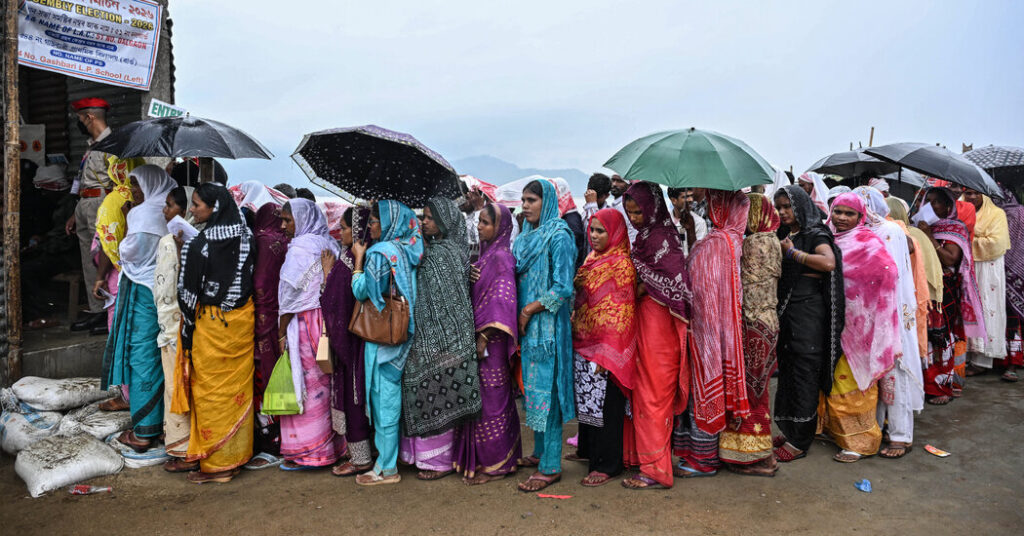
Across India, a recent round of state legislative elections has set up a gargantuan political test. The results on Monday will set the landscape ahead of national elections in 2029; reshape the balance of power in Parliament’s upper chamber; and test the limits of the Hindu nationalist expansion of Prime Minister Narendra Modi’s Bharatiya Janata Party, which has held the reins in New Delhi since 2014.
Four states — Assam, West Bengal, Kerala, and Tamil Nadu — cast ballots in April that will be counted on May 4. The results, along with those in the smaller territory of Puducherry, will determine who governs those areas.
The elections are seen as crucial for the Bharatiya Janata Party, or B.J.P., which lost its majority in the national Parliament in June 2024. Since then, Mr. Modi and his team have focused on winning each and every state election up for grabs. Critics have accused his party of using a voter roll audit to its benefit by disenfranchising sections of the electorate.
Here’s what to know about India’s latest state elections:
Which states voted?
-
West Bengal: Mamata Banerjee’s Trinamool Congress party has held power for 15 years in India’s fourth-most-populous state, home to 105 million people. She is seeking a record fourth term in the face of a rising challenge from the B.J.P., which has never held power in West Bengal but has made big gains there in recent years.
-
Assam: The B.J.P.’s Himanta Biswa Sarma is seeking a second term as the state’s chief minister. Mr. Sarma, who left the opposition Congress party in 2015, has helped turn longstanding anxiety in Assam about the influx of Bengali-speaking migrants from Bangladesh into a panic about Muslim “infiltrators.”
-
Kerala: The Left Democratic Front’s Pinarayi Vijayan is seeking a third term in this southern state. He is battling a revitalized opposition led by the Congress party, his traditional rival. The B.J.P. has only recently made headway in Kerala, securing a handful of seats in 2016 and 2024. Nearly half of Kerala’s voters are either Christian or Muslim, leaving little purchase for the B.J.P.’s Hindu politics.
-
Tamil Nadu: Politics in the state have long been dominated by two parties with origins in and ties to the Dravidian movement, a decades-old political and cultural force that appeals to a sense of regional identity and social justice. They are challenged by a new party led by a popular film actor, Joseph Vijay Chandrasekhar. The B.J.P. has never found much success in Tamil Nadu.
-
Puducherry: A small territory of 1.2 million people abutting Tamil Nadu, Puducherry is led by N. Rangaswamy, an ally of the B.J.P., which has long depended on shifting partnerships between national and regional parties.
What is at stake?
India’s 28 states and eight union territories are in many ways more like the European Union than the United States. Most have their own languages and cultures. Under India’s federal architecture, state governments hold near-total sway over the police, education, health care, agriculture, and infrastructure. State elections choose representatives who sit in their own legislative assemblies.
While India’s prime minister is picked through national elections, state elections matter more to the daily lives of its 1.4 billion people, ranging from the quality of a village clinic to safety on the streets. But the prime minister has significant discretionary power over grants, infrastructure packages and emergency relief. This sets the stage for conflict between the national government and states controlled by opponents that can turn into gridlock.
Where is the biggest showdown?
In West Bengal, in India’s east, the election looks like a litmus test for Mr. Modi. Capturing the state would be a strategic achievement for the B.J.P.
Mr. Modi’s rival, Ms. Banerjee, is facing simmering resentment over issues including allegations of corruption, unemployment, and women’s safety, after the rape and murder of a trainee doctor at a Kolkata hospital in 2024. The B.J.P. is fielding the mother of the victim as a candidate.
The B.J.P. came in second in West Bengal’s elections five years ago, ahead of India’s Communist Party, which once ruled the state. If the B.J.P. wins in West Bengal, analysts say, it can win anywhere.
Why are some voters missing?
India’s national Election Commission is deleting names from voter rolls. In West Bengal, roughly nine million names — more than 10 percent of the state’s electorate — were purged, officially to clean up bookkeeping errors. Muslims make up almost 30 percent of the state’s population and a disproportionate share of voters struck from the rolls. The B.J.P. has framed the move as a crackdown on unlawful immigrants from Bangladesh. Ms. Banerjee’s government calls it an attempt to disenfranchise Indian Muslims.
What is the national impact?
India’s state elections shape national power by determining who sits in the Parliament in New Delhi. Most members of the Parliament’s upper house are elected by the states’ legislators. There are 245 seats in the upper house, with 141 belonging to the B.J.P. and its allies, leaving them short of the two-thirds majority needed to change the country’s constitution. Gains in these state elections would move the B.J.P. closer to that threshold.
Pragati K.B. is a reporter for The Times based in New Delhi, covering news from across India.
The post Modi’s Hindu Right Targets Gains in India’s Elections: What to Know appeared first on New York Times.